
REDD+
Key Takeaways
- REDD+ is the framework behind most forest carbon credits you'll see in the market, but after years of criticism, it's going through a quality reset with jurisdictional baselines, stronger safeguards, and alignment with ICVCM Core Carbon Principles.
- High-integrity REDD+ today means looking beyond the standard logo: you need jurisdictional data for baselines, documented Free Prior and Informed Consent (FPIC), risk-based buffer pools, and independent ratings to separate the top 5% from the 84% that don't deliver real impact.
- For DACH companies under CSRD and SBTi scrutiny, REDD+ can only work as beyond-value-chain mitigation alongside aggressive internal cuts and a growing share of removals, never as a substitute for decarbonisation or a "climate neutral" product claim.
Your board wants visible climate action. Your auditors want bulletproof documentation. And the headlines keep asking whether forest carbon credits are real or just greenwashing theatre. Welcome to the voluntary carbon market in 2025—where REDD+ volumes dropped more than 50% in value between 2022 and 2023, prices for avoided deforestation credits fell 23%, and the whole category is now fighting to prove it can deliver what it promised. But here's the thing: the market didn't collapse—it's resetting. High-integrity jurisdictional REDD+ programs are closing deals at €15–25 per tonne, removal credits now trade at nearly four times the price of avoidance, and new methodologies with jurisdictional baselines are replacing the project-only approach that Science called out for systematic over-crediting. This guide will show you when REDD+ makes sense for a DACH sustainability strategy, how to recognise the top 5% of supply that passes rigorous due diligence, and what evidence you need on file to defend every tonne to your auditors, your NGO critics, and your own board.
The market reset: from boom to scrutiny to a focus on quality
The voluntary carbon market contracted sharply in 2023, with transacted volumes falling 56% and values dropping 61% to USD 723 million. REDD+ and renewable energy credits bore the brunt of this correction. In 2024, volumes fell another 25%, but retirements held steady at 182 Mt, and average prices declined only 5.5%, signalling a shift from volume chasing to a quality focus.
For DACH sustainability leaders, this contraction was more than market noise. It reflected a fundamental reckoning: many legacy forest credits were oversold and under-delivered. Peer-reviewed studies raised uncomfortable questions about baseline inflation and additionality. Media coverage amplified greenwashing accusations. And boards started asking harder questions about what those carbon credit purchases actually achieved.
Yet despite the scrutiny, REDD+ transaction volumes in 2024 reached approximately 28.2 Mt at an average price of around USD 7.87 per tonne, with high-integrity jurisdictional programs commanding significantly higher prices. The market didn't disappear; it evolved. Today's REDD+ landscape is defined by stricter standards, jurisdictional baselines, and a smaller but more credible supply base.
Why forest protection still matters in a 1.5°C, Oxford-aligned strategy
Avoided deforestation today prevents emissions that cannot be recovered later. Forests store massive amounts of carbon, support biodiversity, and underpin water cycles and local livelihoods. Well-designed REDD+ programs can deliver measurable reductions in deforestation alongside community and biodiversity co-benefits .
For a company following the Oxford Principles, REDD+ plays a specific, time-bound role: near-term beyond-value-chain mitigation while you scale internal decarbonisation and grow your portfolio of durable removals. Removal credits now trade at roughly 3 to 4 times the price of avoidance credits, meaning purely removal portfolios remain cost-prohibitive for most corporates in the 2020s. High-quality REDD+ can bridge that gap, provided you treat it with the rigour it demands.
What is REDD+
REDD+ is a climate framework developed under the UNFCCC that incentivises countries, jurisdictions, and projects to reduce emissions from deforestation and forest degradation, and to conserve, sustainably manage, and enhance forest carbon stocks. It is the foundation for most forest carbon credits you see in the voluntary carbon market today. When a vendor offers you "forest conservation credits" or "avoided deforestation tonnes," they are almost always talking about credits derived from a REDD+ methodology.
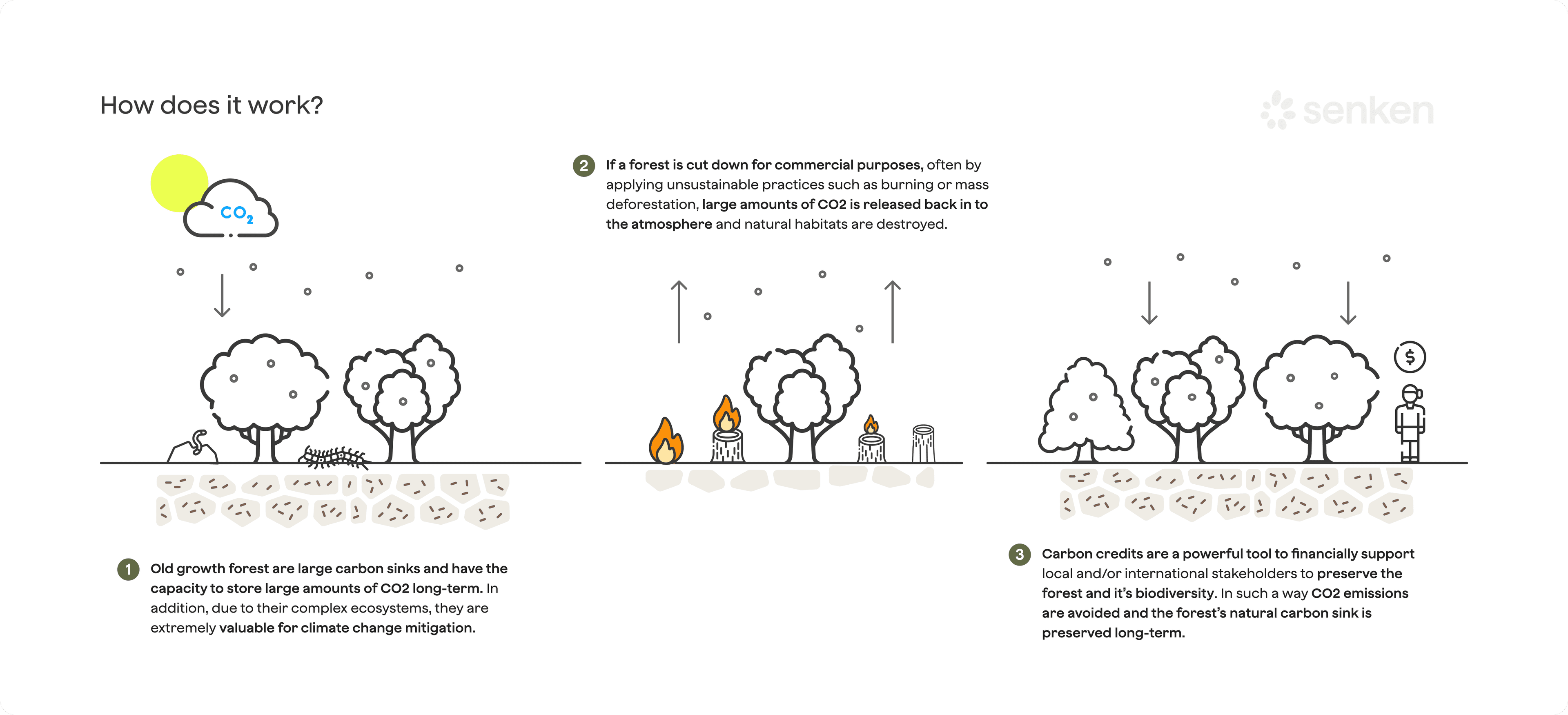
A simple mental model for REDD+, REDD, and the UN-REDD Programme
- REDD+: The UNFCCC framework covering five forest-related activities (we'll walk through those next).
- REDD: The original, narrower framework focused only on reducing deforestation and degradation; REDD+ expanded it.
- UN-REDD Programme: A separate technical assistance initiative run by FAO, UNDP, and UNEP to help countries build capacity, establish monitoring systems, and implement REDD+ at the national level. It is not a credit issuer.
When someone pitches you "UN-REDD credits," ask for clarification. The UN-REDD Programme provides capacity building; the credits themselves come from national or project-level programs certified under voluntary standards that align with the broader REDD+ framework.
What Does REDD+ Stand For
Spelling out the acronym: reducing emissions from deforestation and forest degradation
REDD+ stands for Reducing Emissions from Deforestation and forest Degradation, plus the "+" activities: conservation of forest carbon stocks, sustainable management of forests, and enhancement of forest carbon stocks.
If you have ever searched "redd meaning" or "define redd," this is the answer: a suite of forest-based climate interventions designed to keep carbon locked in trees and soil, rather than released into the atmosphere.
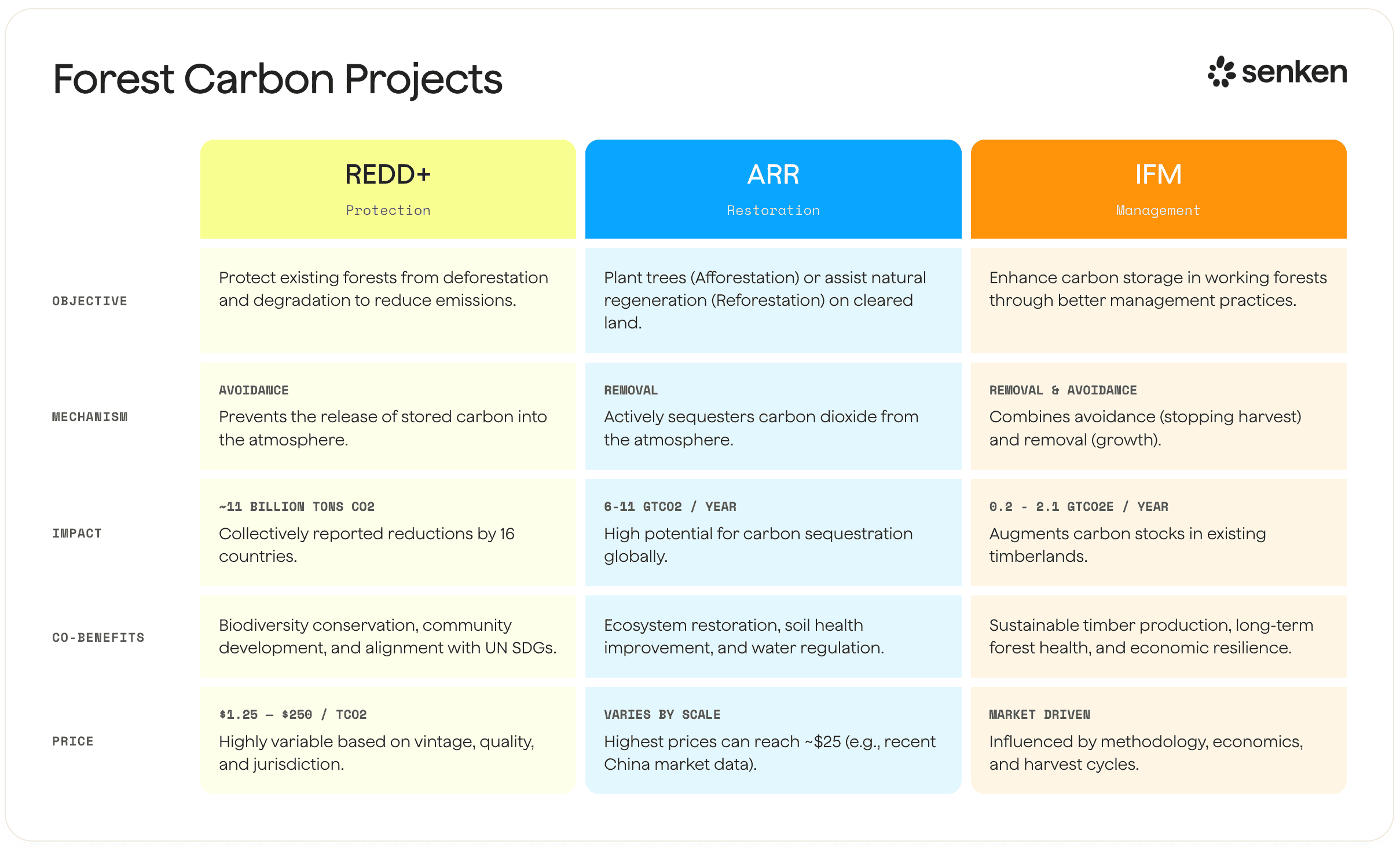
The "+" in REDD+: conservation, sustainable management, and enhancement
The original REDD focused narrowly on stopping forest loss. The "+" broadened the scope to reward positive stewardship:
- Conservation: Protecting existing forests that are not currently under immediate deforestation threat but provide long-term carbon storage and ecosystem services.
- Sustainable management: Managing forests for timber or other products in ways that maintain or increase carbon stocks over time.
- Enhancement: Actively increasing forest carbon through restoration, enrichment planting, or improved growth.
This expansion means REDD+ can cover both avoided emissions (stopping deforestation or degradation) and some carbon removals (enhancement activities), though most REDD+ credits on the market today are still in the avoidance category.
What people really mean when they say "REDD+ carbon credits"
In procurement conversations, "REDD+ credits" typically refer to verified carbon units issued from projects or jurisdictional programs whose core activity is one of the five REDD+ elements. The key implication for you as a buyer: REDD+ credits are predominantly avoided emissions, not durable removals. That shapes where they fit in your portfolio, how you disclose them, and what claims you can make.
The Difference Between REDD and REDD+
From avoiding harm (REDD) to rewarding positive stewardship (REDD+)
REDD began as a mechanism to stop deforestation and degradation. REDD+ added three activities focused on conservation and enhancement, recognising that climate benefits also come from maintaining healthy forests and restoring degraded landscapes.
What changed in scope and activities
| Aspect | REDD | REDD+ |
|---|---|---|
| Scope | Reducing deforestation and degradation only | Adds conservation, sustainable management, and enhancement |
| Typical project types | Projects in high-deforestation-threat zones | Broader: includes protected areas, community forestry, restoration |
| Credit type | Avoided emissions | Primarily avoided emissions; some enhancement = removals |
| Risk profile | High leakage and additionality scrutiny | Similar baseline risks, but jurisdictional approaches reduce leakage |
Why only REDD+ is relevant for today's carbon market
The UNFCCC framework and nearly all contemporary credits operate under REDD+. ICVCM approved major standards like Verra VCS and ART-TREES under the Core Carbon Principles framework, with specific REDD+ categories recognised in late 2024. If a vendor talks about "REDD carbon credits," verify they are aligned with up-to-date REDD+ methodologies and standards, not legacy approaches from the early 2010s.
The 5 REDD+ Activities
Reducing emissions from deforestation
What it looks like on the ground: A project or program works with landowners, communities, or governments to prevent the conversion of forest to agriculture (cattle ranching, soy, palm oil). This might involve land-use planning, payments to communities, enforcement of protected area boundaries, or alternative livelihood programs.
Credit type: Avoided emissions.
Buyer considerations: High risk of baseline inflation if the deforestation threat was overstated. Look for projects using jurisdictional reference levels and third-party validation of the counterfactual scenario. Co-benefits often include biodiversity protection and community income, which can be material for ESG reporting.
Reducing emissions from forest degradation
What it looks like on the ground: Preventing selective logging, firewood extraction, or other activities that thin the forest canopy and reduce carbon stocks without full clearance. This can involve improved forest management plans, certification (e.g., FSC), or community forestry agreements.
Credit type: Avoided emissions.
Buyer considerations: Degradation baselines are harder to measure than deforestation, increasing MRV complexity. Permanence risk can be higher in regions with weak governance. Check that monitoring uses remote sensing plus ground-truthing, and that buffer pool contributions reflect the risk profile.
Conservation of forest carbon stocks
What it looks like on the ground: Long-term protection of forests that are not under immediate, measurable deforestation pressure but require ongoing management and finance to remain intact. Examples include community-managed reserves, Indigenous territory protection, or conservation easements.
Credit type: Avoided emissions (though additionality can be harder to prove if there is no clear threat).
Buyer considerations: Additionality scrutiny is intense here. Ensure the project can demonstrate a credible without-project scenario (e.g., budgets for enforcement would have been cut, or land-use change was legally permissible and economically attractive). Strong safeguards and community engagement are often the most compelling co-benefits.
Sustainable management of forests
What it looks like on the ground: Working forests managed for timber or non-timber products in ways that maintain or grow carbon stocks over the long term. Activities might include reduced-impact logging, longer rotation cycles, or enrichment planting within production landscapes.
Credit type: Primarily avoided emissions relative to conventional logging; some activities may generate small removals.
Buyer considerations: This activity is less common in the voluntary market and often has lower volumes per project. It is well-suited to landscape-scale, jurisdictional approaches where multiple land-use types are integrated. Verify that sustainable management claims are backed by third-party forest certification and transparent carbon accounting.
Enhancement of forest carbon stocks
What it looks like on the ground: Restoring degraded forests, enrichment planting in secondary forests, or assisted natural regeneration. This activity overlaps with Afforestation, Reforestation, and Revegetation (ARR) but sits within the REDD+ framework when it occurs in forest landscapes.
Credit type: Carbon removals (though typically shorter-duration than geological or engineered removals).
Buyer considerations: Permanence risk from fire, pests, and land-use change. Look for robust monitoring (often using satellite time-series and ground plots), clear land tenure, and buffer pools sized to the risk. Enhancement projects can deliver strong biodiversity and water co-benefits, making them attractive for integrated ESG strategies.
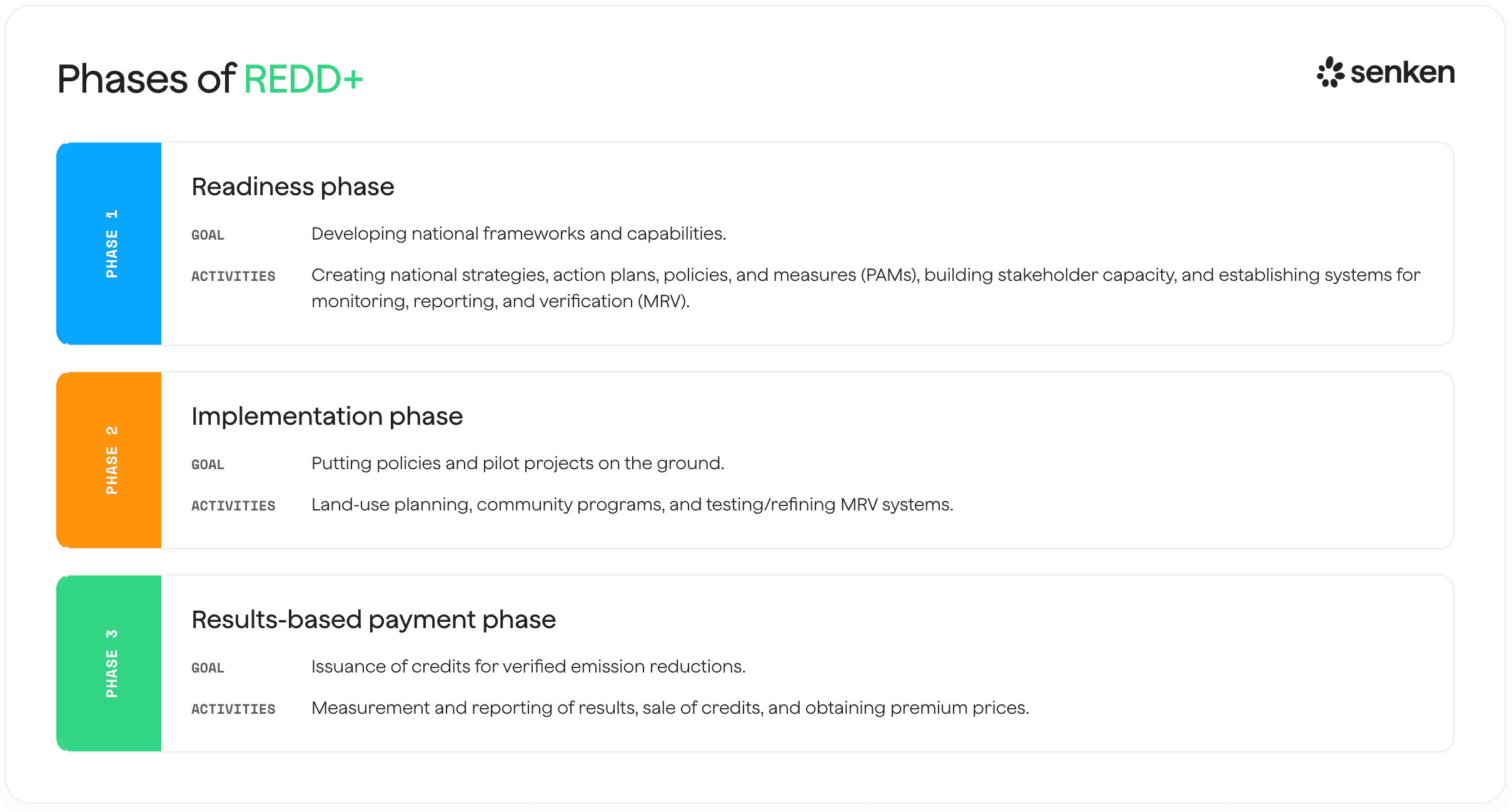
The Three Phases of REDD+ Implementation
1. Readiness phase: strategy, baselines, and MRV systems
In this phase, a country or jurisdiction develops its REDD+ strategy, establishes a national or subnational reference level (the baseline against which future reductions are measured), and builds monitoring, reporting, and verification (MRV) capacity. This involves satellite data infrastructure, stakeholder consultations, safeguard information systems, and policy reforms.
For buyers: No credits are issued in readiness. If a vendor offers "readiness-phase credits," they are likely selling forward commitments or pre-financing, which carries execution risk. Only consider such deals if you have an appetite for project development risk and robust legal protections.
2. Implementation phase: pilot projects and policy measures
Countries and jurisdictions start putting policies and projects on the ground: land-use planning, community programs, enforcement capacity, and pilot REDD+ activities. MRV systems are tested and refined. Some early results may be measured, but credits are not yet formally issued at scale.
For buyers: Forward purchase agreements may emerge in this phase, typically at lower prices than ex-post verified credits. Your risk exposure is moderate to high, depending on governance, MRV robustness, and the timeline to Phase 3.
3. Results-based payment phase: when REDD+ credits can be issued
Once a jurisdiction or project has a verified reference level, MRV in place, and measurable, reported emission reductions, credits can be issued and sold. High-profile deals like Guyana's ART-TREES credits sold to Hess at USD 15–25 per tonne, and LEAF Coalition agreements with Ghana, Costa Rica, and Pará, demonstrate that results-based jurisdictional REDD+ can command premium pricing.
For buyers: This is the phase where you should be purchasing for compliance, beyond-value-chain mitigation, or portfolio fulfilment. Ask vendors: Is this program in results-based payments? What vintage are the credits? Are they ex-post verified and registered?
How REDD+ Credits Work in the Voluntary Carbon Market
Jurisdictional REDD+ programs and ART-TREES
ART-TREES is the leading standard for jurisdictional REDD+ and has been approved for use in CORSIA's second phase (2027–2029) . Jurisdictional programs account for all forest emissions and removals within a national or subnational boundary, set a reference level using historical data and forward-looking adjustments, and issue credits for verified reductions against that baseline.
Advantages for buyers:
- Lower leakage risk, because the accounting boundary covers a whole region
- Stronger governance alignment, since credits are backed by national or state-level policy
- Higher price transparency and premium positioning, reflecting integrity
Considerations:
- Less granular visibility into specific on-the-ground activities
- Requires trust in jurisdictional MRV and safeguard systems
- Indicative pricing for jurisdictional REDD+ ranges from USD 10–15 per tonne currently, with projections toward USD 15 in 2028
Project-level REDD+ credits under standards like Verra VCS
Most REDD+ credits historically came from project-level interventions certified under Verra's Verified Carbon Standard (VCS). Verra's new REDD+ methodology (VM0048) requires projects to use jurisdictional activity data for baselines, moving away from project-specific reference scenarios. This is a direct response to over-crediting concerns and aligns project baselines with national or subnational data.
Advantages for buyers:
- Specific project stories and co-benefit documentation (useful for internal and external communications)
- Flexibility to select projects in priority geographies or with specific SDG alignment
- Established supply and market infrastructure
Considerations:
- Legacy projects under older methodologies may carry a higher baseline risk
- Leakage (emissions shifting outside project boundaries) is harder to account for without jurisdictional integration
- Average REDD+ transaction prices in 2024 were around USD 7.87 per tonne, but dispersion is wide; price alone is not a quality signal
Nested REDD+ approaches and avoiding double counting
Nested approaches allow project-level credits to sit within a jurisdictional accounting framework. Projects are credited based on performance relative to a jurisdictional baseline, and the jurisdiction tracks all emissions to avoid double counting. This structure is increasingly important for alignment with Article 6 of the Paris Agreement, CORSIA, and future compliance schemes.
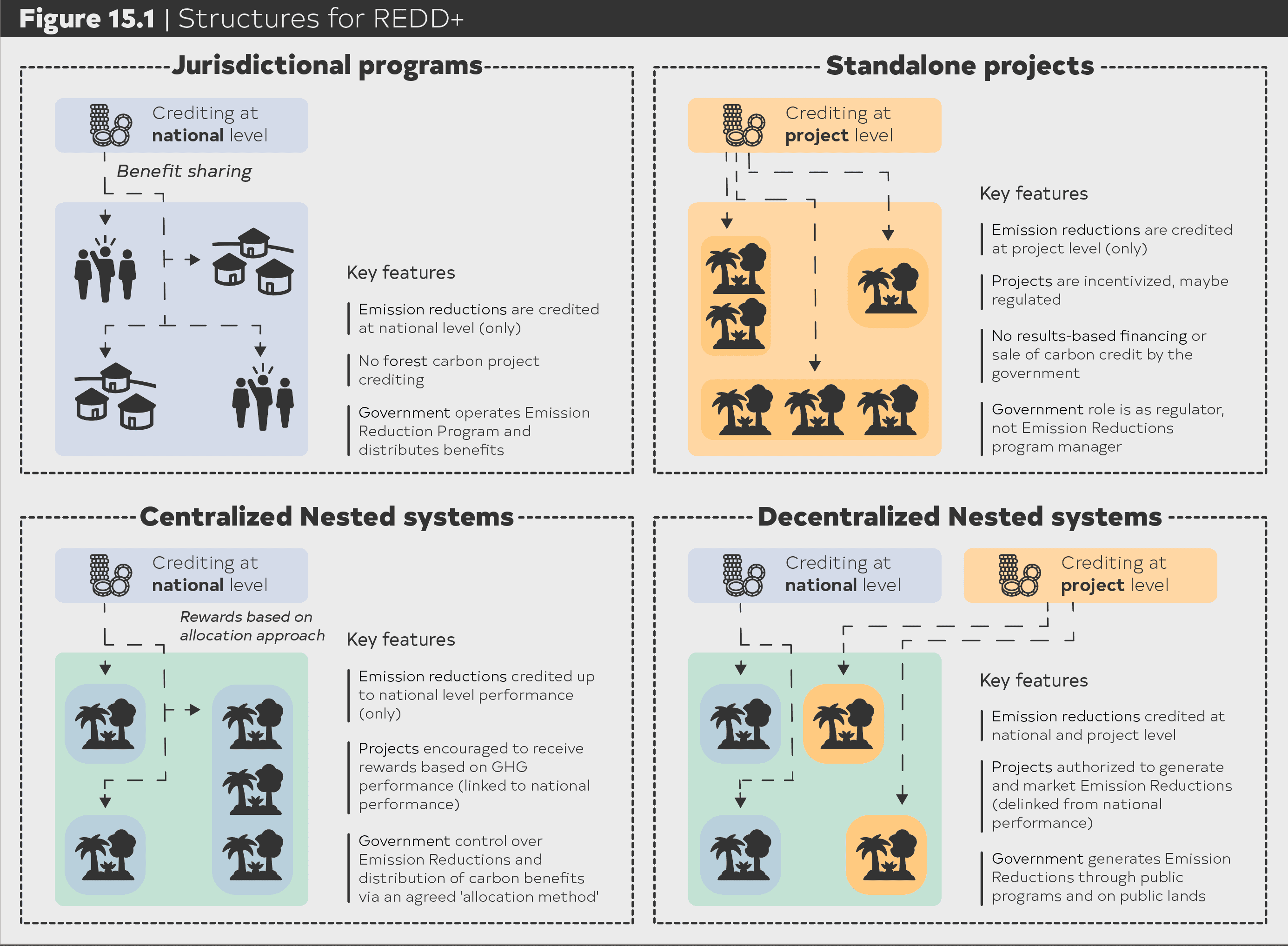
For buyers: Verify that credits come from programs with clear nesting rules and that corresponding adjustments (to prevent double-counting) are in place if the host country intends to use the emission reductions toward its own NDC.
Why baselines and reference levels are the integrity linchpin
Baselines define "what would have happened without the project." If the baseline overstates the deforestation threat, credits are issued for reductions that would not have occurred anyway. Peer-reviewed studies found that many legacy REDD+ projects delivered lower climate benefits than credited, primarily due to inflated baselines.
The shift toward jurisdictional baselines, transparent data sharing, and ICVCM Core Carbon Principles is a direct response to these critiques. As a buyer, your due diligence must go beyond the standard logo to examine how the baseline was set, what data underpin it, and whether independent audits validated the assumptions.
REDD+ Standards and Certification
Verra VCS and the new REDD+ methodology (VM0048)
Verra's VM0048 methodology and jurisdictional data module (VMD0055) require projects to anchor baselines in jurisdictional activity data and use risk-based allocation of credits . This represents a fundamental shift from project-specific counterfactuals to regionally consistent reference levels, reducing the scope for baseline gaming.
What this means for buyers: Projects transitioning to VM0048 will have more conservative, defensible baselines. Expect lower credit volumes per project but higher integrity and alignment with ICVCM CCP. Older vintages under legacy methodologies carry a higher risk and may not qualify for future CCP labelling.
ART-TREES for jurisdictional and HFLD credits
ART-TREES has been approved for CORSIA and covers both emission reductions and removals, including credits from High Forest, Low Deforestation (HFLD) jurisdictions . HFLD programs reward jurisdictions that have historically protected their forests and maintained low deforestation rates, addressing a longstanding equity concern in REDD+ design.
What this means for buyers: ART-TREES credits signal strong institutional backing and alignment with international aviation compliance. High-profile corporate deals, such as Guyana's agreement with Hess and LEAF Coalition ERPAs, demonstrate that jurisdictional REDD+ can attract premium pricing and serious buyer commitments.
Gold Standard, Plan Vivo, and how ICVCM's CCP label fits in
Gold Standard and Plan Vivo also certify REDD+ projects, often with a stronger emphasis on community-led, smallholder models. ICVCM's Core Carbon Principles approval now covers major programs, including Verra, ART, Gold Standard, ACR, and CAR, representing approximately 98% of recent voluntary market retirements.
What this means for buyers: CCP eligibility is necessary but not sufficient. It confirms that a standard meets baseline integrity thresholds, but it does not evaluate individual projects. You still need additional layers of due diligence: third-party ratings (BeZero, Sylvera, Calyx, MSCI), registry monitoring reports, safeguards documentation, and potentially your own or a partner's structured assessment like Senken's 600+ datapoint Sustainability Integrity Index.
Common Criticisms of REDD+ Projects (and What's Changed)
Baseline inflation and doubts about additionality
Several peer-reviewed analyses, including studies published in Science in 2023 and 2025, found that many legacy avoided deforestation projects delivered significantly lower climate benefits than credited, primarily due to inflated baselines that overstated counterfactual deforestation.
What has changed: Verra's VM0048 methodology requires projects to use jurisdictional activity data for baseline setting, and ICVCM CCP approval processes exclude or restrict methodologies with systematic over-crediting risks . ART-TREES programs use national or subnational reference levels that are transparent and subject to technical review. The result is a smaller, more conservative supply of REDD+ credits, with higher integrity but lower volumes per project.
For buyers: Favour credits from programs using jurisdictional baselines, with CCP approval and independent rating agency validation. Be sceptical of large-volume deals at very low prices, which often signal legacy methodologies or weak additionality.
Permanence and reversal risks: fire, illegal logging, policy shifts
Forests are not permanent carbon stores. They can be burned, illegally logged, or cleared if political will or enforcement capacity weakens. Standards address this through buffer pools: a percentage of issued credits is held in reserve and cancelled if reversals occur.
What has changed: Buffer pool requirements have increased, risk assessments have become more sophisticated (using satellite monitoring, fire risk models, governance indicators), and some jurisdictions are integrating REDD+ into national climate policy, reducing the risk of policy rollback.
For buyers: Check the buffer pool contribution (typically 10–30% depending on risk) and verify that the project or program has an active monitoring system with real-time alerts for deforestation or fire. Ask whether insurance or other financial guarantees are in place beyond the buffer pool.
Leakage and displacement of deforestation
Leakage occurs when a project prevents deforestation in one area, but the same economic drivers simply shift activity to another area outside the project boundary. Project-level REDD+ has struggled with leakage accounting because it is difficult to track what happens beyond the fence line.
What has changed: Jurisdictional REDD+ programs reduce leakage by accounting for all forest emissions within a region. Nested approaches require projects to demonstrate that reductions are real at the landscape level. Methodologies now include leakage deductions (typically 10–30%) and monitoring zones around project boundaries.
For buyers: Jurisdictional or nested credits carry lower leakage risk. For project-level credits, verify that leakage has been quantified, deducted, and monitored over time.
Social and governance failures
High-profile cases have emerged where REDD+ projects were accused of land grabs, inadequate benefit sharing, or excluding Indigenous Peoples from decision-making. These failures damage the credibility of the entire REDD+ market and expose corporate buyers to reputational harm.
What has changed: Safeguard requirements are now more stringent and subject to third-party audit. Standards like VCS with CCB (Climate, Community & Biodiversity) certification and ART-TREES include mandatory safeguards, information systems and community engagement documentation . Independent rating agencies now assess governance and social performance as part of their credit scoring.
For buyers: Treat safeguards as non-negotiable. If a project cannot produce clear FPIC documentation, benefit-sharing agreements, and evidence of active community engagement, walk away. The reputational downside far outweighs the cost savings.
How to Assess REDD+ Credit Quality: A Practical Due Diligence Checklist
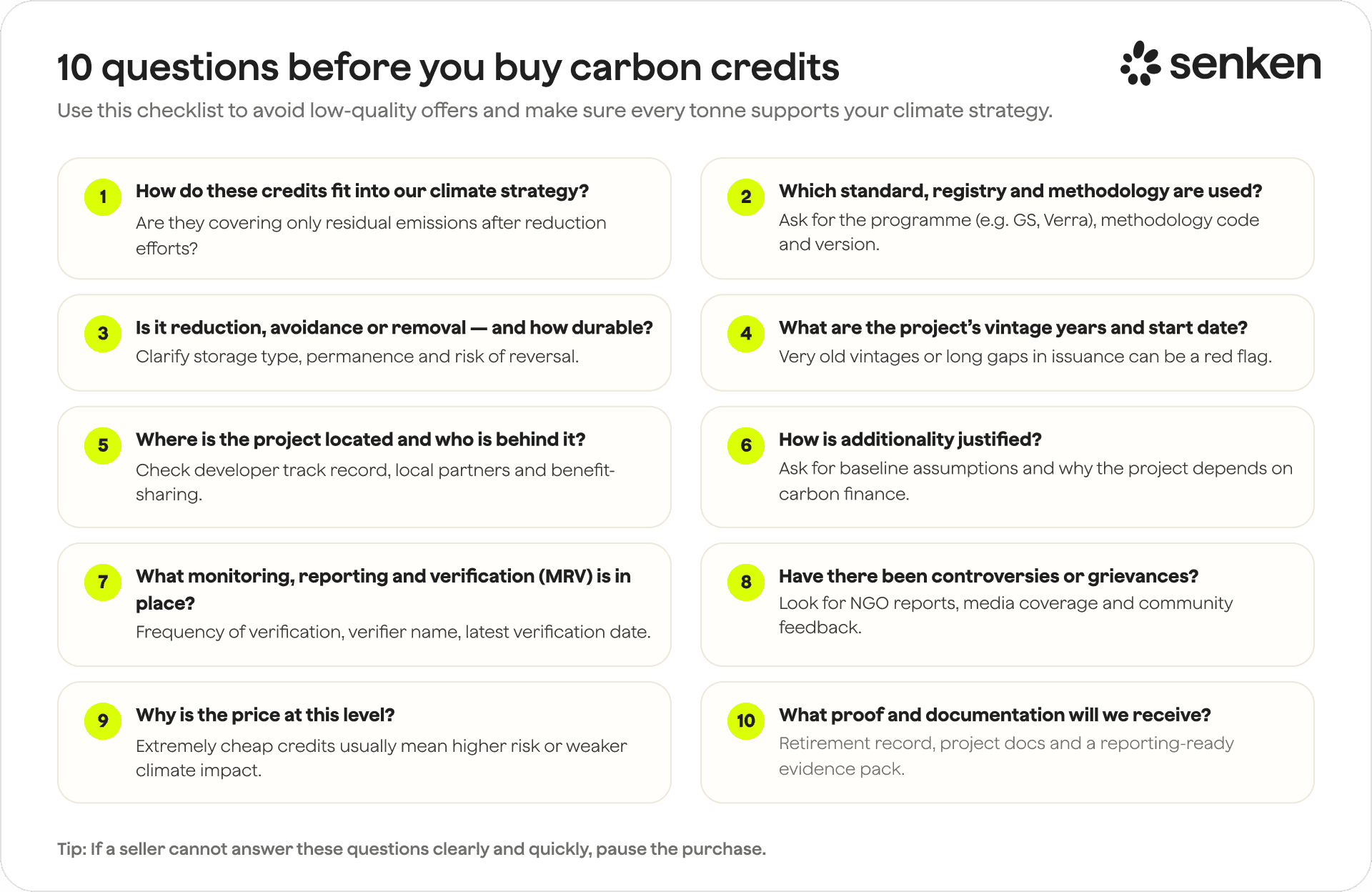
Start with the basics:
- Standard: Verra VCS, ART-TREES, Gold Standard, or another ICVCM-approved program?
- Methodology: Is it using updated methodologies (e.g., VM0048 for VCS) or legacy approaches from the 2010s?
- CCP status: Has the category and vintage been approved under ICVCM Core Carbon Principles?
If the answer to any of these is unclear or negative, proceed with extreme caution.
Step 2: Read the REDD+ reports – baselines, MRV, and auditor findings
Request and review:
- Project Design Document (PDD) or Jurisdictional REDD+ Document: How was the baseline set? What data sources were used? What is the without-project scenario?
- Monitoring reports: What MRV system is in place (satellite, ground plots, third-party digital MRV)? How often is monitoring conducted?
- Verification reports: What did the independent auditor find? Were there corrective action requests? How were they resolved?
Red flags: Unusually high crediting relative to regional deforestation trends, outdated baselines (>5 years old without revision), weak justification for additionality, or repeated audit findings on the same issue.
Step 3: Check permanence tools – buffer pools, risk assessments, monitoring
- Buffer pool contribution: What percentage of credits is held in reserve? Is it appropriate for the risk profile (fire, governance, land tenure)?
- Risk assessment: Does the project use a transparent, data-driven risk tool (e.g., Verra's AFOLU Non-Permanence Risk Tool)?
- Ongoing monitoring: Is there real-time or annual satellite monitoring with alerts for deforestation or degradation within the project area?
Best practice: Favour projects with >20% buffer contributions in high-risk regions, backed by independent monitoring (e.g., Global Forest Watch, Planet, or third-party MRV providers).
Step 4: Verify safeguards, FPIC, and benefit sharing in practice
- FPIC documentation: Meeting minutes, consent forms, third-party verification, and evidence of ongoing consultation.
- Benefit-sharing mechanism: Contracts, payment records, community development reports, and independent evaluations.
- Grievance system: Is there a clear process for communities to raise concerns? Have any been filed? How were they resolved?
Best practice: Cross-check project claims against independent sources: NGO reports, rating agency commentary, media coverage. If communities are publicly opposing the project, that is a hard stop.
Step 5: Triangulate with ratings, external data, and a partner like Senken
No single source gives you the full picture. Combine:
- Third-party ratings: BeZero, Sylvera, Calyx, MSCI (look for ratings of A or above; anything below BBB warrants deep scrutiny)
- Public satellite data: Use Global Forest Watch, GLAD alerts, or other open platforms to verify that forest cover is stable within the project area
- Registry data: Check issuance history, retirement records, and whether any credits have been reversed or suspended
Senken's approach: Our Sustainability Integrity Index applies more than 600 datapoints across five categories – Basic Project Analysis, Carbon Impact, Beyond Carbon, Reporting Process, and Compliance & Reputation – resulting in a <5% acceptance rate. This structured, multi-source framework turns REDD+ due diligence from a months-long internal burden into an audit-ready procurement decision.
REDD+ in Your Corporate Carbon Portfolio
Positioning REDD+ within an Oxford-aligned net-zero pathway
In an Oxford-aligned strategy, your priority is rapid, deep internal decarbonisation. Carbon credits play a supporting role: near-term beyond-value-chain mitigation while you scale your removals portfolio and complete operational abatement. High-quality REDD+ fits as:
- Near-term avoided emissions that deliver real climate benefit today, preventing CO2 release that cannot be undone later
- Nature-positive impact with measurable biodiversity, water, and community co-benefits that strengthen your ESG profile
- Cost-effective scale in the 2020s, while durable removal technologies mature and prices stabilise
As you approach 2030 and beyond, your portfolio should progressively shift toward removals (ARR, biochar, enhanced weathering, eventually DAC and other durable methods), but REDD+ can remain a component if sourced from high-integrity jurisdictional programs.
Balancing REDD+ with removals and other credit types
Removal credits currently trade at approximately 3 to 4 times the average avoidance credit price, meaning a purely removals portfolio would be prohibitively expensive for most DACH companies today. A pragmatic approach:
- 2024–2027: 40–60% high-quality REDD+ (jurisdictional, CCP-eligible, strong ratings), 30–40% nature-based removals (ARR, blue carbon, regenerative agriculture), 10–20% technology-based removals (biochar, enhanced weathering)
- 2028–2035: Gradually reduce REDD+ share to 20–30%, increase durable removals to 50–60%, maintain nature-based removals at 20–30%
- 2035+: Majority durable removals (>70%), with residual high-quality REDD+ or ARR for co-benefits and cost management
This phased approach balances cost, impact, permanence, and co-benefits, while signalling to stakeholders that you are following a science-aligned trajectory.
Managing price–quality trade-offs under CSRD and SBTi
REDD+ prices range from around USD 6–8 per tonne for project-level credits to USD 10–25+ per tonne for high-integrity jurisdictional programs. The temptation to buy at the low end is strong, especially when facing internal budget pressure.
Resist it. Low-price REDD+ almost always signals one or more of:
- Legacy methodologies with weak baselines
- Low or no third-party ratings
- Weak safeguards or governance
- High permanence or leakage risk
- Projects that will not pass future CCP or CSRD scrutiny
Instead, set an internal quality threshold (e.g., "only credits that are CCP-eligible, rated A or above by at least one independent agency, and from jurisdictions with functioning safeguards systems") and budget accordingly. Under CSRD, you must disclose the characteristics and quality of the credits you use. An audit trail showing rigorous due diligence is far more valuable than a marginal cost saving per tonne.
When REDD+ Credits Make Sense for Your Climate Strategy
When high-quality REDD+ is a good fit
REDD+ makes strategic sense if:
- You have a robust internal decarbonisation plan aligned with SBTi or similar science-based targets, and you view REDD+ as beyond-value-chain mitigation, not a substitute for operational emissions cuts.
- You are willing to pay for high-integrity supply: You understand that quality REDD+ costs more than the market average and that the price premium reflects real due diligence, safeguards, and lower risk.
- You value nature and community co-benefits: Forest protection delivers biodiversity, watershed, and livelihood outcomes that matter for your broader ESG strategy and stakeholder expectations.
- You are prepared to invest in or outsource serious due diligence: Either you build internal capacity to evaluate baselines, safeguards, and MRV, or you partner with a specialised provider who can do it rigorously and transparently.
When you should be cautious or avoid REDD+ altogether
REDD+ is a poor fit if:
- You are seeking cheap volume to make "climate neutral" product claims: This exposes you to greenwashing allegations, regulatory action under EU Green Claims rules, and reputational damage.
- You are unwilling to engage with CSRD/Green Claims evidence requirements: REDD+ requires transparent, granular disclosure. If your organisation is not ready for that, you are better off waiting or focusing on removals with simpler stories.
- You lack capacity or partners for robust due diligence: Buying REDD+ based on a registry logo alone is high-risk. If you cannot rigorously assess or outsource assessment of baselines, safeguards, and permanence, delay your purchase until you can.
- You are under immediate board or stakeholder pressure after negative media coverage: If your company has been criticised for past carbon credit purchases or your sector is under intense NGO scrutiny, consider focusing your near-term portfolio on removals or regenerative agriculture with clearer additionality and lower controversy risk.
Operationalising REDD+ procurement with a specialised partner
If you decide REDD+ is appropriate, here is how to operationalise it:
- Establish internal quality policies: Define minimum standards (CCP-eligible, minimum third-party rating, safeguards documentation requirements, jurisdictional preference) and get sign-off from legal, procurement, and the C-suite.
- Adopt a due diligence framework: Use a structured approach, whether in-house or outsourced. Senken's Sustainability Integrity Index provides a 600+ datapoint, five-category framework (Basic Project Analysis, Carbon Impact, Beyond Carbon, Reporting Process, Compliance & Reputation) with a <5% acceptance rate, turning months of internal work into audit-ready project files.
- Build portfolio diversification rules: Cap exposure to any single project (<20% of annual volume), country (<30%), or vintage (<25% from any single year), and blend REDD+ with removals and other credit types.
- Prepare audit-ready evidence packs: For every REDD+ credit you retire, maintain a file with: registry issuance records, MRV and verification reports, safeguards documentation (FPIC, benefit-sharing agreements), third-party ratings, public satellite data showing forest stability, and a summary memo documenting your due diligence process.
- Engage early and transparently: Bring procurement, legal, and communications into the process from day one. Ensure your sustainability reporting (CSRD, CDP, annual report) includes clear, granular disclosure of credit characteristics, volumes, and the quality checks you applied.
By treating REDD+ with the seriousness it demands, you can turn it from a greenwashing risk into a credible, defensible component of an Oxford-aligned, CSRD-ready climate portfolio – ideally with the support of a partner like Senken, who has already done the hard work of screening the market for the top 5% of supply.