
Decarbonisation
A decarbonisation strategy is the step-by-step plan that shows exactly how your organisation will reduce greenhouse gas emissions across operations and value chains, turning climate commitments into funded projects, clear ownership, and measurable progress.
Here's how the key terms stack up:
- Decarbonisation: The process of reducing the carbon dioxide (CO2) and overall GHG intensity of your energy use and industrial operations. It's about cutting emissions at source, not balancing them later. As the WRI frames it, decarbonisation focuses on decreasing the emissions ratio in your business systems over a defined timeframe.
- Net zero emissions: A state where your total anthropogenic GHG emissions are balanced by removals over a specific period. According to the IPCC, this means your residual emissions (what you can't eliminate) are counterbalanced by carbon removals, with the accounting dependent on which gases and timeframes you include.
- Carbon neutrality: Specifically achieving net zero CO2 emissions by compensating every ton emitted with an equivalent removal. The IPCC defines this as annual zero net anthropogenic CO2 emissions by your target date.
- Climate neutrality: A broader concept where human activities result in no net effect on the climate system, accounting for all GHGs plus any regional biogeophysical effects.
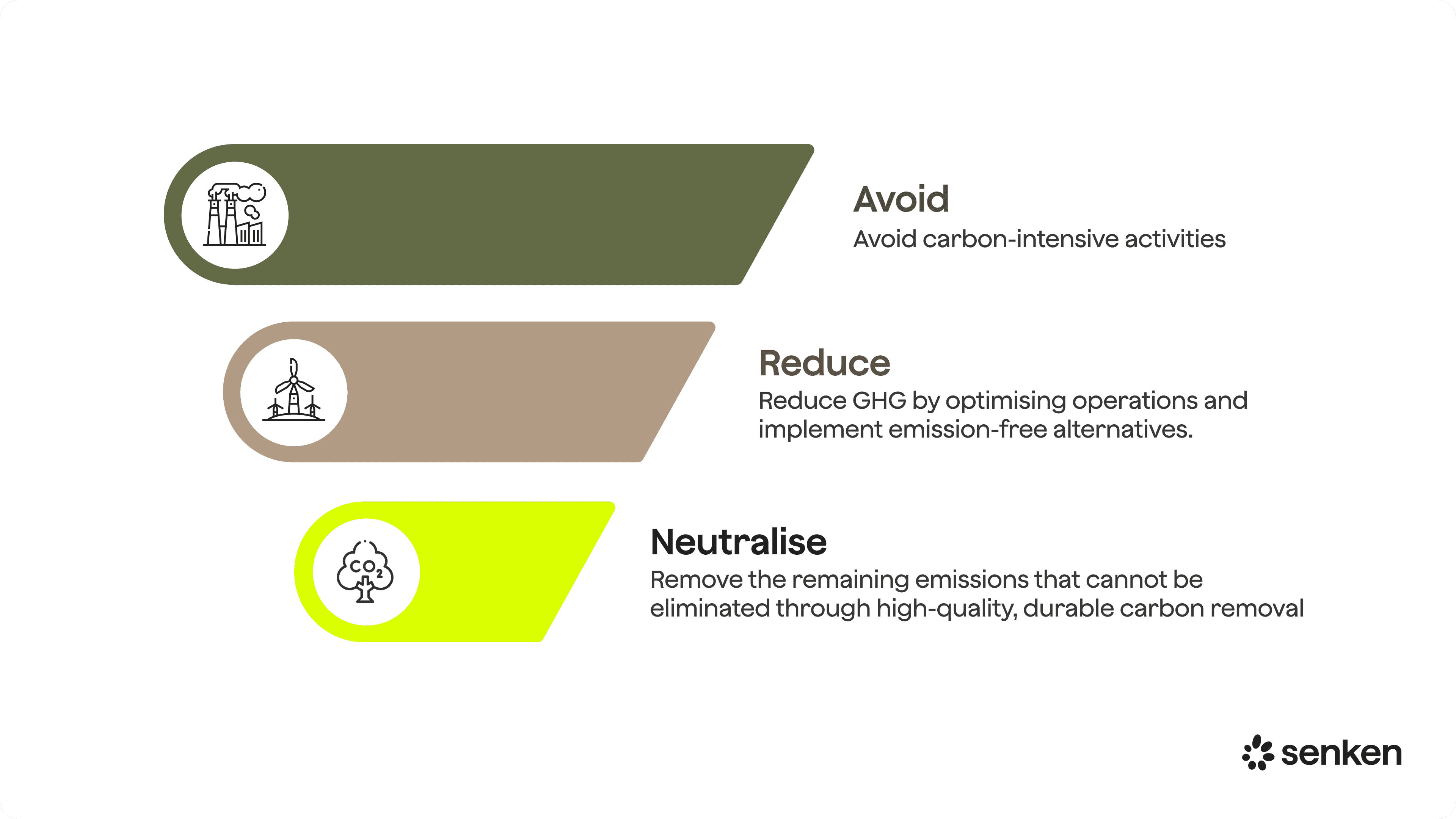
The mitigation hierarchy is your golden rule: avoid and reduce emissions first through operational changes, efficiency gains, and technology shifts. Only then should you neutralise truly residual emissions with high-quality carbon removals. This hierarchy will guide every decision in your strategy, from target-setting to how you use carbon credits, and it's the foundation that keeps you aligned with SBTi and CSRD expectations while protecting you from greenwashing risk.
Why Your Business Needs a Decarbonisation Strategy Now
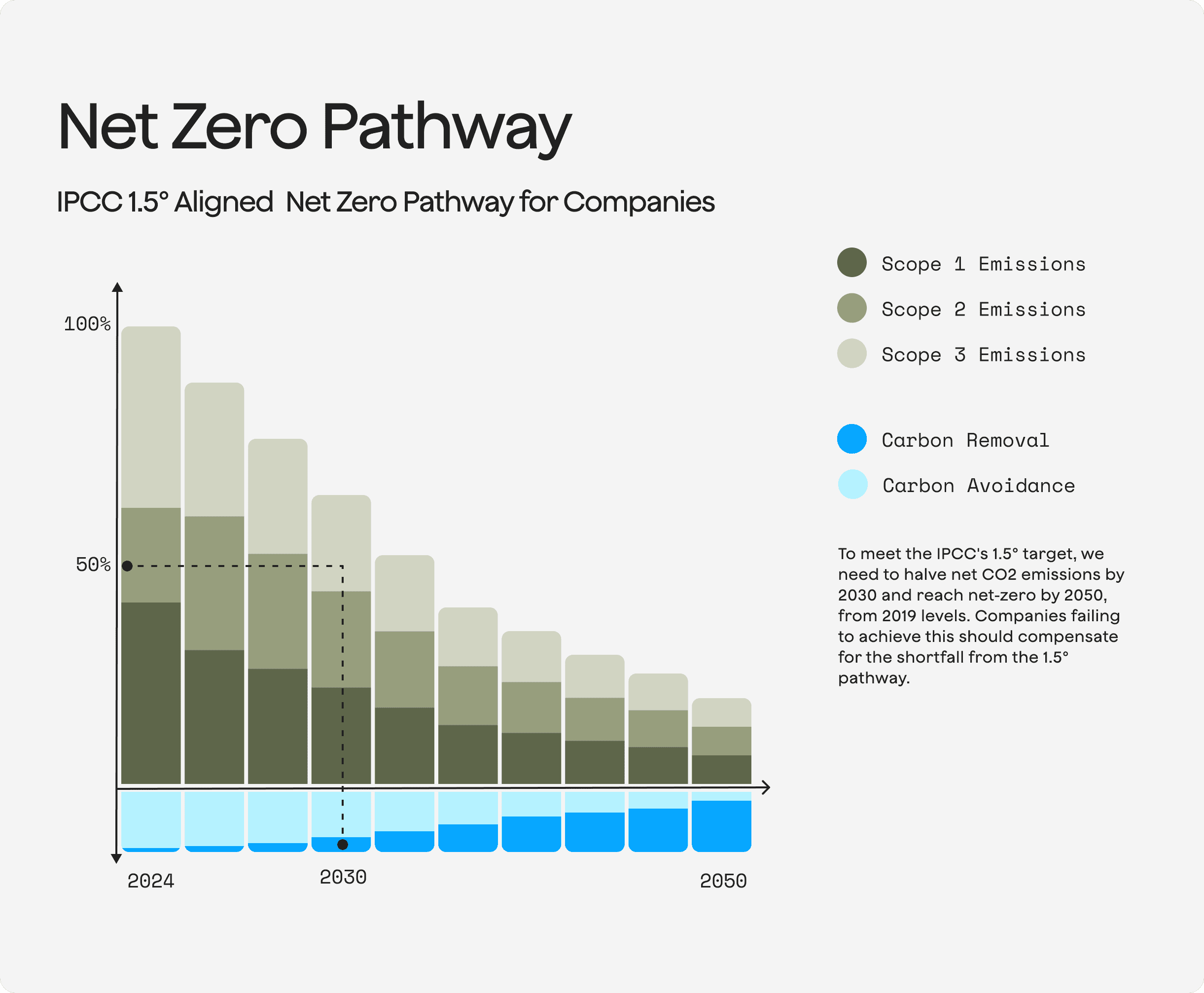
The science is clear. IPCC pathways limiting warming to 1.5°C reach net zero CO2 emissions between 2050 and 2055 , with a remaining carbon budget of around 420-580 GtCO2 from 2018. That means the next seven years are critical, not the distant 2050 deadline. For companies, this translates into immediate regulatory and market pressure.
Regulatory drivers are tightening fast. CSRD and ESRS E1 now require detailed disclosure of your transition plan, targets, and progress. EU ETS is expanding scope and tightening caps. CBAM is creating carbon cost exposure in supply chains. If you're one of the 58% of DAX 40 companies with validated science-based targets , you're already committed to ambitious near-term reductions. If not, you're in the minority and investors are noticing.
The business case is equally compelling. Consider this simple opportunities-and-risks mapping:
Opportunity | Example KPI
Energy cost savings from efficiency | % reduction in energy spend per revenue
Access to green finance | Share of financing linked to sustainability KPIs
Talent attraction | Employee retention rates, applicant quality scores
Supply chain resilience | Diversification index, supplier climate risk scores
Risk | Example KPI
Regulatory penalties | Compliance gap vs CSRD/EU ETS requirements
Higher cost of capital | ESG rating, financing cost premium
Stranded assets | % of capex in high-carbon assets with <10yr payback
Greenwashing litigation | External claims vs verified reductions
The momentum is undeniable. Global clean energy investment is projected to reach $2 trillion in 2024, with solar alone attracting over $1 billion per day . Corporate clean energy procurement hit 55 GW in 2023 , proving that renewables and PPAs are now mainstream tools, not experimental side projects. Companies with strong ESG performance also benefit from measurably lower financing costs, a direct bottom-line advantage.
A Five-Stage Decarbonisation Strategy Framework You Can Actually Run Internally
This framework is designed to fit into your existing corporate planning cycles, with clear ownership and outputs at each stage.
Stage 1: Measure and Baseline Your Emissions
Start with a robust GHG inventory covering Scopes 1, 2, and 3. Your baseline is the foundation for target-setting and tracking, so invest in getting it right. Map data owners across your organisation: facilities teams own Scope 1, procurement owns most of Scope 3 (purchased goods, logistics), HR can help with business travel, and finance typically coordinates company-wide data consolidation.
Use recognised standards like the GHG Protocol, flag data quality tiers transparently (primary data vs spend-based estimates), and identify your emissions hotspots. For CSRD compliance, you'll need assurance-ready data and clear documentation of your methodology. Create a simple data-owner map and quarterly update process so your baseline stays current as your business evolves.
Stage 2: Set Science-Based Reduction Targets
Your targets must be ambitious, credible, and aligned with 1.5°C pathways. Companies with validated SBTi targets reduced Scope 1 and 2 emissions at 5.9% annually, exceeding the required 4.2% for 1.5°C alignment . Use this benchmark to justify your near-term targets internally.
Structure targets by scope and set both absolute and intensity metrics where appropriate. Define interim milestones (e.g., 2030) that create accountability before your long-term net zero date. Be explicit about what SBTi says on carbon credits: deep internal reductions come first, and credits may only be used for residual emissions after you've exhausted abatement options.
Stage 3: Build and Fund Your Decarbonisation Roadmap
List your abatement levers across categories: energy efficiency, electrification, renewable PPAs, fuel switching, process innovation, circularity (recycled inputs, remanufacturing), and product/service redesign. Prioritise using a simple matrix of impact (tCO2e reduced), cost (capex and opex), and time to implement.
Group initiatives into waves: quick wins (payback <3 years), medium-term projects (3-7 years), and strategic bets (longer horizon, higher uncertainty). With corporate PPAs growing 30% year-on-year and RE100 members adding 57 GW of capacity , renewable procurement should be a priority lever for most large companies.
Integrate your roadmap into capital planning by linking projects to internal carbon pricing (if you use it) or sustainability-linked financing covenants. Show the CFO not just the cost, but the risk reduction (regulatory, reputational) and revenue protection from early action.
Stage 4: Embed Implementation and Governance
Set up a cross-functional steering group with representatives from Sustainability, Finance, Operations, Procurement, HR, Legal, and IT. Use a RACI to define who sets targets (typically executive committee), who owns delivery (business unit leaders), who consolidates reporting (sustainability team), and who approves carbon credit purchases (often a joint Sustainability-Finance sign-off).
Embed decarbonisation KPIs in annual performance reviews for relevant roles. Build internal capability through targeted training and clear guidelines. Define approval thresholds and escalation paths for investments and for any external climate claims. This governance layer is what turns a strategy document into a managed programme.
Stage 5: Monitor, Report and Improve
Track progress against a core KPI set: absolute and intensity emissions by scope, share of capex aligned with your transition plan, percentage of top suppliers with their own targets, and status of key roadmap milestones. Align your internal monitoring with CSRD/ESRS reporting cycles so you're always audit-ready.
Build data governance into your systems: define roles for data entry, validation, and sign-off; maintain an audit trail; and plan for limited or reasonable assurance depending on your CSRD phase-in. Review targets and roadmaps at least annually to reflect technology advances, regulatory changes, and actual performance.
Supply Chain Decarbonisation: A Practical Scope 3 Playbook
For most large companies, Scope 3 represents 70-90% of total emissions. Tackling it requires a structured approach, not a blanket engagement with thousands of suppliers.
Segment and Prioritise Your Suppliers
Segment suppliers on two axes: emissions contribution (by spend category and estimated footprint) and strategic importance (volume, technical collaboration, lock-in). Focus intensive engagement on high-emission, strategically important partners where you have leverage. For smaller, transactional suppliers, use standardised questionnaires or industry platforms to collect data at scale.
Create a tiered engagement model: Tier 1 suppliers get direct engagement, co-investment in reduction projects, and contractual target clauses. Tier 2 suppliers receive standardised data requests and scorecards. Tier 3 suppliers are addressed through industry coalitions or sector-wide initiatives.
Engage, Contract and Support for Real Emissions Reductions
Use a combination of tools:
- Data requests: Standardise your GHG data questionnaire and request it as part of RFQs and supplier reviews. Where possible, leverage CDP Supply Chain or sector-specific disclosure platforms.
- Scorecards: Integrate emissions performance and target-setting into supplier scorecards alongside quality, delivery, and cost.
- Contracts: Include clauses requiring disclosure, target-setting, and progress reporting. Consider preferred supplier status for those with validated science-based targets.
- Co-investment: For strategic suppliers, explore joint projects (e.g., on-site renewables, process efficiency) or insetting schemes where you fund emissions reductions in your own supply chain.
European circular economy needs an estimated €55 billion per year in investment, yet recycled materials currently represent only 8.6% of inputs . Collaborating with suppliers on circularity (secondary materials, remanufacturing) is both an emissions reduction lever and a resilience strategy. SBTi expects companies to drive supplier target adoption and report progress, so treat Scope 3 as a managed programme, not a reporting exercise.
Using Carbon Credits Responsibly in Your Decarbonisation Strategy
Carbon credits have a clear but limited role: neutralising residual emissions after you've implemented deep reductions. This aligns with the mitigation hierarchy and with evolving SBTi and CSRD expectations.
Before procuring credits, ensure you meet these criteria:
- Mitigation hierarchy respected: You've set science-based targets, built a funded reduction roadmap, and credits only cover hard-to-abate residuals.
- Quality fundamentals: Credits demonstrate additionality (the project wouldn't happen without carbon finance), permanence (long-term carbon storage or durable impact), minimal leakage, and safeguards against double counting.
- Robust MRV: Independent, third-party verification with transparent, ongoing monitoring. Digital MRV is increasingly the standard.
- Co-benefits: Projects deliver measurable social, biodiversity, or development benefits beyond carbon, aligned with SDGs where relevant.
- Standards alignment: Credits meet ICVCM Core Carbon Principles or equivalent high-integrity frameworks, ensuring credibility with auditors and external reviewers.
Senken's Sustainability Integrity Index evaluates projects across 600+ data points in these categories, helping you shortlist the top 5% of credits on the market. This due diligence is critical for CSRD assurance, where auditors will scrutinise not just the volume of credits retired but the evidence of their quality and the transparency of your procurement process.
Establish an internal carbon credit policy that defines decision criteria, approval workflows, and disclosure rules. This protects you from ad hoc purchases that can undermine your overall strategy or trigger greenwashing accusations. It also makes your carbon credit use auditable and defensible.
Overcoming Common Barriers
Typical Blockers in Large Organisations
Even with executive commitment, decarbonisation strategies stall. Here are the usual suspects and how to tackle them:
- Fragmented ownership: Sustainability owns the target, but Operations, Procurement, and Finance control the levers. Fix: Set up the cross-functional steering group immediately and assign clear accountability via RACI.
- Scope 3 data gaps: Suppliers don't share data, or you're drowning in spreadsheets. Fix: Start with a pilot on your top 20 suppliers by emissions, use a standard template, and incentivise participation via preferred supplier status.
- Budget competition: Decarbonisation projects compete with core capex. Fix: Frame projects as risk mitigation and efficiency gains, link them to sustainability-linked loans or green bonds, and front-load quick wins that pay back fast.
- Sceptical CFOs: Finance sees cost, not value. Fix: Build a one-page business case showing regulatory risk (CSRD penalties, EU ETS exposure), financing benefits (lower cost of capital for ESG-aligned firms), and market positioning.
- Greenwashing fears around credits: Legal and Comms are nervous. Fix: Adopt a formal credit policy with quality criteria, transparent disclosure, and clear language that credits address residuals only, not replace reductions.
Only 14% of listed companies globally have SBTi-validated targets, and only 6% of global corporate emissions are covered by on-track targets. You're not alone if you're in ethe arly stages. The key is to start with a phased, pragmatic approach that builds momentum.