
BeZero
Key Takeaways
- BeZero Carbon is an independent ratings agency that assesses carbon credit quality on a seven-notch scale (AAA+ to A), while procurement platforms like Senken execute purchases, manage retirements, and maintain documentation—most DACH corporates need both to build a defensible strategy.
- Use BeZero-style ratings to set internal quality thresholds and portfolio rules, then operationalise those standards through a procurement platform that enforces filters, handles contracts, and generates audit-ready evidence for CSRD and ESRS E1.
- Higher BeZero ratings command 20–40% price premiums per notch, so you need a clear risk-versus-cost narrative for your CFO: paying more for quality is insurance against greenwashing litigation and reputational damage under EU Green Claims rules.
- CSRD, ESRS E1, and German court rulings on 'climate neutral' all push toward multi-layer due diligence—independent ratings, robust platform integrity frameworks (like Senken's 600+ datapoint SII), and strong contractual safeguards—not just registry labels.
Carbon credits used to be a line item on your sustainability budget. Now, under CSRD and rising greenwashing scrutiny, they're a governance topic that lands on your Supervisory Board's agenda and your auditor's checklist. The question isn't whether to buy credits—it's how to prove the ones you buy are real, additional, and defensible when an NGO, journalist, or Wirtschaftsprüfer asks hard questions.
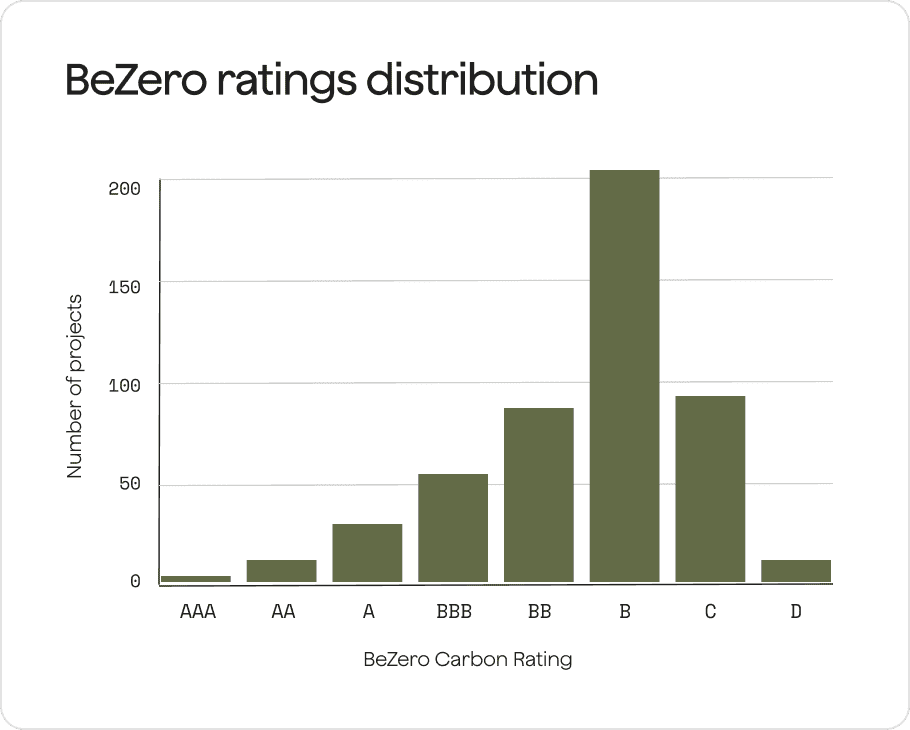
This is where two very different tools come in: BeZero Carbon is an independent ratings agency that assesses whether a credit likely equals one tonne of CO₂e avoided or removed, using a seven-notch risk scale. Procurement platforms like Senken, Patch, or Cloverly are execution engines—they source projects, handle pricing and contracts, retire credits on registries, and store the documentation your compliance team needs.
This guide gives you a practical, step-by-step framework to use BeZero-style ratings together with a high-integrity procurement platform to build an audit-ready carbon credit strategy for companies with over 1,000 employees operating in the DACH region.
BeZero Carbon and Procurement Platforms in Plain Language
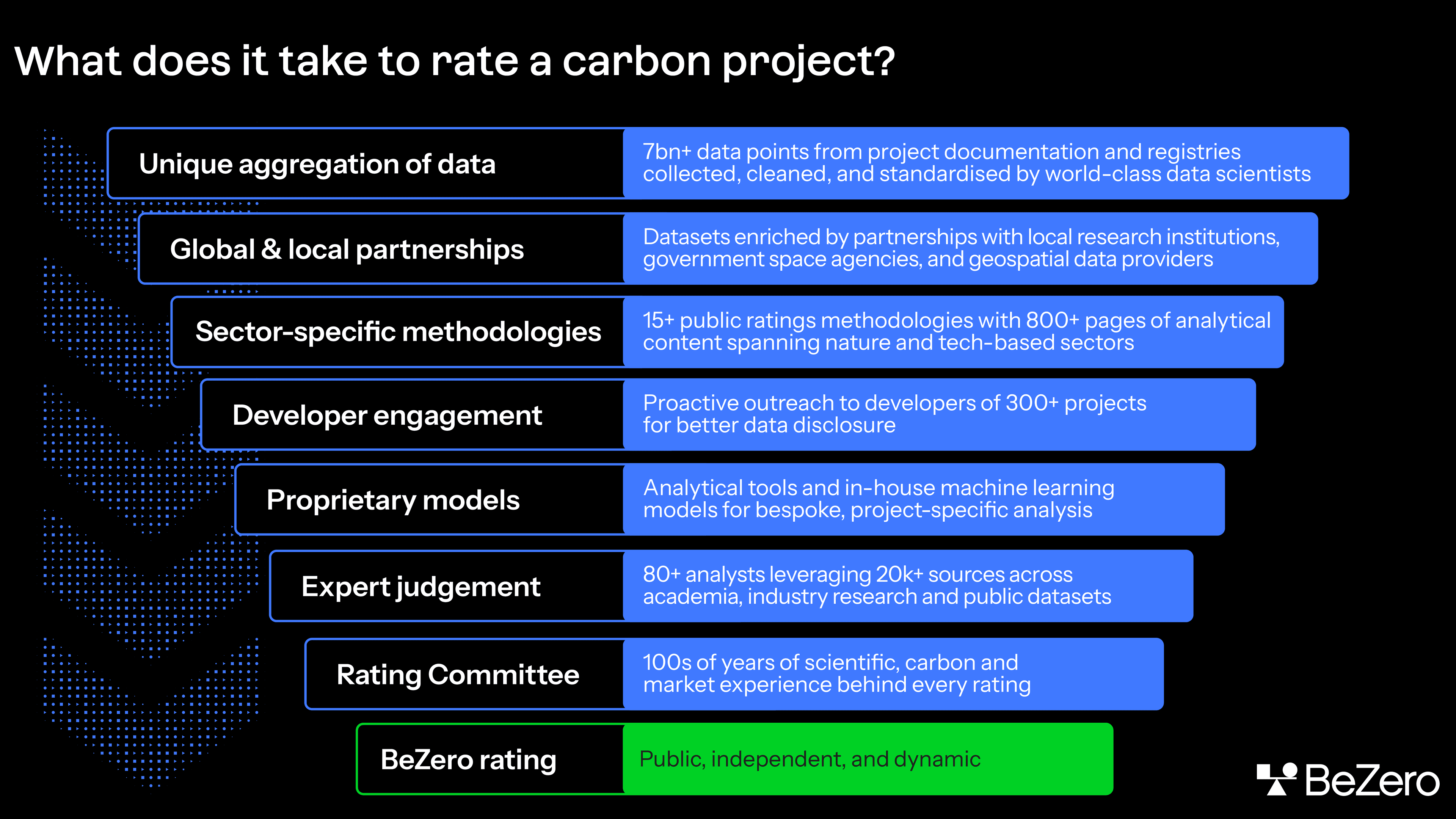
BeZero Carbon is an independent carbon credit ratings agency that assesses whether one credit genuinely represents one tonne of CO₂e avoided or removed. Using a seven-notch scale from AAA+ to A, BeZero evaluates projects across six core risk factors: additionality (which drives roughly 50% of the rating), over-crediting, permanence, leakage, perverse incentives, and policy risk. The ratings draw on over 1,300 publications, earth observation data, and project documentation, giving you a risk-based opinion on credit quality without any involvement in developing, trading, or brokering the credits themselves.
Procurement platforms like Senken, Patch, or Cloverly serve a different function. They aggregate projects, handle pricing discovery, execute transactions, manage retirements, and provide the documentation trail you need for audits and reporting. Many platforms now integrate third-party ratings or run their own quality frameworks. Senken, for example, applies a 600+ data point Sustainability Integrity Index that filters projects on additionality, leakage, permanence, beyond-carbon co-benefits, MRV robustness, and compliance and reputation checks, curating only the top 5% of projects that pass rigorous scrutiny.
For DACH corporates navigating CSRD, ESRS E1, and upcoming EU Green Claims rules, treating carbon credits as a simple online purchase is no longer viable. You need structured quality assurance and robust documentation. BeZero Carbon ratings now appear on over 40 marketplaces and exchanges, signaling that independent ratings are becoming standard infrastructure. Yet ratings alone won't retire credits, generate contracts, or assemble evidence packs. That's where procurement platforms come in. The combination of independent quality signals and execution infrastructure is what transforms carbon credit procurement from a compliance headache into a defensible, audit-ready process.
Carbon Credit Ratings vs Procurement Platforms: Who Does What in Your Company?
Understanding the functional split between ratings agencies and procurement platforms helps you assign internal responsibilities clearly and avoid gaps or duplication.
Independence and conflicts of interest: BeZero Carbon does not develop projects, trade credits, or refer buyers to specific suppliers. This independence positions it as an opinion provider, similar to financial credit rating agencies. Procurement platforms, by contrast, facilitate or execute transactions. Some platforms mitigate conflicts by applying transparent, science-based quality filters (like Senken's Sustainability Integrity Index) before listing projects, while others rely primarily on registry labels and basic checks. For risk-averse DACH corporates, separating the "assess quality" function from the "buy and retire" function reduces the perception of bias and strengthens your governance narrative.
Depth of scientific risk analysis: BeZero's multi-stage rating process involves macro-factor assessments, project-level documentation reviews, weighted aggregation, and unanimous Rating Committee approval. Each rating unpacks specific risks—such as baseline inflation, leakage into adjacent areas, or political instability—that map directly onto scenarios your legal and compliance teams worry about. Procurement platforms vary widely in analytical depth. High-integrity platforms like Senken run 600+ data point checks across carbon impact, beyond-carbon co-benefits, MRV robustness, and compliance history, effectively operationalizing the same risk factors that ratings agencies assess.
Market coverage and transparency: BeZero now covers hundreds of projects across all major standards (Verra, Gold Standard, CDM, ACR, Plan Vivo) and publishes methodologies openly. This transparency matters when you need to explain to your Supervisory Board or auditors how you defined "high quality." Procurement platforms offer varying degrees of transparency: some publish detailed project scorecards and MRV reports; others provide limited insight into sourcing and selection criteria.
How each tool plugs into internal roles: In a typical >1,000-employee DACH organization, sustainability defines climate strategy and quality thresholds, procurement runs tenders and contracting, finance validates cost vs. risk trade-offs, and legal/compliance signs off on claims and contractual clauses. Ratings agencies like BeZero inform the sustainability and finance teams' policy design and portfolio risk modeling. Procurement platforms sit with sustainability and procurement, enabling sourcing, transaction execution, and documentation workflows that legal and audit can review. Neither tool replaces the other; they address different steps in the value chain.
When and How to Use BeZero Carbon Ratings in a DACH Corporate Strategy
BeZero Carbon ratings become most valuable in four scenarios:
Designing or revising your internal carbon credit policy: When you set minimum quality thresholds for the first time (or update them), BeZero ratings give you a concrete, market-recognized benchmark. For example, you might decide that all REDD+ projects must achieve at least an AA rating, while tech-based removals require AAA-, reflecting your board's risk appetite. This explicit rule makes procurement easier and gives procurement and legal teams clear go/no-go criteria.
Preparing for CSRD and ESRS E1 disclosures: Under ESRS E1, you must disclose assumptions and methodologies for neutralization claims and describe climate-related risks. Using independent ratings to substantiate your additionality and permanence assumptions provides audit-ready evidence and demonstrates due diligence. While no regulation yet mandates specific ratings, auditors increasingly expect to see third-party validation when material climate claims are made.
Defending public net-zero or climate-neutral claims: If your company communicates externally about carbon neutrality, the German Federal Court of Justice ruling and the EU Green Claims Directive mean you must clarify what "climate neutral" entails and prove it with robust documentation. High BeZero ratings, combined with a rigorous procurement platform integrity framework, form the backbone of that proof.
Justifying budget decisions and price premiums: Research shows that higher-rated credits command price premiums of 20–40% per rating notch, and in some categories much more. CFOs and boards will ask, "Why are we paying more?" The answer is straightforward: higher ratings reduce the probability of reputational damage, NGO criticism, and future re-purchasing if your original credits are later found to be low quality. Framing the premium as insurance against legal and brand risk makes the business case clear.
To turn ratings into decision rules, use them to define acceptable rating bands by project type, diversify across methodologies and geographies to spread risk, and build downgrade scenarios into your procurement contracts. For instance, specify that if a project's rating falls below a certain threshold, the seller must repurchase or replace the credits. This clause shifts risk and reinforces your quality commitment.
Building an Integrated, Audit-Ready Procurement Workflow
A practical workflow has three steps, each with clear ownership and deliverables.
Step 1: Translate ratings into clear internal quality criteria
Start by co-creating a written carbon credit policy with input from sustainability, procurement, finance, legal, and compliance. Use BeZero-style ratings and Senken's Sustainability Integrity Index (or equivalent multi-criteria frameworks) to set minimum acceptable quality levels. For example:
- For high-risk categories (avoided deforestation, cookstoves): Accept only projects rated AA or above by BeZero, or projects that score in the top decile on Senken's SII additionality and leakage metrics.
- For tech-based removals (biochar, enhanced weathering, carbon mineralization): Require AAA- or higher, or projects with permanence >1,000 years and robust digital MRV.
- For nature-based removals (ARR, IFM): Require strong co-benefit scores (biodiversity, community welfare) and alignment with ICVCM Core Carbon Principles.
Document these thresholds in a short internal guideline (2–3 pages) and obtain formal sign-off from the relevant decision-makers (Head of Sustainability, CFO, General Counsel). This transforms quality from opinion into policy.
Step 2: Use a procurement platform to source, contract, and retire
With clear criteria in hand, leverage a procurement platform to filter available projects and execute transactions. Platforms that integrate BeZero ratings (such as Xpansiv's CBL Marketplace) or apply equally rigorous internal frameworks (like Senken's Sustainability Integrity Index) save you the work of manual cross-checking. Key platform requirements include:
- Traceability from issuance to retirement: Full audit trail linking registry serial numbers, transaction records, and retirement certificates.
- Standardized contracts with quality warranties: Clauses covering rating downgrades, reversal events, and non-delivery.
- Automated documentation generation: Evidence packs that bundle project design documents, MRV reports, rating summaries, and retirement proofs into CSRD-ready formats.
Run all sourcing via the platform, enforce your internal quality filters, and maintain a centralized project database accessible to procurement, finance, and legal. This reduces internal coordination overhead and ensures consistency across multi-year purchasing.
Step 3: Assemble an evidence pack your Wirtschaftsprüfer will accept
For each project in your portfolio, compile a standardized evidence pack containing:
- Independent rating reports (BeZero or equivalent), including the version date and methodology applied.
- Project Design Document and applied methodology, with additionality tests and baseline scenarios.
- Monitoring, Reporting & Verification reports for all credited vintages, including third-party audit statements.
- Contracts with quality warranties, reversal risk provisions, and indemnity clauses.
- Retirement certificates from the registry, showing serial numbers and retirement date.
- Sustainability Integrity Index scorecards or similar multi-criteria assessments.
- Internal approval notes documenting who reviewed ratings, who approved the purchase, and how it aligns with your carbon credit policy.
Store these documents in a structured digital repository (ideally within your procurement platform or enterprise document management system) and tag them by project, vintage, and reporting period. When your auditors review ESRS E1 disclosures or when NGOs submit information requests, you can produce the complete file in hours, not weeks.
Staying Compliant: CSRD, ESRS E1, and EU Green Claims in Practice
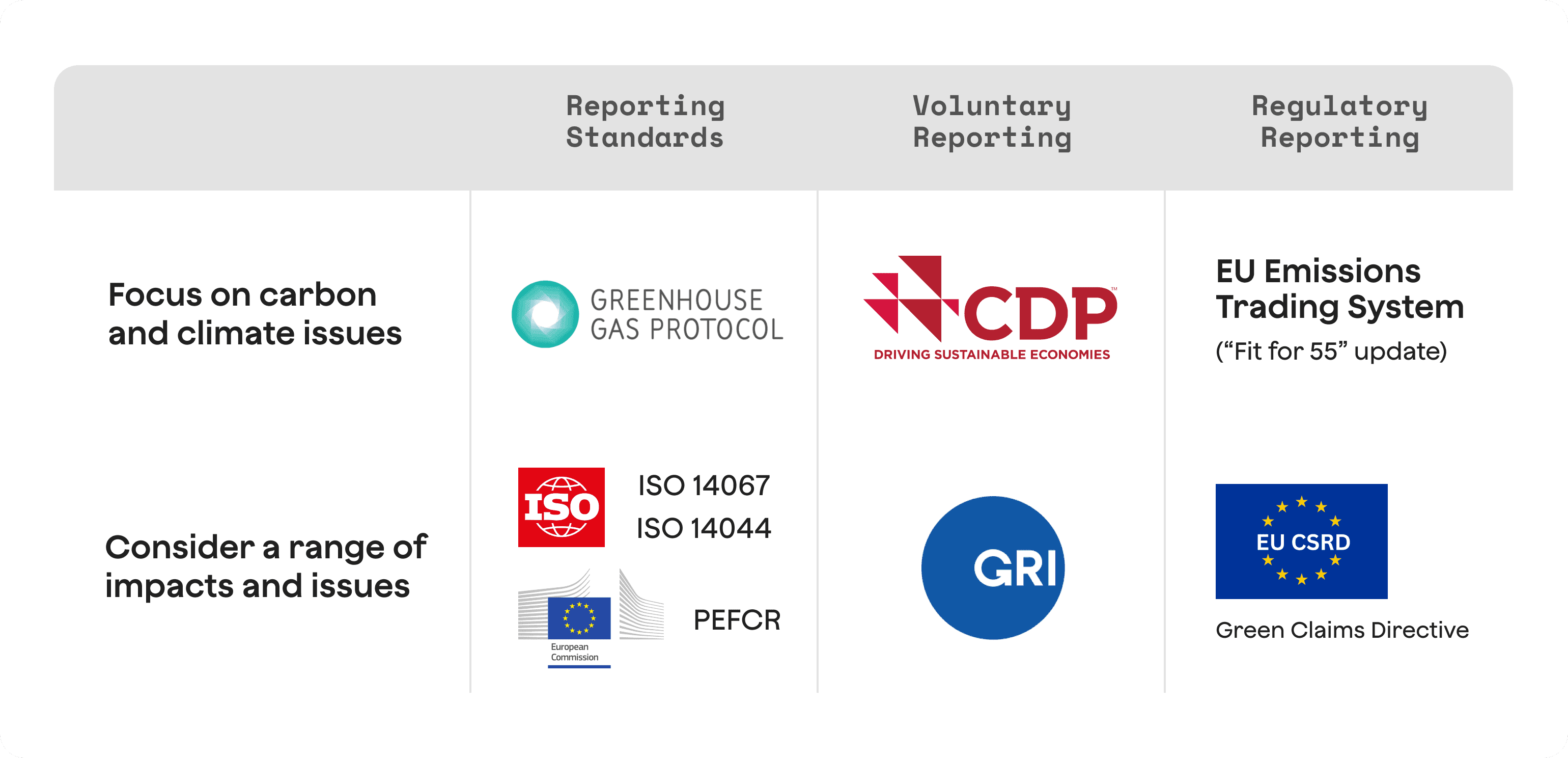
CSRD and ESRS E1 require companies to disclose how they address residual emissions, explain any neutralisation claims, describe transition plan assumptions, and identify climate-related risks. Carbon credit procurement touches all four areas:
Treatment of residual emissions and neutralisation: If you claim Scope 1 or 2 neutrality using offsets, ESRS E1 expects you to explain which emissions are residual (unavoidable after all reduction efforts) and how you validated the offsets' quality and additionality. Independent ratings from BeZero, combined with robust platform integrity frameworks, provide the third-party validation that substantiates these explanations.
Transition plan assumptions: If your net-zero pathway includes Beyond Value Chain Mitigation (BVCM) or future use of carbon removals to meet SBTi interim targets, auditors will scrutinize the quality and permanence assumptions behind those credits. Ratings help quantify the probability that credits deliver as promised, which feeds directly into risk-adjusted scenario modeling.
Climate-related risks: Over-reliance on low-quality credits is a material risk, as NGO investigations, regulatory scrutiny, and potential fines under the EU Green Claims Directive can impact brand value and investor confidence. Documenting your use of independent ratings and multi-layered due diligence demonstrates active risk management.
The EU Green Claims Directive and the Empowering Consumers Directive impose stricter requirements: environmental claims must be verified by independent third parties, and misleading claims can result in fines of up to 4% of annual turnover. In Germany, the Federal Court of Justice has ruled that "climate neutral" is ambiguous and must be clarified in context. Practically, this means you cannot rely on vague offset labels. You must show a clear chain: decarbonization first, then high-integrity credits (backed by ratings and documentation) for residual emissions, with transparent communication of what "neutral" means.
For German entities, this aligns with increasing court and NGO activity. Deutsche Umwelthilfe has sued multiple companies over "climate neutral" labels, and Senken's analysis shows that 68% of DAX40 buyers purchased portfolios with limited real impact. The legal and reputational downside of weak procurement far outweighs the cost of robust ratings and platforms.
Anti-Greenwashing Checklist and Common Pitfalls to Avoid
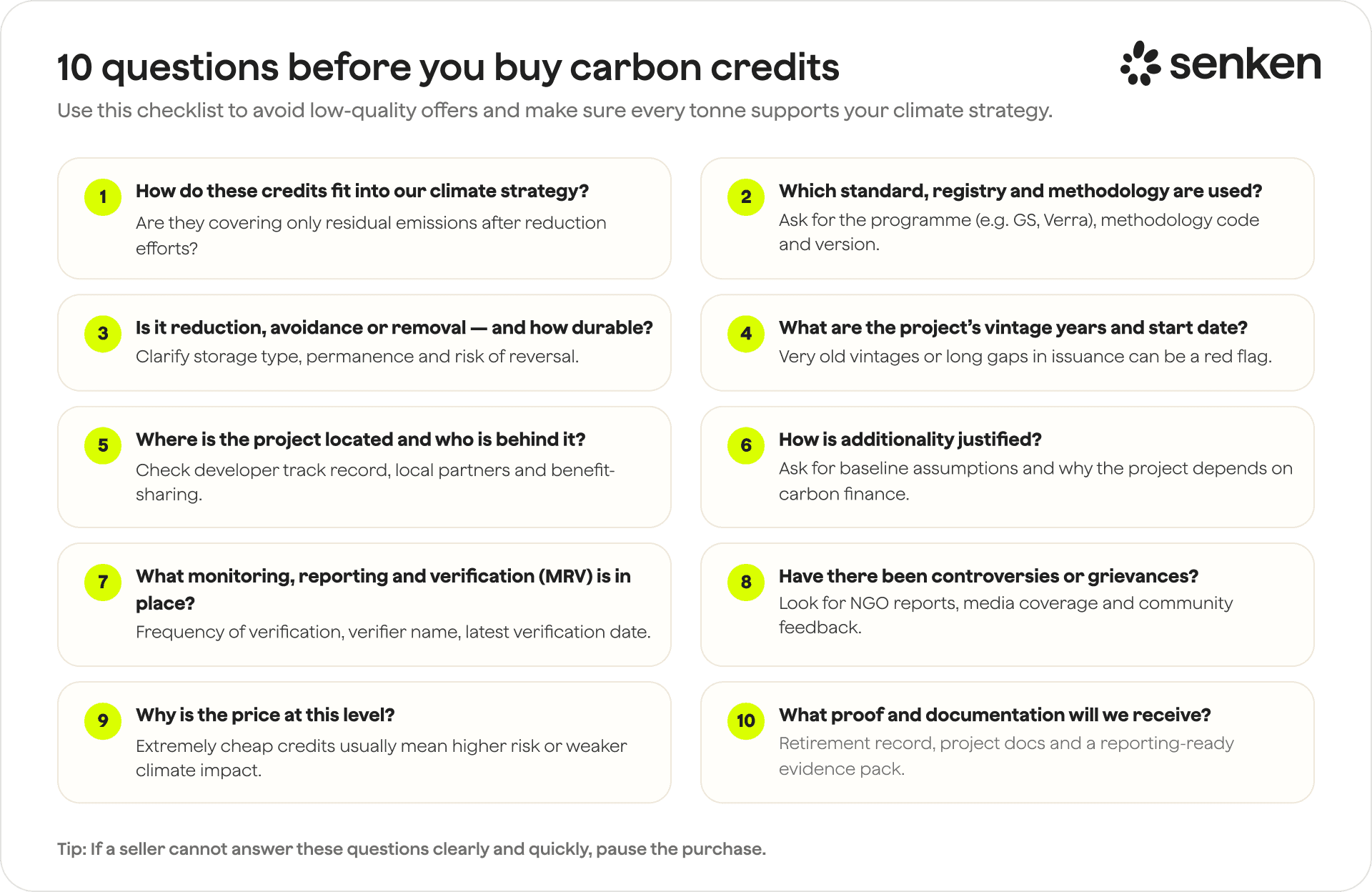
Governance and approval workflows:
- Assign clear ownership: sustainability defines quality criteria, procurement sources and contracts, legal reviews claims language, finance signs off on budget and risk trade-offs.
- Require formal approval (Head of Sustainability + CFO or General Counsel) before any public climate-neutral claim.
- Schedule annual portfolio reviews to check for rating changes, project performance updates, and emerging controversies.
Quality thresholds and diversification:
- Set minimum rating levels by project type (e.g., AA for avoidance, AAA- for removals).
- Combine external ratings (BeZero, Sylvera, Renoster) with platform-level integrity checks (Senken's 600+ data points, ICVCM Core Carbon Principles alignment).
- Diversify across methodologies, geographies, and project developers to reduce concentration risk.
Mandatory documentation per project:
- Rating report (date, version, methodology).
- PDD and methodology with additionality and baseline justification.
- MRV reports and third-party audit certificates.
- Contract with quality warranties and downgrade clauses.
- Retirement certificate with registry serial numbers.
- SII scorecard or equivalent multi-criteria assessment.
- Internal approval memo linking purchase to policy.
Ongoing monitoring:
- Subscribe to rating updates (BeZero and other agencies publish downgrades and methodology changes).
- Track project news and registry status quarterly.
- Build contractual right to repurchase or substitute if ratings fall or projects face controversies.
Common pitfalls and mitigations:
Pitfall 1: Relying only on platform marketing filters or registry labels. Many platforms list projects with minimal additional due diligence. Even Gold Standard or Verra labels alone are insufficient, as controversies have affected certified projects.
Mitigation: Demand platforms that integrate independent ratings or apply SII-level scrutiny (600+ data points, transparent scoring). Only shortlist projects that pass multiple quality layers.
Pitfall 2: Ignoring rating downgrades and vintage issues. A project rated AAA in 2022 may be downgraded to AA or A due to new evidence (e.g., satellite data showing less forest protection than claimed).
Mitigation: Set up alerts for rating changes and build downgrade clauses into contracts. Budget for potential re-purchasing if quality deteriorates.
Pitfall 3: Weak contract clauses on quality and reversal risk. Generic contracts often lack warranties on additionality, permanence, or seller obligations if ratings fall.
Mitigation: Include explicit quality warranties, seller indemnity for greenwashing claims, and provisions for credit replacement if performance fails.
Pitfall 4: Poor internal communication and siloed decision-making. Sustainability buys credits, communications makes public claims, legal learns about it only when an NGO lawsuit arrives.
Mitigation: Establish a cross-functional carbon credit steering committee with standing members from sustainability, procurement, finance, legal, and communications. Review all purchases and claims together before execution.
A simple, written standard operating procedure (SOP) covering these steps is what convinces audit and legal teams that your sustainability function has greenwashing risk under control. The SOP need not be complex—2 to 3 pages outlining roles, minimum quality criteria, required documents, and approval gates—but it must exist in writing and be followed consistently.
By combining independent ratings from providers like BeZero Carbon with high-integrity procurement platforms such as Senken, and embedding both into a clear governance framework, you transform carbon credits from a reputational liability into a strategic, audit-ready asset that supports your net-zero journey and satisfies the toughest regulatory and stakeholder scrutiny.