
Microbial Mineralisation
Key Takeaways
- Microbial mineralisation uses microbes to accelerate natural rock weathering and lock atmospheric CO2 into stable carbonate minerals on geological timescales—offering one of the most durable carbon removal pathways available today.
- For DACH corporates under CSRD and SBTi pressure, microbial mineralisation sits in the "novel, long-lived" removal bucket and can support Oxford-aligned net-zero strategies when integrated thoughtfully into a diversified portfolio.
- Because this pathway is emerging, the integrity of credits depends on robust MRV, conservative baselines, strong additionality, and third-party oversight—a simple quality checklist is non-negotiable.
- Microbial mineralisation should complement, not replace, more mature solutions like biochar and nature-based projects, typically as a small but strategic share of a removal portfolio that balances near-term action with long-term durability.
Microbial mineralisation is the process where microorganisms convert atmospheric CO2 into stable, inorganic carbonate minerals—essentially turning carbon into rock. It's distinct from soil mineralisation (the decomposition of organic matter) and broader biomineralization (any microbial mineral formation). In climate contexts, we're specifically interested in how certain microbes accelerate natural geological weathering to permanently store carbon.
For sustainability managers in DACH, this matters now. Regulators, auditors, and frameworks like SBTi are pushing companies toward durable, long-lived carbon removal—not just short-term offsets. Microbial mineralisation offers geological-scale permanence (10,000+ years), but it's still emerging. That means limited supply, evolving MRV standards, and real greenwashing risk if you don't know what to look for.
This guide gives you a board-ready definition, explains how the process actually removes and stores CO2, and translates that into concrete procurement criteria and portfolio decisions you can plug into your existing carbon credit policy. No jargon, no fluff—just what you need to evaluate this pathway intelligently and avoid costly mistakes.
What Is Microbial Mineralisation In A Carbon Removal Context
Microbial mineralisation is a carbon removal pathway that uses microorganisms to accelerate the natural geological process of mineral weathering, converting atmospheric CO2 into stable carbonate minerals that remain locked away on timescales of thousands to millions of years. Unlike broad biomineralization (which includes everything from seashells to bone formation) or soil mineralisation (the breakdown of organic matter in soil), microbial mineralisation for carbon removal focuses specifically on engineered systems that speed up the reaction between CO2, water, and silicate minerals to create permanent, inorganic carbon storage.
Here's why this matters for DACH corporates right now. Under CSRD, you need to demonstrate the integrity and durability of purchased carbon credits. SBTi's Net-Zero Standard 2.0 draft is ramping up the share of "novel, long-lived" removals (1000+ years permanence) from 7% of residual emissions in 2030 to 32% by 2050. Microbial mineralisation sits squarely in that long-lived category alongside enhanced weathering and direct air capture, making it a strategic hedge against future compliance tightening and price surges for durable removals.
The Oxford Principles for Net Zero Aligned Carbon Offsetting explicitly call for a shift toward removals with high storage durability as companies approach net zero. Microbial mineralisation's geological permanence profile aligns with that guidance, and because it can deliver co-benefits such as improved soil health and nutrient availability, it offers a narrative advantage over purely engineered solutions when you need to explain your carbon strategy to boards, auditors, and the public.
How Microbial Mineralisation Removes Carbon And Stores It Permanently
Role Of Microbes In Accelerating Weathering
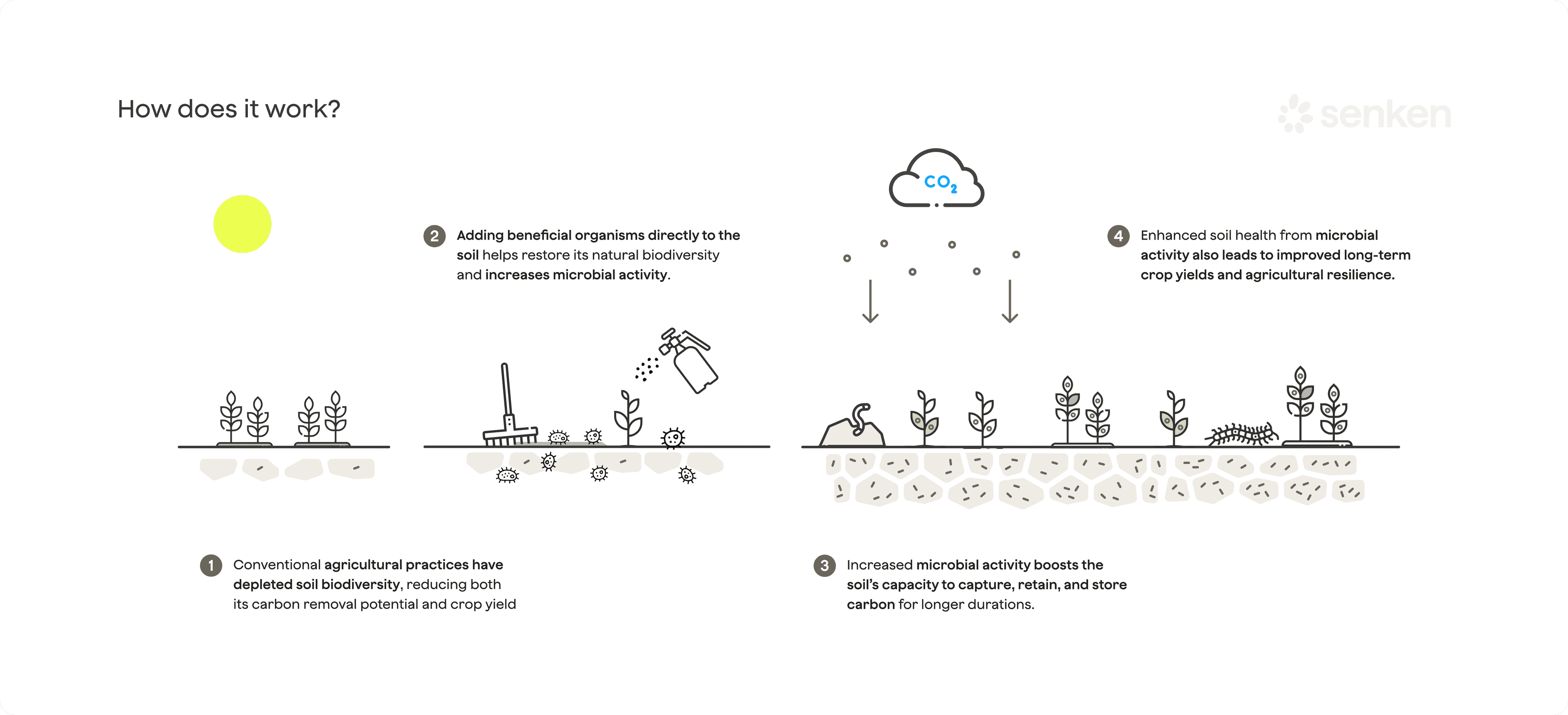
Microbes, primarily bacteria and fungi, create chemical microenvironments around silicate minerals in soil or other substrates. They secrete organic acids and enzymes that lower pH locally and break down mineral structures, releasing calcium (Ca) and magnesium (Mg) ions much faster than would occur through natural weathering alone. This microbial activity effectively acts as a biological catalyst, turning a process that normally takes millennia into one that can happen within years or even months in a managed project setting.
In practical terms, project developers cultivate specific microbial strains selected for their weathering efficiency, then apply them to agricultural fields or suitable land alongside the target minerals. The microbes colonise plant roots and soil particles, continuously driving the weathering reaction as long as conditions (moisture, temperature, substrate availability) remain suitable.
From Silicate Breakdown To Carbonate Minerals
Once the silicate minerals release Ca and Mg ions, those ions dissolve in soil water that has absorbed CO2 from the atmosphere (forming carbonic acid and bicarbonate). The dissolved ions then react with the bicarbonate to precipitate as solid carbonate minerals, primarily calcite (CaCO3) and magnesite (MgCO3). This is the step where atmospheric carbon is chemically bound into a stable, rock-like form.
The key climate benefit is permanence. Carbonate minerals formed through this pathway are thermodynamically stable under surface conditions and will persist for 10,000 years or longer, far exceeding the Oxford Principles' threshold for durable storage. Compared to reforestation and soil carbon (both less than 100 years permanence) or even biochar (less than 1000 years under most conditions), microbial mineralisation offers the kind of geological-scale storage that satisfies both SBTi's "novel removal" requirements and the CFO's question about reversal risk.
Peer-reviewed geochemistry literature supports the stability claim. Studies of natural carbonate deposits show that once formed, these minerals do not spontaneously release CO2 unless subjected to extreme heat or acidic conditions that do not occur in typical soil or construction environments. This evidence base is critical when you need to defend the durability assumption internally or to external auditors under CSRD disclosure rules.
How To Evaluate Microbial Mineralisation Carbon Credits
Core Quality Indicators For Microbial Mineralisation Projects
Start with additionality. A credible microbial mineralisation project must demonstrate that the CO2 removal and mineralisation would not have occurred without the intervention. Look for clear documentation of the baseline scenario (typically near-zero inorganic carbon accumulation in standard agricultural practice) and evidence that the project is not simply claiming credit for natural weathering that was already happening. Conservative accounting here is non-negotiable.
Next, assess permanence. The project should quantify how much CO2 is locked into carbonate minerals versus temporary soil carbon stocks, and provide geochemical or empirical evidence that those carbonates are stable under site-specific conditions. Ask for third-party verification of mineral formation, ideally using direct sampling and analytical techniques such as X-ray diffraction or isotopic analysis, rather than relying solely on models.
Check the CO2 equation and lifecycle accounting. Credible projects will deduct emissions from microbe production, transport, application machinery, and any inputs. Look for net removal efficiency above 80%, and be wary of projects that do not disclose lifecycle boundaries or assume unrealistic system efficiency.
Leakage and reversal risk should be explicitly addressed. For microbial mineralisation, leakage might occur if the intervention changes land use or displaces activity elsewhere, though this is typically lower risk than in forestry projects. Reversal risk is minimal once carbonates form, but projects should have monitoring plans to confirm that mineralisation is proceeding as modelled and that carbon is not being re-released through unforeseen chemical or biological pathways.
MRV, Standards And Independent Verification
Measurement, Reporting, and Verification (MRV) for microbial mineralisation is complex because the process happens in soil, often at small spatial scales. Strong projects will use a combination of soil sampling, geochemical analysis, remote sensing where applicable, and transparent reporting of uncertainty ranges. Look for QR-coded batch tracking, registry integration, and regular third-party audits, not just developer self-reporting.
On the standards side, emerging methodologies under registries such as Puro.earth or the Global Biochar C-Sink Standard (which has begun to include mineralisation pathways) provide a useful benchmark. As of early 2025, there is no single dominant standard for microbial mineralisation, so you should evaluate the methodology documentation directly. Check whether it has been peer-reviewed, whether it requires independent validation (e.g., ISO 14064-3 certification), and whether it has endorsement or recognition from bodies like ICVCM or national regulators. Layer your verification. Do not rely on a single registry label.
Use Senken's 600+ datapoint Sustainability Integrity Index to cross-check project claims against multiple quality dimensions: carbon impact (additionality, permanence, baseline), beyond-carbon co-benefits (soil health, community impact), reporting transparency (MRV robustness), and compliance and reputation (external ratings, public track record). This multi-layer approach is what separates strategic, audit-ready procurement from box-ticking exercises that expose you to future greenwashing accusations.
Where Microbial Mineralisation Fits In Your Carbon Removal Portfolio
Think of your carbon removal portfolio as a spectrum from short-lived, lower-cost options to long-lived, higher-cost, higher-integrity removals. Nature-based solutions like reforestation and soil carbon cluster at the lower end: permanence under 100 years, costs around €25 to €50 per tonne, but often with valuable biodiversity and community co-benefits. Technology-based removals like biochar and enhanced weathering sit in the middle: permanence under 1,000 years, costs from €100 to €500 per tonne, and strong MRV. Microbial mineralisation sits alongside enhanced weathering in that middle-to-high durability band, with a permanence profile of 10,000+ years once carbonates form.
Here's where portfolio design gets practical. SBTi's draft standard suggests that by 2030, 7% of the removals addressing your residual emissions should be novel, long-lived methods (1000+ years), climbing to 17% by 2035 and 32% by 2050.
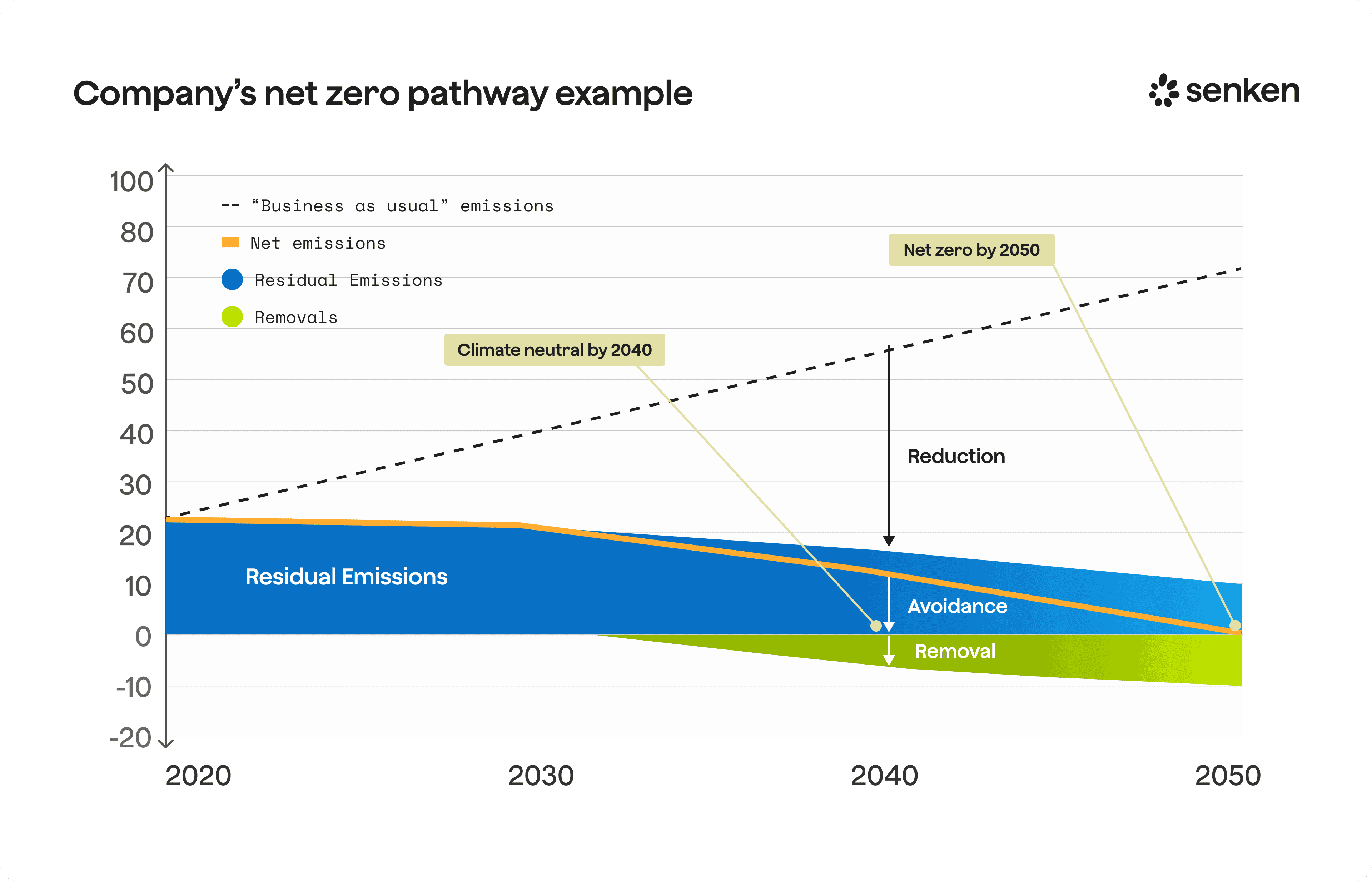
For a DACH industrial company with 50,000 tonnes of hard-to-abate emissions and a 2040 net-zero target, that means you need to start building exposure to methods like microbial mineralisation now, even if supply is limited and prices are higher, because waiting until 2035 will mean competing for scarce, expensive credits in a seller's market.
A pragmatic allocation for 2025 to 2027 might look like this: 70 to 80% of your removal budget in mature, cost-effective options (reforestation, biochar) that deliver co-benefits and meet near-term voluntary claims, 10 to 15% in enhanced weathering or microbial mineralisation pilots to build knowledge and secure early access, and 5 to 10% in DAC or other frontier methods to signal innovation and hedge against future regulatory shifts. As methodologies mature and supply scales, you can rebalance toward a 50:50 mix of conventional and novel removals by 2035, staying ahead of the SBTi curve without over-exposing your budget to experimental tech.
Use tools like Senken's Sustainability Integrity Index to screen projects consistently across all these categories. The framework evaluates permanence, additionality, co-benefits, and compliance in a standardised way, so you can compare a microbial mineralisation project in the US Midwest against an enhanced weathering project in Germany or a biochar project in the Rhineland on an apples-to-apples basis. That comparability is what lets you build a truly diversified, Oxford-aligned portfolio rather than a collection of one-off credit purchases.
Practical Steps To Pilot Microbial Mineralisation In Your Company
Start by updating your internal carbon credit policy to explicitly include durable removals and define eligibility thresholds. Many DACH companies still operate procurement guidelines written for forestry and cookstoves. Add a permanence requirement (e.g., "at least 20% of purchased removals must have permanence >1000 years by 2027"), clarify that novel methods like microbial mineralisation are in scope provided they meet additionality and MRV standards, and set a budget cap for pilots so you can learn without over-committing.
Run a small, well-documented pilot. Identify 500 to 2,000 tonnes of credits from a microbial mineralisation project that has independent verification, transparent MRV, and a credible developer track record. Structure the purchase as a multi-year offtake if possible, so you lock in pricing and build a relationship with the developer, but include review gates so you can adjust or exit if MRV issues emerge or standards shift. Document everything: the due diligence process, the rationale for durability and additionality assumptions, the expected co-benefits, and how the credits will be reported in your sustainability disclosures and GHG inventory.
Align claims and communications with the latest guidance. Under the EU Green Claims Directive and German court rulings, you cannot simply say "climate neutral" without specifying exactly what that means and providing evidence in the immediate context. If you retire microbial mineralisation credits, disclose the methodology, permanence estimate, registry, and verification body in your annual report and on your website. Emphasise that these credits address residual emissions as part of a science-based net-zero strategy, not as a substitute for deep decarbonisation.
After 12 to 18 months, review the pilot. Did the project deliver the promised tonnes? Were MRV reports transparent and timely? Did third-party ratings (e.g., BeZero, Sylvera) or the Senken Sustainability Integrity Index flag any concerns? Did stakeholders (investors, customers, NGOs) respond positively or raise questions? Use those learnings to decide whether to scale microbial mineralisation to 5 to 10% of your removal portfolio in the next procurement cycle or to hold steady while the methodology matures further.
Risks, Limitations And How To Avoid Greenwashing
Be transparent about what is not yet settled. While the underlying geochemical processes of silicate weathering and carbonate formation are well understood, large-scale, field-level MRV for microbial mineralisation is still an active area of research and standards development. Quantifying exactly how much CO2 has been mineralised in situ, distinguishing project-driven mineralisation from natural background rates, and accounting for spatial and temporal variability all require conservative assumptions and robust sampling protocols. If a project claims 100% certainty or does not disclose uncertainty ranges, that is a red flag.
Supply and maturity constraints are real. As of early 2025, only a handful of microbial mineralisation projects have issued credits on recognised registries, and total annual issuance is orders of magnitude smaller than for forestry or biochar. This means availability is limited, prices are relatively high, and you may need to commit early or join a buyer coalition to secure volume. Treat microbial mineralisation as a strategic, long-term portfolio component, not as a near-term, high-volume solution.
Avoid the greenwashing traps. Under CSRD and the Green Claims Directive, you are liable if you make climate claims that rest on low-quality or non-additional offsets. The Max Planck Institute found that 84% of carbon credits in the broader market are high-risk, and Senken's analysis of DAX40 companies shows that 68% of those who bought credits ended up supporting projects with no real climate impact. Microbial mineralisation is not immune to these risks, especially if you buy from developers who cannot provide third-party verification, transparent MRV, or evidence of additionality.
Use a structured quality framework. Senken's 600+ datapoint Sustainability Integrity Index provides a systematic way to evaluate microbial mineralisation projects across five dimensions: basic project details (methodology, registry, third-party review), carbon impact (permanence, additionality, baseline, leakage), beyond-carbon co-benefits (soil health, community impact, governance), reporting process (MRV transparency and frequency), and compliance and reputation (external ratings, public track record, alignment with ICVCM Core Carbon Principles). Only 5% of projects assessed by Senken pass the full quality bar, which underscores why independent, multi-layer due diligence is essential.
Finally, size your exposure to match the maturity and risk profile. A reasonable approach for a large DACH corporate in 2025 might be to allocate 5 to 10% of your carbon removal budget to microbial mineralisation and similar novel methods, reserving the majority for proven solutions while you build expertise and track methodology evolution. As standards solidify, supply scales, and your internal confidence grows, you can increase that share in line with SBTi's long-lived removal trajectory. This cautious but proactive strategy lets you secure early access to high-integrity, durable removals without betting the entire carbon budget on an emerging method.
If you want support navigating microbial mineralisation procurement, evaluating projects, or building an Oxford- and CSRD-aligned carbon removal portfolio, Senken's team can help. We use our Sustainability Integrity Index to screen every project, provide audit-ready documentation, and work with you to design a diversified removal strategy that balances cost, risk, and impact. Get in touch at contact@senken.io to discuss your specific needs.