
Ocean Alkalinity Enhancement
Key Takeaways
- Ocean Alkalinity Enhancement (OAE) stores CO₂ as dissolved bicarbonate for thousands of years, but only ~730 tonnes have been independently verified so far—making it a high-durability, extremely early-stage option for your portfolio rather than a bulk compliance solution.
- For DACH corporates facing CSRD audits and SBTi's tightening removal requirements, the critical question isn't whether OAE chemistry works in theory, but whether specific projects have robust MRV (like Isometric protocols), transparent documentation, and can survive regulatory scrutiny.
- Current OAE credits cost roughly $250–500 per tonne, positioning them as an innovation allocation within an Oxford-aligned strategy—not a replacement for near-term emissions reductions or your primary removal volume.
- Environmental integrity matters as much as carbon accounting: credible OAE projects pair local ocean acidification benefits with rigorous monitoring of ecosystem impacts, trace metals, and water chemistry to avoid greenwashing accusations and reputational damage.
Ocean alkalinity is the ocean's natural capacity to neutralize acids, largely controlled by dissolved carbonate and bicarbonate ions. Ocean Alkalinity Enhancement (OAE)—a form of marine carbon dioxide removal—accelerates this process by adding alkaline minerals or solutions to seawater, allowing the ocean to absorb more atmospheric CO₂ and store it as bicarbonate for millennia. While the chemistry is well understood, the commercial reality is stark: roughly 600,000 tonnes of OAE removals have been contracted, but only about 730 tonnes have been independently verified and issued as credits.
For a DACH-headquartered company with over 1,000 employees, this matters now because SBTi is tightening its stance on durable removals, CSRD auditors are demanding defensible documentation, and the first verified OAE credits and six-figure offtakes have just emerged. You don't need to become an ocean chemist, but you do need a clear view on if, when, and how OAE fits into your carbon credit strategy—and which projects can actually deliver the quality and transparency your compliance team requires.
What Is Ocean Alkalinity Enhancement
Ocean alkalinity is the ocean's natural capacity to neutralize acids. It's primarily controlled by dissolved carbonate and bicarbonate ions in seawater. Think of it as the ocean's chemical buffer that keeps pH stable and allows the sea to absorb CO₂ from the atmosphere.
Ocean Alkalinity Enhancement (OAE) is the deliberate addition of alkaline substances or alkalinity solutions to seawater, or to waters that flow into the sea, to speed up what nature already does slowly. Over geological timescales, rocks weather naturally on land and gradually release alkalinity into rivers and oceans. OAE accelerates this process dramatically by adding alkaline minerals directly to coastal waters, creating electrochemically-generated alkalinity solutions, or treating wastewater and river outfalls with alkaline materials before they discharge to the sea.
The result is that the ocean can absorb and store more atmospheric CO₂, converting it into dissolved bicarbonate ions that remain stable in seawater for thousands of years. This is what sets OAE apart as a marine carbon dioxide removal (mCDR) pathway. It's not about avoiding emissions or temporarily sequestering carbon in biomass that could burn or decay. OAE offers genuinely durable storage measured in millennia, not decades.
That said, OAE is still in a very early commercial phase. As of late 2025, roughly 600,000 tonnes of CO₂ removal have been contracted through OAE-related offtake agreements, but only around 730 tonnes have been independently verified and issued as carbon credits . For context, Planetary delivered 625.6 verified tonnes through Isometric's registry, and CREW Carbon delivered 104.4 tonnes of wastewater alkalinity enhancement credits . So while the chemistry is sound and the first credits are flowing, this is not yet a gigaton-scale solution you can rely on for bulk compliance volume today.
OAE sits within the broader mCDR landscape alongside other ocean interventions like iron fertilization (stimulating phytoplankton blooms), macroalgae or kelp sinking (biological carbon capture), and direct ocean capture (electrochemical extraction of CO₂ from seawater). Each has different durability, MRV complexity, and environmental risk profiles. OAE stands out for its long-term storage and growing acceptance among early corporate buyers, but it requires rigorous project-level due diligence to separate high-integrity projects from speculative claims.
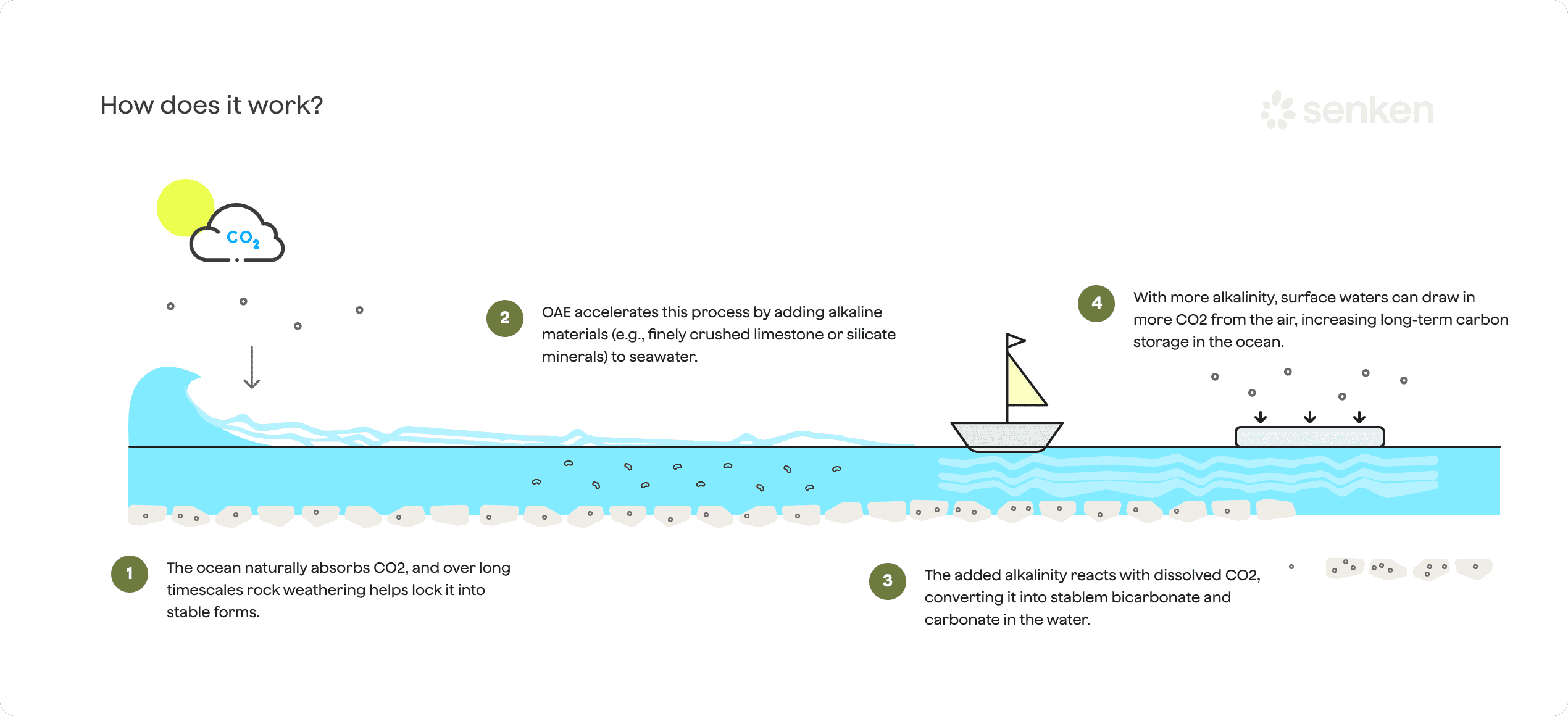
How Ocean Alkalinity Enhancement Removes Carbon from the Atmosphere
The Ocean's Natural Alkalinity and Carbon Cycle
Oceans already act as the planet's largest carbon sink. Atmospheric CO₂ dissolves into surface waters, reacts with water molecules to form carbonic acid, and is then buffered by the ocean's existing alkalinity. This natural process maintains ocean pH and allows continuous CO₂ uptake, but it's limited by the ocean's finite buffering capacity.
On land, rock weathering releases alkalinity slowly over millions of years. Rainwater absorbs CO₂, becomes mildly acidic, and gradually dissolves alkaline minerals in rocks. The resulting dissolved ions wash into rivers and eventually the sea, replenishing ocean alkalinity and enabling further CO₂ absorption. This natural weathering cycle is fundamental to Earth's long-term carbon regulation, but at geological timescales it's far too slow to counteract industrial emissions within our lifetimes.
Accelerating Rock Weathering with Alkalinity Solutions
OAE accelerates this natural process by orders of magnitude. Instead of waiting for rocks to weather slowly on hillsides, we grind alkaline minerals (like olivine or basalt) into fine particles and add them directly to coastal waters or farmland adjacent to waterways. Alternatively, electrochemical systems can split seawater to produce an alkaline stream that's returned to the ocean while managing the acidic byproduct separately.
When alkalinity is added to seawater, it reacts with dissolved CO₂ and carbonic acid, forming bicarbonate (HCO₃⁻) and carbonate (CO₃²⁻) ions. This shifts the ocean's chemistry to allow more atmospheric CO₂ to dissolve into the water to replace what was converted. The process is sometimes called ocean alkalinization in the scientific literature, reflecting the active intervention to increase alkalinity beyond natural levels.
Different alkaline feedstocks behave differently. Silicate minerals like olivine and basalt dissolve relatively slowly but offer high net alkalinity gain per tonne. Calcium carbonate (limestone) dissolves faster but adds less new alkalinity because it also releases some CO₂ during dissolution. Processed materials like quicklime or industrial byproducts (e.g., steel slag) can dissolve very quickly but require energy-intensive production and careful management of trace metals. Electrochemical approaches offer precise control and clear accounting but are currently more expensive and energy-demanding.
Long-Term Carbon Storage as Bicarbonate Ions
Once CO₂ is converted into bicarbonate and carbonate ions in seawater, it stays there. Unlike forestry projects where carbon is stored in trees that can burn, be logged, or die, or soil carbon projects where tillage can release CO₂ back into the atmosphere within decades, OAE stores carbon in dissolved form in a massive, stable reservoir. The storage duration is measured in thousands of years , making OAE one of the most durable carbon removal pathways available.
This durability aligns well with the Oxford Principles for net-zero aligned offsetting, which prioritize long-lived removals over short-term sequestration. As SBTi's draft Net-Zero Standard 2.0 pushes companies toward higher shares of novel, long-duration removals (1,000+ year permanence) for neutralizing residual emissions, OAE becomes strategically relevant. It's not a replacement for aggressive decarbonization, but it's one of the few pathways that can credibly claim millennia-scale storage and avoid the reversal risks that plague nature-based solutions.
The trade-off, of course, is complexity. Measuring carbon stored as dissolved ions in a dynamic, three-dimensional ocean is far harder than counting trees. That's why MRV and independent verification are so central to OAE's credibility, and why you should never accept an OAE credit without understanding exactly how removal was quantified and what uncertainty margins were applied.
Materials and Methods Used in Ocean Alkalinization
Olivine and Basalt
Olivine and basalt are abundant silicate minerals that have become the poster children for mineral-based OAE. When finely ground and added to seawater or spread on coastal land, they dissolve slowly, releasing magnesium, iron, and silicon along with alkalinity. The rate of dissolution depends on particle size, water temperature, pH, and turbulence, which is why grain size, deployment location, and mixing conditions are critical to project design.
Olivine offers high theoretical CO₂ removal per tonne of rock (roughly 1.1 tonnes of CO₂ per tonne of olivine under ideal conditions), but in practice dissolution can be slow. Projects often grind olivine to sand-sized particles and deploy it in high-energy coastal surf zones or mix it into agricultural soils near waterways to speed up the reaction. Basalt behaves similarly but is generally more abundant and cheaper to source, making it a practical choice for large-scale pilots.
UNDO, which runs the largest Enhanced Rock Weathering program in the UK, spreads locally sourced basalt on farmland and achieves life-cycle carbon efficiency above 90%, with removal permanence exceeding 10,000 years . The agricultural co-benefits (nutrient addition, pH correction, potential fertilizer savings) help offset costs and secure farmer participation, but the main climate value is the long-term alkalinity reaching rivers and eventually the ocean. This approach blurs the line between terrestrial enhanced weathering and OAE, and some buyers classify it under both umbrellas depending on how much alkalinity ultimately enters marine waters.
Limestone and Calcium Carbonate
Limestone (calcium carbonate) is cheaper and more widely available than silicate minerals, and it dissolves faster in seawater. However, the net CO₂ benefit is lower because limestone dissolution itself releases CO₂. The overall reaction still increases ocean alkalinity and enables net CO₂ uptake, but the efficiency is roughly half that of silicates per tonne of material.
For this reason, limestone-based OAE is less common in early commercial projects. It may have a role where fast dissolution and low logistics costs matter more than maximizing removal per unit mass, but most developers and buyers currently favor silicate minerals or electrochemical approaches that avoid the CO₂ release issue entirely.
Calcium carbonate does have one niche advantage: it can be sourced from waste streams (e.g., crushed concrete, shells) or industrial byproducts, potentially lowering cost and embodied emissions. Projects exploring this route will need to demonstrate rigorous life-cycle accounting and MRV to ensure net removal claims are credible.
Quicklime, Industrial Byproducts, and Electrochemical Approaches
Quicklime (calcium oxide) and Portlandite (calcium hydroxide) are processed alkaline materials made by heating limestone. They dissolve very quickly in water and deliver high alkalinity per tonne, but their production is energy-intensive and releases CO₂ unless powered by clean energy and equipped with carbon capture. This makes the net climate benefit highly dependent on the production pathway and energy source, adding complexity to MRV and raising the cost per verified tonne.
Industrial byproducts like steel slag or cement kiln dust contain alkaline compounds and are sometimes proposed as low-cost feedstocks for OAE. The appeal is clear: turning waste into climate solutions. The challenge is ensuring these materials don't introduce harmful trace metals (e.g., chromium, nickel) or other contaminants into marine ecosystems. Rigorous environmental testing and transparent disclosure are essential, and regulatory approval can be slow, particularly for open-ocean deployment.
Electrochemical OAE represents a different approach altogether. Companies like Ebb Carbon and Equatic use electrochemical cells to split seawater, producing an alkaline stream (which is returned to the ocean) and an acidic stream (which is managed separately, sometimes neutralized with CO₂ to form stable carbonates). This method offers precise control, avoids mining and grinding, and produces a clean product with minimal trace-metal risk. The trade-offs are higher energy demand and higher current costs. Equatic's electrochemical OAE is selling at around $500 per tonne , compared to roughly $271 per tonne for Planetary's mineral OAE delivered via coastal outfalls .
Deployment modes vary widely. Coastal surf zones and beach applications rely on wave energy to enhance dissolution. River and wastewater outfalls add alkalinity to freshwater streams that discharge into the ocean, a pathway used by CREW Carbon and accepted by some buyers under the OAE umbrella . Open-ocean dispersal from ships offers scale but raises permitting, governance, and monitoring challenges. Each mode has distinct MRV implications: coastal and outfall deployments are easier to monitor but affect smaller areas, while open-ocean approaches are harder to track but potentially more scalable.
Environmental Benefits and Risks of Ocean Alkalinity Enhancement
Countering Ocean Acidification
One of OAE's most compelling co-benefits is its potential to locally counteract ocean acidification. As atmospheric CO₂ dissolves in seawater, it forms carbonic acid and lowers pH, making it harder for calcifying organisms like corals, shellfish, oysters, and some plankton to build shells and skeletons. This is already causing significant ecological stress in many marine ecosystems.
By adding alkalinity, OAE raises pH and increases the concentration of carbonate ions, which are the building blocks these organisms need. In theory, carefully managed OAE could create localized refuges where shell-forming species can thrive even as broader ocean acidification continues. For coastal communities dependent on shellfish aquaculture or coral reef tourism, this could be a tangible, near-term benefit beyond climate mitigation.
That said, the magnitude and spatial extent of this co-benefit depend heavily on deployment scale, location, and mixing dynamics. Small pilot projects won't shift regional ocean chemistry. Large-scale deployments could, but they also carry greater ecological risk and will require far more robust environmental monitoring and governance than we have today.
Potential Risks to Marine Ecosystems
OAE is not risk-free. Adding alkalinity changes seawater chemistry, and we don't yet fully understand how marine ecosystems will respond at scale. Potential risks include:
- Rapid pH changes beyond safe bounds: While raising pH is the goal, localized spikes near discharge points could stress or harm sensitive species. Dosing rates, dilution, and mixing are critical design parameters.
- Trace metals and contaminants: Some alkaline minerals and industrial byproducts contain trace metals like nickel, chromium, or heavy metals that can be toxic to marine life. Feedstock purity and environmental testing are essential.
- Impacts on phytoplankton and food webs: Changes in carbonate chemistry, nutrient availability, or light penetration (from suspended particles) could affect primary productivity and ripple through the food web in unpredictable ways.
- Broader ecosystem responses: We have limited data on how different species, life stages, and habitats will respond to sustained alkalinity addition. Laboratory and mesocosm studies provide clues, but real-world, long-term impacts remain uncertain.
Regulatory bodies and scientific networks treat OAE as an active research topic rather than a fully de-risked solution. That cautious stance should inform your risk assessment as a buyer. OAE is promising, but it's not a drop-in replacement for established removal pathways. Every project needs environmental scrutiny commensurate with its scale and location.
Monitoring Requirements for Ecosystem Safety
Responsible OAE projects pair carbon accounting with rigorous environmental monitoring. Best practice includes:
- Baseline studies to characterize local water chemistry, species composition, and ecosystem health before deployment begins.
- Conservative dose limits and staged rollouts to test responses at small scale before expanding.
- Ongoing monitoring of pH, carbonate saturation, trace metals, dissolved oxygen, nutrient levels, and biological indicators (plankton abundance, species diversity, shellfish health).
- Transparent data sharing with independent scientists, regulators, and the public to build trust and enable adaptive management.
- Independent ecological oversight, ideally by marine biologists with no financial stake in the project.
For corporate buyers, this translates into a clear due-diligence question: does the project have a credible environmental monitoring plan, and is that data independently verified and publicly disclosed? If the developer can't show you monitoring protocols and baseline data, or if environmental safeguards are treated as an afterthought to carbon accounting, that's a red flag.
Greenwashing risk is not just about over-claiming carbon removal. It's also about downplaying or ignoring environmental harm. A DAX-listed company that backs an OAE project later found to have damaged a coastal fishery or coral reef will face reputational and regulatory consequences far worse than the cost of the credits themselves. Senken's Sustainability Integrity Index evaluates projects across biodiversity, water quality, and ecosystem impacts precisely because beyond-carbon risks are central to long-term credibility.
How Much Does Ocean Alkalinity Enhancement Cost
OAE carbon credits today sit in the mid-hundreds of dollars per tonne range, making them one of the more expensive removal options in the market. But understanding why, and where prices might go, is essential for budget planning and internal stakeholder conversations.
Recent large-scale offtakes provide the best price signals. Frontier's purchase of 115,211 tonnes from Planetary's mineral OAE project in Halifax came in at roughly $271 per tonne . CREW Carbon's wastewater alkalinity enhancement credits transacted at around $447 per tonne through Frontier . Equatic's electrochemical OAE is selling at approximately $500 per tonne as it moves from pilot to early commercial scale.
These prices are not outliers or R&D premiums. They reflect the real cost structure of OAE today: mining or sourcing alkaline feedstock, grinding to the right particle size (energy-intensive for fine powders), transporting material to deployment sites, building and operating coastal infrastructure or electrochemical plants, and funding substantial MRV and permitting overhead. Electrochemical routes add the cost of electricity and equipment, while mineral routes add logistics and slower dissolution trade-offs.
It's worth noting that earlier, smaller purchases were sometimes lower. For example, Stripe's 2020 pre-purchase from Vesta's coastal enhanced weathering pilot came in at $75 per tonne , but that was explicitly an R&D support contract, not a reflection of commercial cost at scale. Supplier roadmaps often cite aspirational targets below $100 per tonne by the late 2020s, but those assume technology learning curves, economies of scale, and infrastructure buildout that haven't materialized yet. For procurement planning in 2025–2027, assume mid-hundreds of dollars per tonne.
How does that compare to other durable removals? OAE is broadly in line with other novel, long-duration pathways. Biochar typically costs $100–250 per tonne, enhanced rock weathering on land $180–500 per tonne, and Direct Air Capture with geological storage can range from $400 to over $1,000 per tonne depending on technology and scale. Nature-based solutions like reforestation or soil carbon are cheaper ($25–50 per tonne) but offer far shorter permanence and higher reversal risk, making them unsuitable for long-term neutralization under frameworks like SBTi Net-Zero 2.0.
From a CFO's perspective, OAE's cost can be justified as part of a strategic, long-term durability allocation. You're not buying OAE to offset bulk Scope 3 emissions today. You're buying a small volume to secure learning, test MRV, build internal capability, and lock in potential price advantages before regulatory mandates drive demand and prices higher. If SBTi's draft removal factors come into force and durable removals become mandatory for net-zero claims, companies that waited will compete for limited supply at even higher prices. Early, disciplined exposure to OAE and similar pathways is about managing future risk, not just ticking a compliance box.
Measuring and Verifying Carbon Removal from Ocean Alkalinity Enhancement
Tracking Dissolved Inorganic Carbon Changes
Measuring OAE's climate impact is fundamentally different from counting trees or weighing biochar. The carbon removed is dissolved in seawater as bicarbonate and carbonate ions, invisible to the naked eye and constantly mixing with the surrounding ocean. The MRV challenge is to detect the relatively small change in dissolved inorganic carbon (DIC) and alkalinity caused by the project against the background variability of a dynamic ocean.
In practice, this means deploying sensors and taking water samples upstream and downstream of the alkalinity addition point, measuring parameters like DIC, total alkalinity, pH, salinity, and temperature. Scientists then use these measurements, combined with validated ocean chemistry models and mixing equations, to estimate how much additional CO₂ was absorbed from the atmosphere as a result of the alkalinity increase.
This approach is scientifically sound but requires careful experimental design. Sample size, frequency, sensor calibration, and quality control all matter. Projects also need to account for natural variability (tides, seasonal cycles, weather events) and ensure their monitoring captures the spatial and temporal scales over which alkalinity disperses and reacts.
Attribution and Baseline Challenges
The ocean is not a laboratory beaker. Currents, eddies, upwelling, and biological activity create a constantly shifting baseline, and the "signal" from an OAE project can be small relative to this "noise," especially for pilots. This makes attribution (proving the observed change was caused by the project, not natural variability or other factors) one of the toughest MRV problems in marine CDR.
To address this, OAE projects typically rely on:
- Control sites (areas with similar conditions but no alkalinity addition) to compare against treatment areas.
- Before-and-after comparisons with robust baseline monitoring to establish what's normal for that location.
- Mass-balance modeling that tracks the alkalinity added, estimates how much dispersed and reacted, and calculates the resulting CO₂ uptake based on well-established ocean chemistry equations.
Even with these tools, uncertainty is inherent. Projects report uncertainty ranges (e.g., ±20% or ±30% at one or two standard deviations), and credits are typically issued conservatively, discounting for this uncertainty . For corporate buyers, this is not an academic detail. It directly affects how many verified tonnes you receive for a given amount of alkalinity deployed, and how defensible your removal claim will be under audit.
Emerging MRV Standards and Protocols
The good news is that MRV for OAE is no longer purely theoretical. Isometric published the first dedicated OAE protocol (Ocean Alkalinity Enhancement from Coastal Outfalls) in 2024, and used it to verify the world's first OAE credits from Planetary (625.6 tonnes) and the first wastewater alkalinity enhancement credits from CREW (104.4 tonnes) . These protocols combine field measurements with modeling, apply conservative uncertainty discounts, and require transparent data disclosure.
Other registries are catching up. Puro.earth has approved several marine CDR methodologies and updated its Enhanced Rock Weathering standard in 2025, though it does not yet have a dedicated OAE methodology for all deployment types. Verra launched an Ocean Carbon Working Group in 2023, but its "Sectoral scope 17 – Ocean Carbon" remains under development, and OAE methodologies are still in the pipeline.
Frontier, the advanced market commitment backed by Stripe, Google, Shopify, and others, has played an outsized role in shaping early OAE market norms. Frontier's offtake agreements require transparent MRV, independent verification, and public data sharing, setting a high bar that other buyers are starting to adopt. If a project can meet Frontier's standards and get credits verified through a registry like Isometric, that's a strong positive signal.
For sustainability leaders, the key questions to ask are:
- Which MRV methodology is the project using, and who developed it?
- What uncertainty range is applied, and how are credits discounted?
- Is verification done by an independent third party (not just the developer)?
- Will raw MRV data and verification reports be available for CSRD and audit documentation?
Don't accept generic assurances. Ask for the protocol name, the verifier's identity, and sample verification reports. If the developer is vague or defensive, walk away. Weak MRV is the fastest route to greenwashing accusations.
Current Barriers to Scaling Ocean Alkalinity Enhancement
Scientific and Technical Uncertainties
Despite promising early results, OAE still faces significant scientific unknowns. We don't have decades of data on how large-scale alkalinity addition affects marine ecosystems over time. Laboratory and mesocosm studies provide insights, but real-world complexity (food webs, seasonal cycles, species interactions) is hard to replicate in controlled settings.
Key uncertainties include:
- Ecosystem-scale responses: How will plankton communities, fish populations, and benthic organisms respond to sustained alkalinity addition? Will there be tipping points or cumulative impacts that aren't visible in short pilots?
- Long-term fate of added minerals: What happens to the solid particles and trace elements that don't dissolve immediately? Do they accumulate on the seafloor, smother habitat, or get transported elsewhere?
- Extrapolation from pilots to gigatonnes: Can the positive results from small, well-monitored coastal projects scale to the gigatonne-per-year deployments needed to make a meaningful climate impact, or will new problems emerge at scale?
For corporate buyers, this translates into technology risk. OAE is not a mature, plug-and-play solution. It's an innovation play. You should budget for the possibility that some early projects don't deliver expected volumes, that MRV methodologies evolve and require retroactive adjustments, or that regulatory constraints slow deployment. Diversification across multiple durable removal types (biochar, enhanced weathering, DAC, OAE) is the only sensible risk-mitigation strategy.
Regulatory and Governance Gaps
International law on ocean interventions is fragmented. The London Protocol regulates ocean dumping and has been interpreted by some to restrict large-scale OAE, though recent amendments and clarifications suggest pathways for responsible deployment. National permitting regimes for coastal and offshore OAE are nascent at best. In some jurisdictions, existing environmental laws were written with industrial pollution in mind and don't clearly cover deliberate alkalinity addition for climate benefit.
Social license is equally uncertain. Coastal communities, fishing industries, conservation groups, and Indigenous peoples have a legitimate stake in ocean health. Large-scale OAE without transparent consultation and benefit-sharing risks opposition and reputational damage. Projects that treat stakeholder engagement as a checkbox will struggle to scale.
For DACH-headquartered companies, this governance complexity is both a risk and a due-diligence requirement. If you're buying OAE credits from a project in Southeast Asia or the Pacific, do you know whether it has local regulatory approval, community consent, and transparent environmental oversight? Can you document this for CSRD and board scrutiny? Or are you relying on a developer's assurances with no independent verification?
Senken's Sustainability Integrity Index assesses governance, stakeholder engagement, and compliance precisely because these "soft" factors are often the difference between a high-integrity project and a reputational liability waiting to happen.
Infrastructure and Logistics Constraints
Scaling OAE to meaningful climate impact would require mining, grinding, and moving millions of tonnes of rock per year, or building dozens of large electrochemical plants near suitable coastlines. Neither is trivial.
Mining and grinding: Olivine, basalt, and limestone are abundant, but extracting and processing them at scale has environmental footprints (land disturbance, diesel use, dust) and competes with other industrial uses. Transport emissions can eat into net climate benefit, especially for long-distance shipping. Projects need to demonstrate that life-cycle emissions (mining, processing, transport, deployment) are far smaller than the CO₂ removed, typically aiming for carbon efficiency above 90%.
Electrochemical infrastructure: Building and operating electrochemical OAE plants requires capital, clean electricity, and access to seawater. Coastal real estate is limited and contested. Power requirements for large-scale deployment could compete with grid decarbonization or other climate priorities, particularly if the electricity is not 100% renewable.
Deployment logistics: Whether spreading minerals on coastlines, dosing outfalls, or dispersing alkalinity from ships, deployment at scale means coordinating fleets of equipment, managing seasonal weather windows, and integrating with existing coastal activities (shipping, fishing, recreation). These are solvable problems, but they take time and investment.
The upshot for corporate buyers: OAE has contracted roughly 600,000 tonnes of CO₂ removal across all deals to date, with only around 730 tonnes independently verified and issued . The gap between contracted and delivered is a measure of how early-stage this pathway is. For the 2020s, OAE will remain a small, strategic allocation in your portfolio, not a bulk compliance solution. Plan accordingly, and don't over-commit to any single technology or developer.
Ocean Alkalinity Enhancement Compared to Other Marine Carbon Removal Methods
Ocean Iron Fertilization
Ocean iron fertilization involves adding iron (a limiting nutrient in some ocean regions) to stimulate phytoplankton blooms, which absorb CO₂ during photosynthesis. When the phytoplankton die, some fraction of the biomass sinks to the deep ocean, sequestering carbon.
Permanence is uncertain. Much of the carbon is re-released by bacteria and zooplankton in the water column, and only a small fraction reaches long-term storage on the seafloor. Estimates vary widely, making MRV challenging.
Environmental risk is high. Large-scale phytoplankton blooms can deplete oxygen, alter nutrient cycles, shift species composition, and create ecological disruption. Governance concerns are severe; the London Protocol and Convention on Biological Diversity have both raised red flags, and no major commercial buyers have backed iron fertilization at scale.
Market acceptance is low. Despite decades of research, iron fertilization has not gained traction in the voluntary carbon market due to permanence uncertainty, environmental concerns, and governance challenges. For corporate buyers seeking defensible, CSRD-ready removals, iron fertilization is a non-starter today.
Macroalgae Cultivation and Sinking
Macroalgae (kelp, seaweed) grow fast and absorb CO₂ during photosynthesis. Some projects propose cultivating macroalgae offshore and sinking it into the deep ocean to sequester carbon long-term, or using it for biomass energy with carbon capture.
Permanence is again the key question. If sunk biomass decomposes in the deep ocean and releases CO₂ that later upwells, storage duration is limited. MRV requires tracking what fraction of biomass reaches deep water, stays there, and is effectively removed from the carbon cycle. This is technically difficult and still under development.
Environmental impact is mixed. Macroalgae farms can provide habitat for marine species and improve local water quality, but large-scale monocultures and sinking could alter nutrient cycles and seabed ecosystems. Governance and permitting are evolving.
Cost is potentially lower than OAE, but verified tonnage is scarce. A few early pilots exist, but market maturity is similar to OAE: small volumes, evolving MRV, and high uncertainty. For buyers, macroalgae is another innovation allocation, not a bulk solution.
Direct Ocean Capture
Direct ocean capture (DOC) uses electrochemical or chemical processes to extract dissolved CO₂ directly from seawater, then either stores the CO₂ geologically or converts it into stable mineral carbonates. It's conceptually similar to direct air capture (DAC) but operates on seawater instead of air.
Permanence can be very high if CO₂ is geologically stored or mineralized, offering millennia-scale durability similar to OAE. MRV is straightforward because CO₂ is captured as a concentrated stream, making measurement and verification simpler than tracking dissolved inorganic carbon changes in the ocean.
Environmental risk is lower than OAE or iron fertilization because the intervention is contained (a facility processing seawater) rather than dispersed across the ocean. However, there are still questions about brine discharge, energy use, and chemical inputs.
Cost is currently high, often $500–1,000+ per tonne, similar to DAC. DOC is at an even earlier stage than OAE commercially, with only small pilots operational. It's a promising long-term pathway but not a near-term procurement option for most companies.
Comparison summary:
| Method | Permanence | MRV Difficulty | Environmental Risk | Cost (2025) | Market Maturity |
|---|---|---|---|---|---|
| OAE | 1,000+ years | Moderate-High | Moderate | $250–500/t | Early commercial |
| Iron Fertilization | Uncertain | High | High | N/A | Not market-ready |
| Macroalgae Sinking | Uncertain | High | Moderate | $100–300/t (est.) | Pilot stage |
| Direct Ocean Capture | 1,000+ years | Low-Moderate | Low | $500–1,000+/t | Very early stage |
OAE sits in the middle: durable, with emerging MRV, moderate environmental risk if done responsibly, and pricing that reflects its novelty. It's one tool in a diversified marine CDR toolkit, not a silver bullet. Smart buyers will allocate small volumes to OAE alongside other durable removals and monitor how the science, regulation, and market evolve over the next few years.
How to Evaluate Ocean Alkalinity Enhancement Carbon Credits
Developer Credibility and Scientific Backing
Start with the basics: who is developing the project, and do they have the scientific and operational expertise to deliver credible carbon removal? Look for:
- Scientific advisory board: Does the project have independent marine scientists, oceanographers, or carbon cycle experts providing oversight? Are these advisors publishing peer-reviewed research, or are they just names on a website?
- Track record: Has the developer successfully deployed and verified previous projects, or is this their first attempt? First-of-a-kind projects carry higher risk but can be valuable learning opportunities if approached cautiously.
- Transparency: Is project-level data (deployment volumes, water chemistry measurements, MRV reports) publicly disclosed, or does the developer hide behind confidentiality? Trusted buyers like Frontier require transparency; you should too.
- Validation by reputable buyers: Has the project secured offtakes from corporate buyers known for rigorous due diligence (e.g., Microsoft, Stripe, Google, Shopify, airlines)? This is not a guarantee of quality, but it's a positive signal.
Red flags include developers who over-promise (e.g., "we can remove gigatonnes next year"), downplay environmental risks, or are vague about MRV methodology. If a project sounds too good to be true, it probably is.
MRV Methodology and Third-Party Verification
This is the single most important evaluation criterion. Without robust MRV, an OAE credit is just a marketing claim, not a defensible carbon removal.
Ask these questions:
- Which MRV methodology is used? Is it a recognized registry protocol (e.g., Isometric's OAE or Wastewater Alkalinity Enhancement), or a bespoke developer methodology? If bespoke, who peer-reviewed it, and is it publicly available?
- Who is the independent verifier? Is verification done by a third-party auditor with marine science expertise, or by the developer's own team? Registry-issued credits (Isometric, Puro.earth, Verra) typically require independent verification; direct purchases from developers may not.
- What uncertainty range is applied, and how? Does the project quantify uncertainty (e.g., ±20% at 1 standard deviation) and apply a conservative discount factor? Or does it claim exact removal numbers with no margin of error?
- What monitoring commitments exist? Is the project continuously monitoring water chemistry, or just taking a few samples at project start? Are monitoring protocols disclosed and auditable?
- What environmental safeguards are in place? Does the MRV protocol include biological and ecosystem monitoring, or only carbon accounting?
Demand documentation. A credible OAE project should provide you with MRV protocol summaries, verification reports, and evidence of registry acceptance. If the developer won't share these materials under NDA, walk away. Weak MRV is the fastest path to greenwashing accusations, and those accusations will land on your company's doorstep, not the developer's.
Additionality and Permanence Documentation
Additionality asks: would this carbon removal have happened without credit revenue? For OAE, the answer is usually yes (projects are financially dependent on carbon credit sales), but you should still confirm. If a project is funded by government grants, philanthropic donations, or R&D budgets, and carbon credits are sold on top, there may be double-counting risk. Ensure contracts specify that credits are exclusive and not claimed by multiple parties.
Permanence for OAE is strong on paper (millennia-scale storage as bicarbonate), but the devil is in the details. Ask:
- How is long-term storage verified? (Ocean chemistry models, not just assumptions.)
- Are there any scenarios where stored carbon could be re-released? (Unlikely for OAE, but understanding the assumptions matters.)
- Does the project have a buffer pool or insurance to cover unexpected reversals or MRV adjustments?
For SBTi-aligned net-zero planning, OAE's long permanence makes it eligible as a novel, durable removal for residual emissions neutralization. Document this clearly, because your auditors will ask.
Finally, leverage independent, multi-dimensional assessments. Senken's Sustainability Integrity Index evaluates OAE projects across 600+ data points covering basic project details, carbon impact, beyond-carbon co-benefits, MRV process, and compliance/reputation. Rather than relying on registry labels alone (which vary in rigor), a systematic SII assessment helps you filter out the bottom 95% of projects and focus only on the top tier. That's how you build a defensible, CSRD-ready OAE allocation without becoming a marine CDR expert yourself.
Integrating Ocean Alkalinity Enhancement into Your Carbon Portfolio
OAE is not a replacement for decarbonization, and it's not a bulk volume solution for Scope 3 offsetting today. It's a strategic, long-term durability play that fits within a carefully structured, Oxford-aligned carbon credit portfolio.
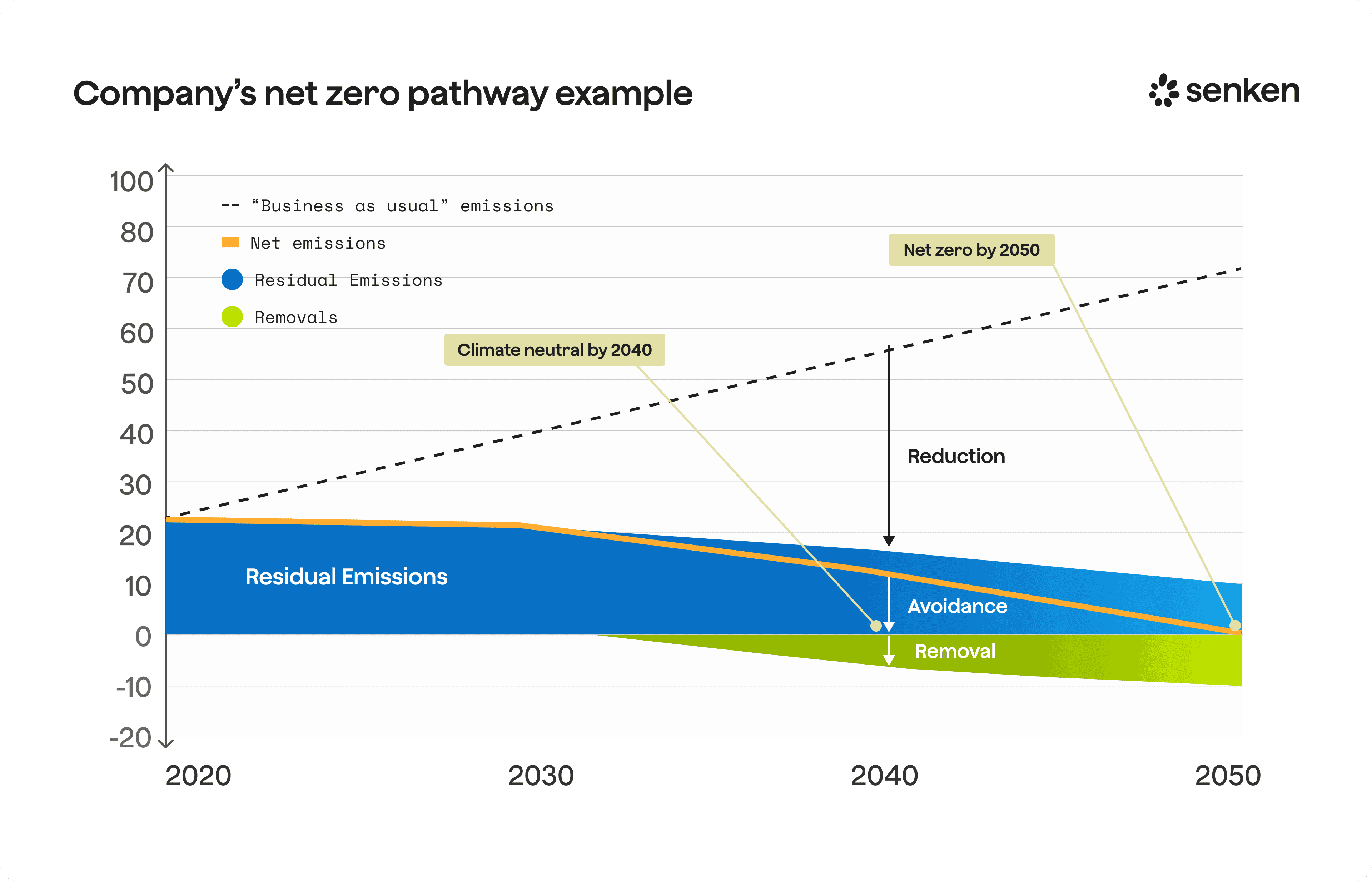
1. Reconnect to the Oxford Principles and SBTi Net-Zero 2.0
The Oxford Principles prioritize increasing the share of carbon removals (versus avoidance) and shifting toward long-duration storage over time. SBTi's draft Net-Zero Standard 2.0 will require companies to neutralize residual emissions with removals, and it sets explicit targets for the share of those removals that must be "novel" (1,000+ year permanence). OAE, with its millennia-scale bicarbonate storage, squarely fits the novel category.
By 2030, SBTi expects companies to address at least 7% of residual emissions with novel removals; by 2050, that rises to 32%. If your company has set SBTi-aligned net-zero targets, you will need durable removals like OAE, enhanced weathering, biochar, or DAC eventually. Starting small now lets you learn, test MRV, build internal capability, and avoid the rush when mandates kick in.
2. Recommend a phased approach
Don't bet your entire removal budget on OAE today. Instead:
- 2025–2027 (Pilot phase): Allocate 5–10% of your removal budget to OAE, structured as a learning investment. Purchase small volumes (hundreds to low thousands of tonnes) from high-integrity projects with transparent MRV (e.g., projects verified by Isometric or backed by Frontier buyers). Treat this as innovation spend or beyond-value-chain mitigation, not core compliance volume.
- 2028–2030 (Scale-up phase): As MRV standards mature, verified volumes increase, and costs potentially decline, expand OAE allocation to 10–20% of removals. Pair OAE with other durable pathways (biochar, enhanced weathering) to diversify technology and geography risk.
- Post-2030 (Portfolio balancing): Use OAE as one of several long-duration removal options to meet SBTi's rising novel-removal fractions. Continue to monitor environmental performance, governance, and market pricing, and adjust allocations based on performance and regulatory guidance.
3. Set internal governance thresholds
Define clear internal policies on what makes an OAE credit acceptable for your portfolio:
- Minimum MRV standard (e.g., registry-verified via Isometric or equivalent)
- Maximum acceptable MRV uncertainty (e.g., ±30%)
- Environmental safeguards required (baseline studies, ongoing biological monitoring, public data disclosure)
- Governance and community consent expectations
- Exclusions (e.g., no projects with unresolved controversy, no feedstocks with high trace-metal risk)
These thresholds should be documented and reviewed annually as standards evolve. They give procurement teams and partners clear guardrails and help you explain decisions to auditors and stakeholders.
4. Manage stakeholder communication
CFOs, risk teams, and boards will ask why you're spending $250–500/t on OAE when cheaper credits exist. Your narrative should be:
"We are building a long-term, SBTi-aligned carbon strategy. Regulations will soon require a share of our residual emission neutralization to come from durable, 1,000+ year removals. OAE is one of the few pathways that offers this durability today, and early pilots help us secure learning and potential cost advantages before mandatory procurement drives prices higher. We are allocating a small, disciplined portion of our budget to OAE, diversified across multiple projects and technologies, with strict quality filters to manage greenwashing and environmental risk. This is about strategic readiness, not speculation."
Provide evidence packs: MRV summaries, registry documentation, SII scorecards, and case examples from peer companies. Make it easy for internal stakeholders to say yes.
5. Work with a procurement partner like Senken
Evaluating OAE projects at the level of rigor described in this article is a full-time job. Most sustainability teams don't have the bandwidth or expertise to review MRV protocols, assess marine ecology risks, and negotiate multi-year offtakes with early-stage developers.
Senken's role is to handle that complexity for you. We apply our Sustainability Integrity Index to filter OAE projects, shortlist only those that pass strict carbon impact, beyond-carbon, MRV, and compliance criteria, and structure portfolios that balance OAE with other durable removals in an Oxford-aligned mix. We negotiate multi-year offtake agreements to lock in pricing and supply, and we deliver CSRD-ready evidence packs so your audit and reporting processes are straightforward.
Our clients don't need to become ocean chemists. They need a trusted partner who can translate scientific complexity into defensible, strategic procurement decisions. That's what we do.
6. Link back to the broader business case
Early exposure to OAE and other durable removals isn't just about compliance. It's about:
- Cost certainty: Locking in $250–300/t today may look expensive now, but if prices double by 2030 (as projected for high-quality removals overall), you've saved significantly.
- Supply security: The companies that secure multi-year offtakes now will have access when others are scrambling.
- Internal learning: Piloting OAE builds organizational capability, tests reporting systems, and creates case studies you can use to educate stakeholders and refine your strategy.
- Brand differentiation: Leading companies that transparently pilot novel removals build credibility and trust, positioning themselves ahead of the compliance wave.
OAE is not for everyone, and it's not for every use case. But for a DACH-headquartered company with >1,000 employees, SBTi commitments, and a long-term net-zero roadmap, a small, well-governed OAE allocation makes strategic and financial sense. The key is to act now, with eyes wide open to both the opportunity and the risk, and with a rigorous partner to guide the journey.