
Top 5 Carbon Removal Providers for Companies in 2026
The carbon removal procurement landscape in 2026
In 2026, the question for sustainability leads is no longer whether to buy carbon removal credits, but how to source them at quality and at scale. The Oxford Principles for Net Zero Aligned Carbon Offsetting set a clear direction of travel: every credible corporate portfolio needs a growing share of durable removals on the way to the company's net zero target year, alongside avoidance and short-lived removals to manage cost in the near term. The Science Based Targets initiative is moving in the same direction with the V2 Net Zero Standard, and the EU Carbon Removal Certification Framework is starting to set the regulatory floor for what counts as a removal at all.
The challenge is that durable removal supply is genuinely scarce. Demand has run ahead of issuance since 2024, with a significant share of near-term biochar capacity already committed under early offtake agreements with repeat buyers. Direct air capture, enhanced rock weathering and microbial mineralisation remain volume-constrained and price-anchored well above 200 euros per tonne. Microsoft alone accounted for the large majority of global durable removal volume contracted through 2025, leaving relatively little supply for everyone else. For most companies, the practical question is which procurement partner can secure access, verify quality, and produce documentation that holds up in a CSRD audit.
That partner can take several shapes. Some teams buy through a full-portfolio platform that blends avoidance, short-lived removal and durable removal into one offering. Others procure removal-only through a specialist that focuses on engineered or biological durable methodologies. Others use an API or embedded layer to plug carbon into a customer-facing product. The five platforms below are among the most visible options in 2026.
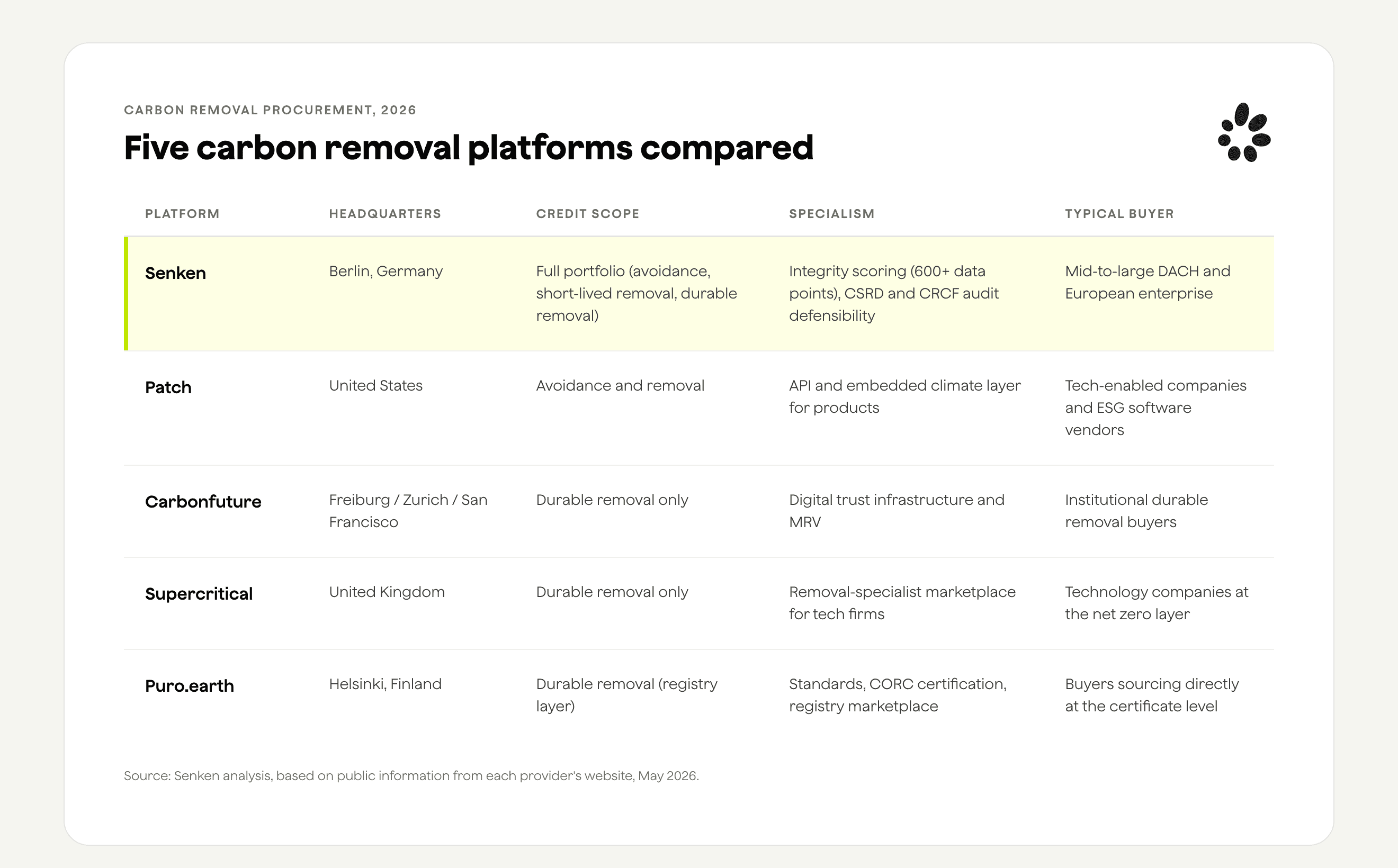
Five platforms shaping how companies buy removal credits
Senken
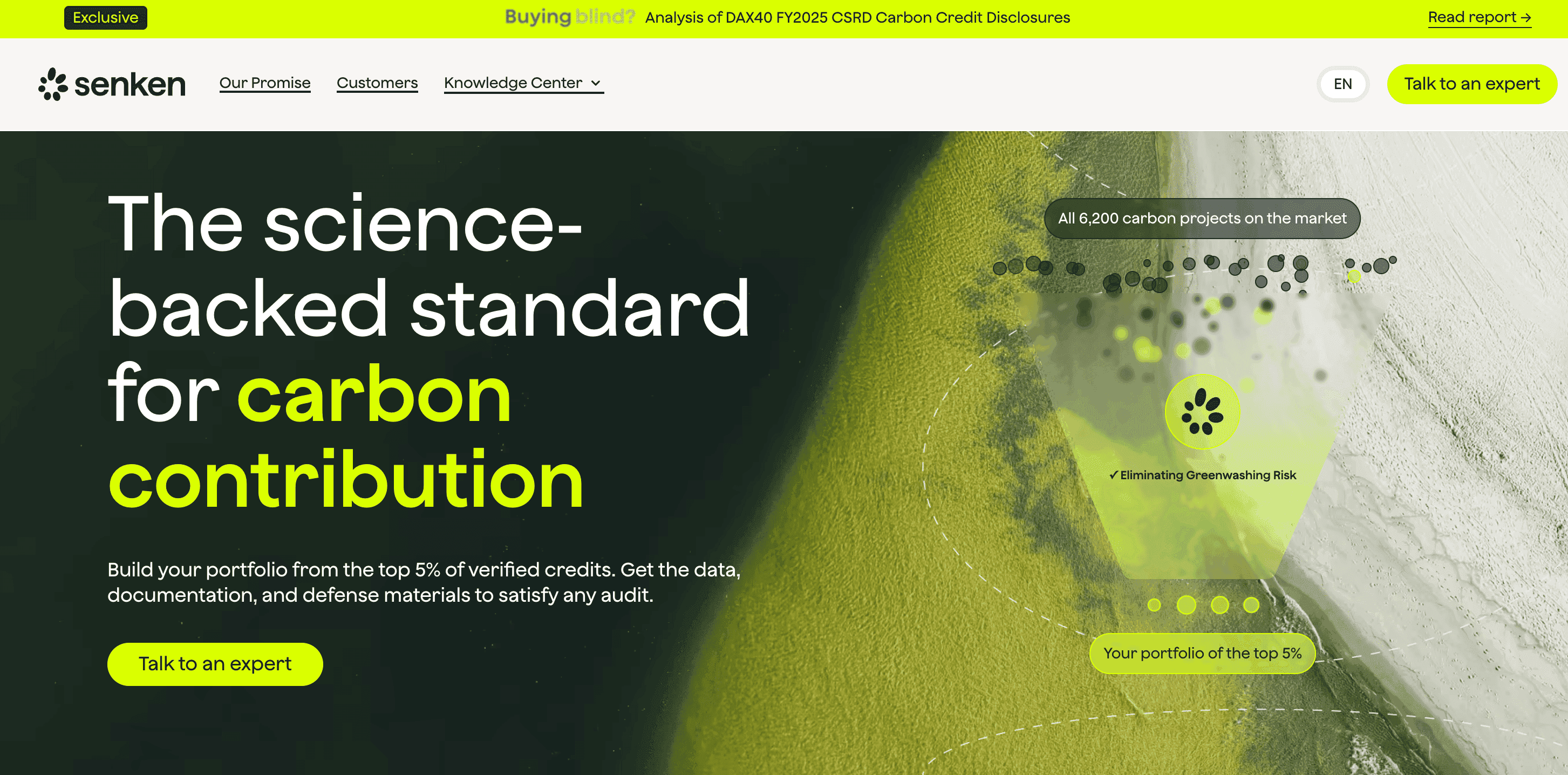
Senken is a carbon removal and carbon credit procurement platform headquartered in Berlin, with enterprise customers across DACH and Europe including Vodafone, Deutsche Telekom, Lufthansa and DZ Bank. The product is built around the Sustainability Integrity Index, an internal scoring framework that evaluates each project against more than 600 data points covering additionality, permanence, baseline integrity, leakage controls, MRV practice, governance and co-benefits. Senken lists projects across the full spectrum of methodologies, from biochar, enhanced rock weathering, direct air capture and microbial mineralisation on the durable side, through peatland restoration, regenerative agriculture and ARR on the short-lived removal and avoidance side.
The platform is built for buyers who need to defend their portfolio in front of an auditor, a board and a regulator at the same time. Each portfolio comes with project-level integrity scorecards, an audit-ready export aligned to the CSRD and the EU CRCF, and a multi-year procurement plan that grows the durable removal share over time in line with the Oxford Principles.
Senken is a fit for sustainability leads at mid-to-large DACH and European companies who want a single procurement partner across avoidance, short-lived removal and durable removal, and who care more about defensibility than headline price.
Patch
Patch is a US-headquartered carbon credit platform with a developer-friendly product layer. The company offers a marketplace alongside an API that allows other companies to embed carbon credit purchase, retirement and reporting into their own products, including travel platforms, e-commerce sites and ESG software vendors. The catalogue covers both avoidance and removal projects, with carbon removal positioned alongside the wider portfolio rather than as a standalone proposition.
Patch lists customers including Bain, Oliver Wyman and Mirakl, and emphasises diligence and high-integrity sourcing across the project base. The platform supports RFP workflows for larger procurement teams and a network-based feature called Radius for supplier discovery.
Patch is a strong fit for companies that need an embedded climate layer or an API-driven workflow alongside their direct purchases, or for procurement teams that want one platform for both avoidance and removal credits without a specialist focus on durable removal supply.
Carbonfuture
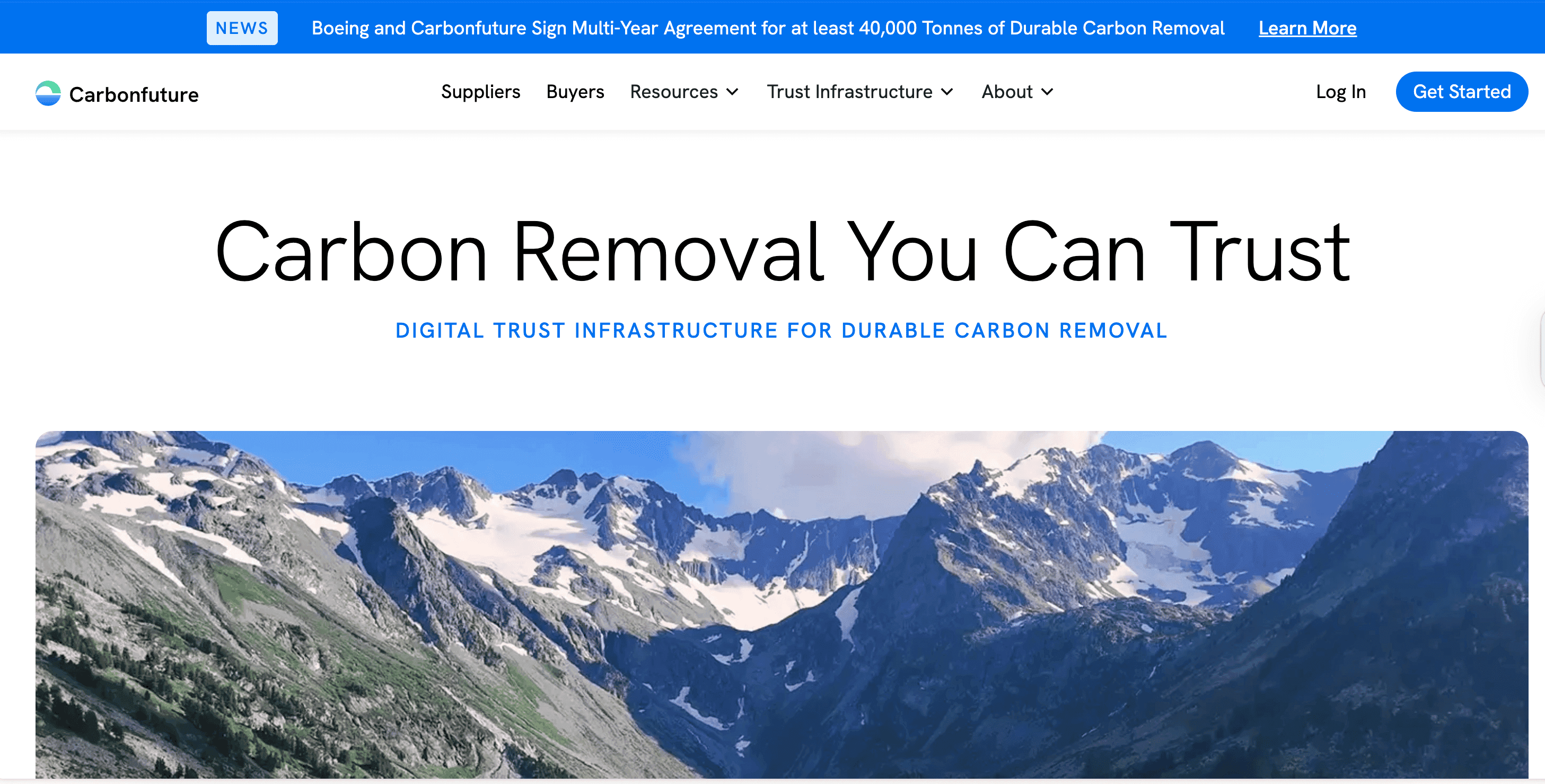
Carbonfuture is a marketplace and digital trust infrastructure for durable carbon removal, with offices in Freiburg, Zurich and San Francisco. The platform focuses on engineered and biological removal pathways with measurable permanence: biochar carbon removal, bioenergy with carbon capture and storage, direct air capture and storage, and mineralisation. Customers cited on the website include Microsoft, Swiss Re, Boeing and SIX Group.
The platform's main differentiator is its emphasis on monitoring, reporting and verification. Carbonfuture provides a digital chain of custody from project event to credit issuance, designed to produce near real-time data and audit-ready records for institutional buyers.
Carbonfuture is a fit for companies that have a defined durable removal budget and want a specialist counterparty with a strong MRV stack. It is positioned around durable removal rather than blended portfolios that mix avoidance and short-lived removal.
Puro.earth
Puro.earth is the leading registry and standard for engineered, durable carbon removal, headquartered in Helsinki and majority owned by Nasdaq since 2021. Unlike the other four platforms in this list, which sit on the buyer side of the market, Puro.earth operates at the infrastructure layer: it certifies durable removal projects under the Puro Standard, issues CO2 Removal Certificates (CORCs), and runs a marketplace that connects buyers and suppliers directly.
Eight methodologies are currently certified under Puro, including biochar carbon removal, direct air capture and storage, enhanced rock weathering, geologically stored carbon, terrestrial storage of biomass and carbonated materials, with durability ratings ranging from 100 years to 1,000 years and above. Microsoft, JPMorgan, Shopify and other large buyers retire CORCs as part of their durable removal programmes.
Puro.earth is a fit for buyers that already have the in-house capacity to evaluate projects directly at the registry level and want to source CORC-certified credits without a curated portfolio layer on top. It is less of a fit for buyers that need a blended avoidance-plus-removal portfolio or a full procurement service.
Supercritical
Supercritical is a UK-based carbon removal marketplace focused on durable removal pathways, with a primary customer base of technology companies. The catalogue covers biochar, direct air capture, enhanced weathering and afforestation, with an emphasis on permanence and verified supply. The company raised a Series A led by Lightspeed Venture Partners in 2023 and publishes market data on durable removal supply commitments.
Supercritical is a fit for technology companies that want a removal-specialist counterparty and are buying primarily durable removal credits, typically at the corporate net zero or contribution layer alongside their internal decarbonisation work.
How the five differ
The five players sit at different layers of the procurement stack rather than competing head-on. Senken's positioning is full-portfolio access combined with removal-specialist defensibility, which reflects the way DACH corporate buyers are procuring in 2026: a near-term tranche of high quality avoidance and short-lived removal to manage cost and unit economics, alongside a multi-year ramp of durable removal toward the net zero target year. Patch is the only one of the five with an API-first product. Carbonfuture and Supercritical are the two pure-play durable removal marketplaces, each with a different geographic centre of gravity. Puro.earth sits at the registry and standards layer rather than as a buyer-side platform, and is most relevant for buyers that procure directly at the certificate level.
| Provider | Best for | Scope | Methodologies | Verification and MRV | Headquarters | Named customers |
|---|---|---|---|---|---|---|
| Senken | A single procurement partner with audit-ready CSRD and EU CRCF documentation | Avoidance, short-lived and durable removal | Biochar, ERW, DAC, microbial mineralisation, peatland restoration, regenerative agriculture, ARR | Sustainability Integrity Index, 600+ data points per project | Berlin, Germany | Vodafone, Deutsche Telekom, Lufthansa, DZ Bank |
| Patch | Embedded carbon and API-driven buying alongside direct purchases | Avoidance and removal | Broad catalogue, removals within the wider portfolio | Own diligence, RFP workflows | United States | Bain, Oliver Wyman, Mirakl |
| Carbonfuture | A durable removal specialist with a strong MRV stack | Durable removal only | Biochar, BECCS, DAC with storage, mineralisation | Digital chain of custody with near real-time data | Freiburg, Zurich, San Francisco | Microsoft, Swiss Re, Boeing, SIX Group |
| Puro.earth | Registry-level sourcing of CORC-certified credits | Durable removal registry and standard | Eight certified methodologies, biochar to geologically stored carbon | Puro Standard, durability ratings of 100 to 1,000+ years | Helsinki, Finland | Microsoft, JPMorgan, Shopify |
| Supercritical | Technology companies buying durable removal | Durable removal only | Biochar, DAC, enhanced weathering, afforestation | Verified supply, published market data | United Kingdom | Not published |
What this means for procurement teams
Before signing with any platform, three questions are worth asking.
First, what share of the portfolio will be durable removal, and how does that share grow toward the company's net zero target year? Any procurement strategy that stalls below 10 percent durable removal by the end of the decade will struggle to align with the SBTi V2 Net Zero Standard and the Oxford Principles direction of travel.
Second, what does the platform's audit trail actually contain? CSRD reporting requires named projects, registry IDs, vintages, retirement dates, and a documented quality assessment for each credit. Procurement teams should ask each shortlisted provider for a sample of the audit export file, not only for a screenshot of the dashboard. The two are not always equivalent in practice.
Third, who curates the catalogue, and against what criteria? Ask each provider to publish their selection framework, ideally with the weights and decision rules used to accept or reject a project. A platform's selection logic is the part of the product that determines whether a portfolio holds up over five years.
"The companies that get this right are not chasing the lowest tonne in 2026. They are building a portfolio they can still defend in 2030, with a durable removal share that grows year on year, and with project-level documentation an auditor can sign off without a follow-up call."
Adrian Wons, CEO and Co-Founder, Senken
The five platforms above are the most visible options for companies that want a credible procurement partner in 2026. Each is built for a different buying job. The right choice is the one whose product fits the way the company will need to report, defend and scale its carbon removal portfolio over the rest of the decade.
If you would like a portfolio assessment against the criteria above, or would like to see how a multi-year durable removal ramp compares to your current allocation, get in touch.