
MRV and Digital MRV (Monitoring, Reporting, and Verification)
MRV (Measurement/Monitoring, Reporting, Verification) is the quality-control system that determines whether a carbon credit represents real climate impact/. Without rigorous MRV, your credits and climate claims won't survive regulatory audits or board scrutiny.
Think of MRV as the quality-control backbone of every carbon credit you buy. It's the evidence chain that proves a project actually reduced or removed the emissions it claims. Without rigorous MRV, you cannot judge whether a credit represents real climate impact or just creative accounting.
Here's why this matters now. Recent analysis of over 2,300 carbon projects found that in several categories, fewer than 16% of issued credits correspond to real emission reductions. Cookstove projects delivered roughly 11% of claimed impact, avoided deforestation around 25%, and wind power showed no statistically significant reductions compared to baseline scenarios. The problem isn't carbon credits themselves but weak MRV that allows over-crediting through optimistic baselines, underestimated leakage, and inadequate permanence buffers.
For companies facing CSRD audits and supervisory board scrutiny, weak MRV translates directly into greenwashing risk. When Senken analyzed DAX40 sustainability reports, we found that 68% of companies purchasing carbon credits ended up with projects delivering no real climate impact. Many already face public allegations; for the rest, it's a matter of time. The root cause? Insufficient attention to MRV quality during procurement.
Understanding MRV isn't academic. It's your first line of defence in vendor negotiations, your validation in front of sceptical boards, and your audit trail when ESRS E1 disclosures come under statutory review.
How MRV Actually Works: From Baseline to Issued Carbon Credit
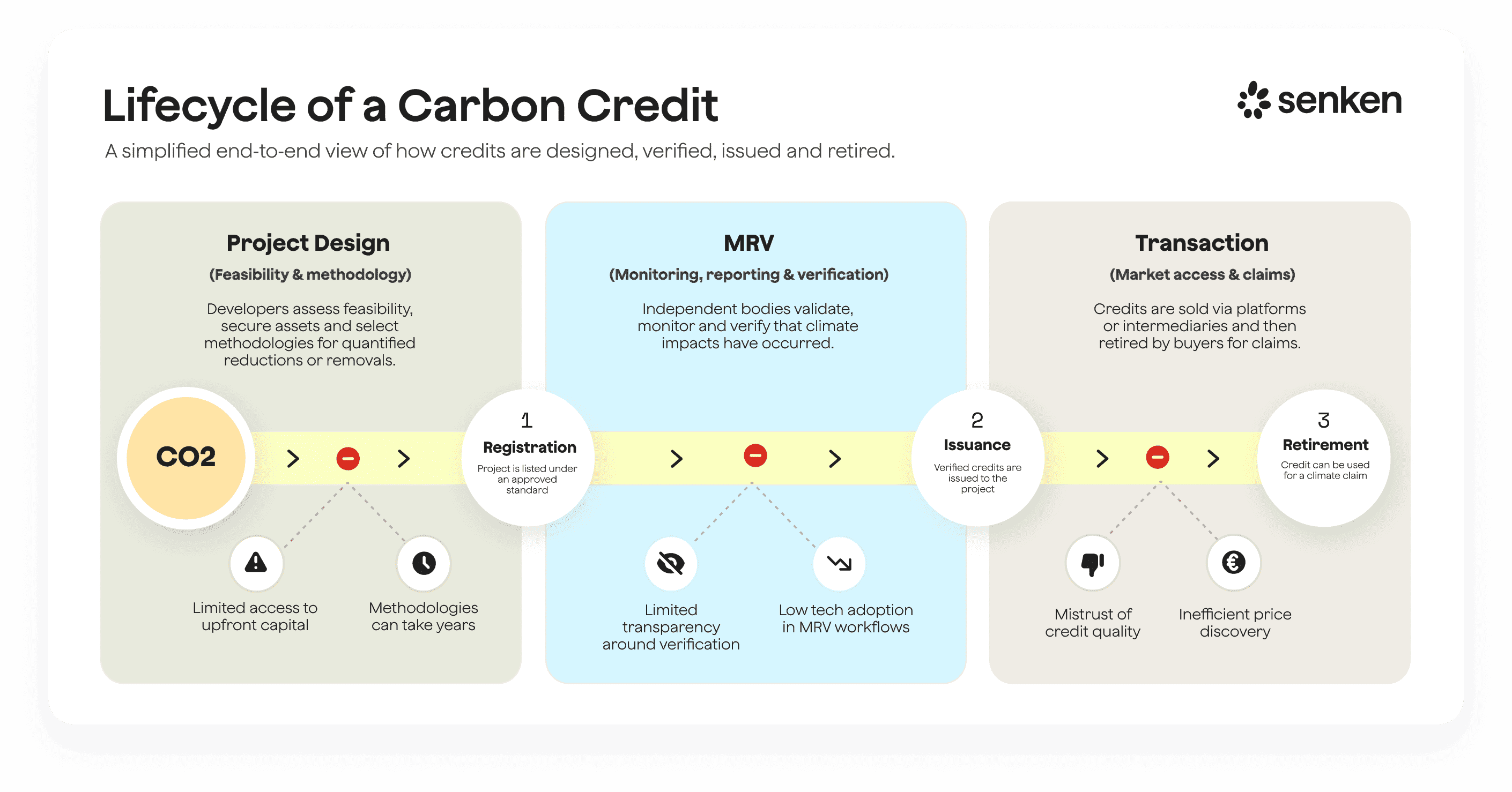
Step 1: Baselines and Reference Levels
Every carbon project starts by answering a counterfactual question: what would have happened without this project? That answer is the baseline, and it's where over-crediting often begins.
For forestry projects, baselines forecast deforestation rates. Research shows that median baseline uncertainty spans 171% of the mean estimate, with forecast errors reaching 0.78 to 3.56 times actual rates depending on the projection method. A project using an inflated deforestation baseline will issue credits for forest that was never truly at risk.
When evaluating a project, ask how the baseline was constructed. Multi-model ensemble approaches reduce variability compared to single projection methods. Look for sensitivity analyses and conservative assumptions. If a project claims high deforestation risk in an area with stable land use, your MRV red flag should be waving.
Step 2: Monitoring and Measurement
Once the baseline is set, projects must monitor actual activity. For emissions avoidance projects like REDD+, this means tracking forest cover over time. For removal projects like afforestation or biochar, it means measuring carbon stocks or production volumes.
Data quality varies dramatically. Direct measurement through sensors, field plots, or metering provides higher confidence than modelled estimates. Digital MRV platforms using satellite imagery or IoT sensors can improve frequency and transparency, but they introduce their own uncertainties. For example, satellite-based biomass estimates achieve strong correlation at landscape scale but tend to overestimate in non-forest areas and saturate in high-biomass forests.
The critical buyer question: what data sources underpin the monitoring, how often are they collected, and where does modelling replace direct observation? Conservative quantification means erring toward underestimating reductions when uncertainty exists.
Step 3: Reporting to the Standard/Registry
Projects compile monitoring data into periodic reports submitted to their registry (Verra, Gold Standard, Puro.earth, etc.). These reports should detail emission reductions or removals achieved, reference the approved methodology, and document any deviations or risk events.
As a corporate buyer, you should be able to access these monitoring reports. Transparency here is non-negotiable. If a seller cannot or will not share monitoring reports, assume the project has something to hide.
Step 4: Independent Verification (ISO 14064-3 Logic)
Verification is where MRV earns its credibility or exposes its weaknesses. An accredited third-party verifier reviews the monitoring report, assesses evidence, and issues a verification statement confirming the volume of emission reductions or removals eligible for crediting.
ISO 14064-3 sets the standard: verifiers must be impartial, follow an evidence-based approach, and apply conservative principles when data is uncertain. The verification statement should specify volumes, address non-permanence risk, and confirm leakage treatment. A rigorous verifier will flag optimistic assumptions or inadequate monitoring.
Examine who verified the project. Are they accredited by a recognized body? Have they verified hundreds of similar projects, or is this their first? Independent ratings agencies like MSCI evaluate verifier track records as part of project scoring, and you should too.
Step 5: Issuance and Registration of Credits
After verification, the registry issues serialized carbon credits and records them on a public ledger. Each credit represents one tonne of CO2 equivalent reduced or removed, tied to a specific project and vintage year.
This registry entry is your audit trail. It should link to the project documentation, verification statements, and any buffer pool contributions for permanence risk. When you retire credits, that retirement is also recorded and publicly visible, preventing double-counting.
Buyer checkpoint: Ensure you receive registry serial numbers for every credit purchased, and verify they appear as retired in your company's name. This simple step prevents fraud and creates the documentation chain your auditor will expect.
Traditional MRV vs. Digital MRV (dMRV): What Changes for You as a Buyer?
What Is Digital MRV in Practice?
Digital MRV refers to the use of sensors, satellites, earth observation platforms, and automated data systems to monitor, report, and verify emission reductions or removals. Instead of manual field measurements and annual reporting, dMRV promises continuous monitoring, real-time data access, and greater transparency.
Examples include CO2 sensor networks for methane capture projects, satellite imagery for forest monitoring, smart meters for renewable energy, and blockchain-based data registries. The appeal is clear: more data, more often, with less room for manipulation.
Where dMRV Is a Real Upgrade – and Where Its Limits Show
Digital MRV delivers genuine improvements in specific contexts. High-density CO2 sensor networks, when calibrated every three to six months, can maintain accuracy within ±1–3 ppm daily error. This precision works well for point-source emissions like biogas facilities or industrial methane capture, where continuous monitoring materially improves quantification over periodic sampling.
Similarly, grid-connected renewable energy projects benefit from smart metering that records every kilowatt-hour with minimal uncertainty. Here, dMRV reduces verification costs and increases transparency without sacrificing accuracy.
But dMRV has real limitations in complex nature-based projects. Satellite-based above-ground biomass estimates show strong correlation at county or landscape scale (R² around 0.88–0.90) but systematically overestimate in non-forest areas and saturate in dense tropical forests. Ground-truthing remains essential. Remote sensing also struggles with below-ground carbon, soil organic matter, and social co-benefits like community livelihoods, all of which matter for holistic project quality.
The bottom line for buyers: dMRV is not a magic bullet. It enhances transparency and can reduce costs, but it does not eliminate the need for robust methodologies, conservative assumptions, and independent verification. When a vendor pitches dMRV, ask about calibration frequency, ground-truth validation protocols, and how the system handles uncertainty. If they claim satellite data alone proves additionality or permanence, walk away.
How to Embed MRV Standards into Contracts and Internal Policies
Standardize MRV requirements across your procurement process:
In RFPs: Require submission of monitoring reports, verification statements, and verifier accreditation proof as part of the bid. Specify minimum buffer pool levels and acceptable methodologies.
In contracts: Include clauses granting you the right to audit MRV data, require delivery of all project documentation within 30 days of purchase, and define remedies if verification is later revoked or disputed (credit replacement, refund, or price adjustment).
In internal policies: Set minimum standards aligned with ICVCM Core Carbon Principles, CSRD/ESRS expectations, and your SBTi commitments. Require sign-off from risk or audit teams for purchases above a certain threshold.
For ongoing monitoring: Establish a review cycle (e.g., annual) to check whether projects in your portfolio remain in good standing and whether new monitoring reports show continued performance.
By embedding MRV due diligence into standard workflows, you de-risk procurement, streamline approvals, and ensure consistency across business units.
Carbon credits remain essential for reaching net zero, but only when backed by transparent, conservative, and independently verified MRV. Treat MRV not as a technical box to check but as the strategic control system that protects your budget, your reputation, and your climate credibility. Companies that hard-wire MRV quality into procurement today will be the ones still confidently using carbon credits when regulations tighten tomorrow.