
EU Adopts First CRCF Certification Methodologies for Permanent Carbon Removals
The European Commission has adopted the world's first voluntary standard for certifying permanent carbon removals, covering DACCS, BioCCS, and biochar. Here's what it means for corporate carbon procurement.
On February 3, 2026, the European Commission adopted the first set of certification methodologies under the Carbon Removals and Carbon Farming (CRCF) Regulation. This marks a significant shift from rule-setting to implementation: carbon removal projects using direct air capture, bioenergy carbon capture, or biochar can now apply for EU certification.
The move positions the EU as the global leader in defining what counts as a verified tonne of permanent carbon removal—and gives corporate buyers a government-backed quality benchmark for the first time.
What Was Adopted
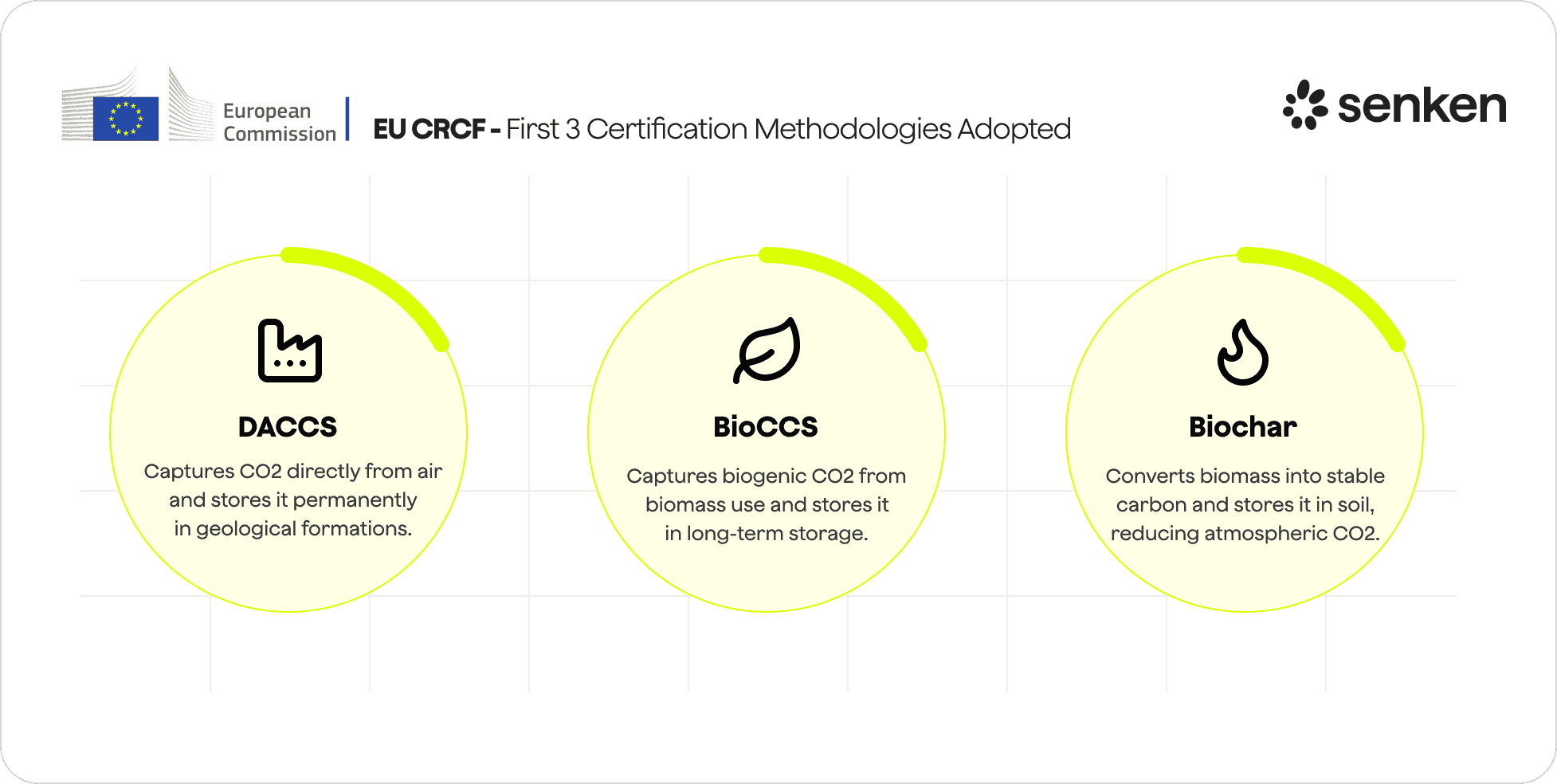
The new delegated regulation establishes certification methodologies for three types of permanent carbon removal activities:
- Direct Air Capture with Carbon Storage (DACCS) captures CO₂ directly from ambient air and stores it in geological formations for thousands of years
- Biogenic Emissions Capture with Carbon Storage (BioCCS) captures CO₂ from bioenergy or bio-industrial processes and stores it permanently
- Biochar Carbon Removal (BCR) converts biomass into stable carbon that can be stored in soils for centuries
These three pathways were selected based on technological maturity and their potential contribution to EU climate targets. The methodologies define what counts as a tonne of removal, how permanence must be ensured, and how risks like leakage and liability are managed.
Why This Matters for Corporate Buyers
For enterprises buying carbon credits, CRCF certification will increasingly become the reference point for "high-quality" in Europe. Here's why:
Regulatory alignment. CRCF-certified units map cleanly to CSRD/ESRS E1 disclosure requirements for financed removals. The four-unit typology (permanent removals, carbon farming sequestration, soil emission reductions, product storage) gives auditors the granular evidence they expect.
Greenwashing protection. The framework addresses a core credibility problem in voluntary carbon markets. With third-party verification, mandatory liability rules for reversals, and a unified EU registry launching by 2028, CRCF provides structural safeguards that standalone voluntary standards cannot match.
Future-proofing for SBTi net-zero. SBTi's evolving guidance requires permanent removals for neutralization of residual emissions at net-zero. CRCF permanent removal units align with this requirement, giving buyers a clear pathway to compliance.
Market signal. The Commission also announced an EU Buyers' Club to pool voluntary demand for CRCF credits, creating a clear market signal for developers and accelerating deployment of removal technologies.
What's Coming Next
The delegated regulation now goes to the European Parliament and Council for a two-month scrutiny period. Absent objections, it will be published in the Official Journal in early April and enter into force 20 days later.
Two additional delegated regulations are expected in 2026:
- Carbon farming methodologies covering agriculture, agroforestry, peatland rewetting, and afforestation—enabling farmers and foresters to earn result-based payments
- Carbon storage in products methodologies for bio-based construction materials, helping building owners demonstrate and certify their structures' carbon storage capacity
Once methodologies are in force, certification schemes (including existing VCM standards like Verra, Gold Standard, or Puro.earth) can apply to the Commission for recognition. Recognized schemes will be able to certify projects under CRCF rules while maintaining their own registries until the EU registry goes live.
What Corporate Buyers Should Do Now
The adoption of these first methodologies changes the practical landscape for procurement. Companies actively buying carbon removals should:
Review current contracts. Assess whether existing offtake agreements with biochar, DACCS, or BioCCS suppliers will qualify for CRCF certification once recognized schemes are available. Projects located in the EU with geological storage in EU-permitted sites are best positioned.
Update procurement criteria. If you haven't already, build CRCF-eligibility into your purchasing requirements for permanent removals. This doesn't mean waiting—it means specifying that suppliers must obtain CRCF certification once available.
Monitor certification scheme recognition. The Commission will publish a standardized assessment protocol for scheme recognition. Track which schemes apply and receive recognition to understand where to source CRCF-certified units.
Align with your reporting timeline. For companies reporting under CSRD from 2025 or 2026, the emergence of CRCF-certified units provides a clear disclosure category. Build your E1-7 templates around CRCF unit types now.
For a comprehensive guide to how CRCF interacts with CSRD, SBTi, and VCMI—and a detailed 24-month roadmap for corporate strategy—see our full CRCF Academy article.
Source: EU sets world's first voluntary standard for permanent carbon removals, European Commission, February 3, 2026.