
EmpCo Directive: What Changes for Your Carbon Credit Strategy in September 2026
The EU's Empowering Consumer Directive (EmpCo) rewrites the rules on environmental marketing. If you're a sustainability manager at a DACH company, this directly affects how you communicate about carbon credits, climate targets, and everything with the word "green" on it.
Here's what the regulation actually says, what it means for your work, and what you need to do before the September 2026 deadline.
"We built a carbon credit program over two years, and now the question from legal is: what can we actually still say about it?" That's the most common version of the question we hear from sustainability managers across DACH. The answer is more nuanced than the headlines suggest.
The EmpCo Directive in brief
EmpCo is the short name for Directive (EU) 2024/825, an EU anti-greenwashing regulation that becomes binding on September 27, 2026. Its full title is the "Directive on empowering consumers for the green transition through better protection against unfair practices and through better information."
Rather than creating a new regulatory framework from scratch, EmpCo amends two existing pieces of EU consumer law: the Unfair Commercial Practices Directive (UCPD) from 2005 and the Consumer Rights Directive from 2011. This matters because the enforcement mechanisms are already in place. Competition authorities, consumer protection agencies, and courts across the EU already have the tools to act on violations.
The regulation came out of a European Commission finding that over half of environmental claims examined in a 2020 study were vague, misleading, or unfounded, with 40% completely unsubstantiated. EmpCo is part of the broader European Green Deal strategy, and it targets exactly the kind of vague sustainability language that has become standard in corporate marketing.
Key dates
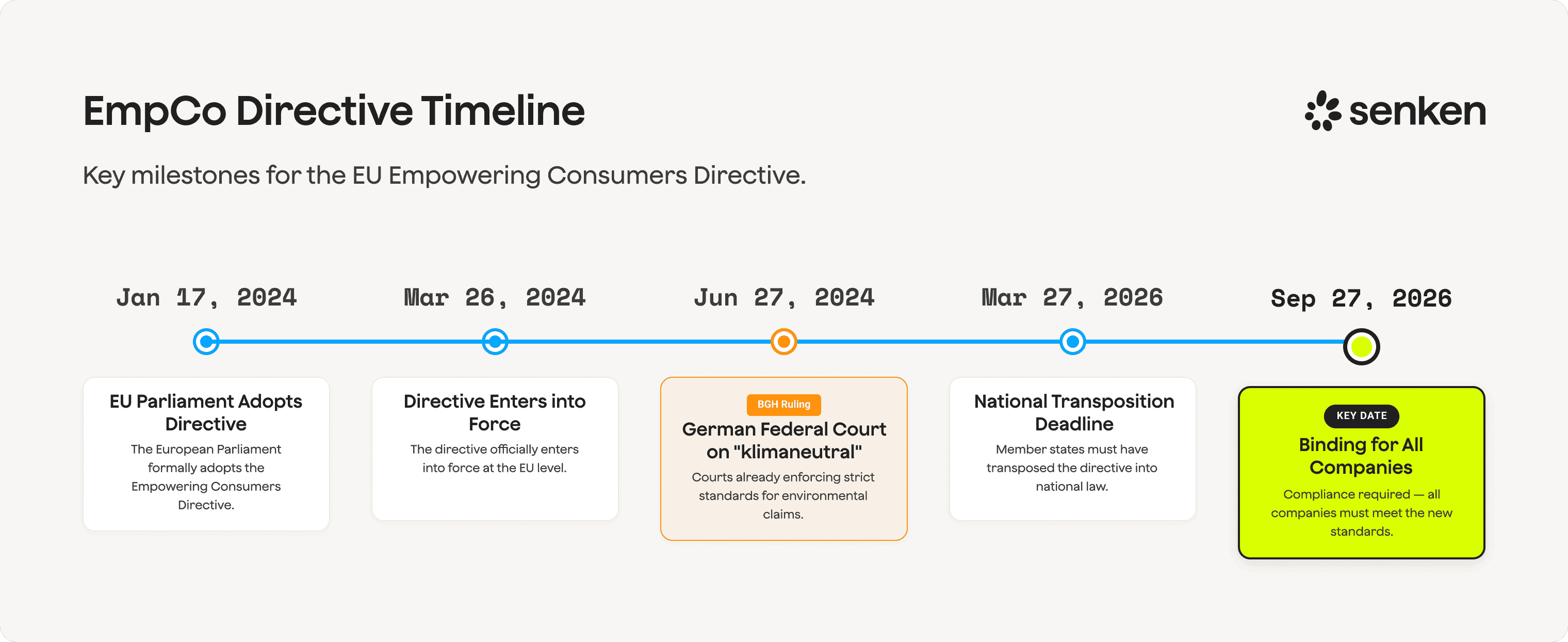
- January 17, 2024: EU Parliament adopted the directive
- March 6, 2024: Published in the Official Journal
- March 27, 2026: Member states must transpose into national law
- September 27, 2026: Rules become binding for companies. No transition period after this date.
The ban on product-level "climate neutral" claims
This is the single biggest change for companies with carbon strategies.
EmpCo explicitly prohibits claiming that a product has a neutral, reduced, or positive impact on the environment in terms of greenhouse gas emissions when that claim is based on carbon offsetting outside the product's value chain. This covers "climate neutral," "CO2 neutral," "carbon neutral," "climate positive," and similar terms.
The logic behind the ban: offsetting and reduction are fundamentally different things, and consumers can't be expected to understand that distinction when they see a "climate neutral" label on a product.
This doesn't apply to corporate-level climate communication. You can still talk about your climate strategy, your carbon credit investments, and your reduction targets on your website, in sustainability reports, and in investor materials. What's banned is putting "climate neutral" on a product and pointing to purchased credits as the reason.
Carbon credits under EmpCo: still allowed, different rules for communication
EmpCo does not ban carbon credit investments. It bans a specific type of claim about those investments.
You can still purchase high-quality carbon credits as part of your climate strategy. You can still report on those purchases in your sustainability report. You can still include them in your CSRD disclosures. What you can't do is slap a "climate neutral" label on a product because you bought credits to cover its emissions.
What you can say
Contribution claims work. Instead of "this product is climate neutral," you say things like:
- "We invest in certified forest conservation projects"
- "We contribute to verified carbon removal initiatives"
- "We support climate projects that remove X tonnes of CO2 annually"
These describe what your company does without making a neutrality claim about a specific product. The shift is from "our product is neutral" to "our company is taking responsibility."
"Since the BGH ruling, the conversation with our clients has fundamentally changed. It's no longer 'get us the cheapest credits for a klimaneutral label.' It's 'help us build a climate story we can actually defend internally and externally.'" - Adrian Wons, CEO & Co-Founder, Senken
What you can't say
Anything that implies a product has neutral or positive climate impact because of purchased offsets. This includes:
- "Climate neutral" labels on packaging
- "CO2 compensated" product claims
- "Carbon positive" product marketing backed by credit purchases
- Any variation that links product-level environmental impact to offsetting
Generic green claims like "sustainable" or "eco-friendly" require proof
These terms are gone unless you can back them up.
EmpCo prohibits generic environmental claims like "eco-friendly," "green," "sustainable," "natural," "biodegradable," "climate-friendly," or "environmentally conscious" unless the company can demonstrate what the directive calls "recognised excellent environmental performance relevant to the claim."
In practice, this means you either hold a valid certification from an official scheme or you have verifiable data that backs up the claim. The burden of proof shifts to the company. You can't use vague environmental language and argue that consumers should have known it was just marketing.
If your website says your service is "sustainable" somewhere in the copy, that now needs to be backed by something concrete.
Net-zero pledges and future environmental commitments
They need substantiation, not necessarily removal.
EmpCo allows future environmental commitments like net-zero pledges, but only if they meet three conditions:
- The commitment is clear, objective, and publicly available. Vague language like "we're working toward climate neutrality" doesn't cut it.
- It's supported by a detailed implementation plan with measurable, time-bound targets. You need to show the actual roadmap, not just the destination.
- It's verified by an independent third-party expert, with findings available to consumers. Self-assessment is not enough.
If you already have a Science Based Targets initiative (SBTi) commitment with a validated pathway, you're in a strong position. If your net-zero pledge is a sentence on your website with no plan behind it, you either need to build the plan or remove the claim.
German courts are already enforcing stricter standards
Germany isn't waiting for September 2026.
The German Federal Court of Justice (Bundesgerichtshof) issued a landmark ruling on June 27, 2024, finding that advertising products as "klimaneutral" without clear explanation of whether neutrality is achieved through reduction or compensation is misleading. The case was brought by the Wettbewerbszentrale, Germany's main competition watchdog.
The court held that "klimaneutral" is inherently ambiguous: consumers could interpret it as actual emissions reduction or as offsetting through credit purchases. Because these are fundamentally different mechanisms, companies must clarify which one they mean, and this clarification must appear in the advertisement itself, not just on a linked website or behind a QR code.
This means that for companies operating in Germany, the rules are effectively already in force. The Deutsche Umwelthilfe alone has initiated over 100 legal proceedings against misleading environmental claims, with more than 90 successful court cases specifically targeting "klimaneutral" advertising. The Wettbewerbszentrale has been equally active, including high-profile cases like Apple's "carbon neutral" Watch. Waiting until September 2026 to adjust your German-facing communications is risky.
German UWG implementation
Germany is transposing EmpCo through amendments to the Act Against Unfair Competition (Gesetz gegen den unlauteren Wettbewerb, UWG). The draft published by the Federal Ministry of Justice in late 2024 actually goes beyond EmpCo's minimum requirements in certain areas. For example, the draft references a broader concept of "business act" rather than EmpCo's narrower "commercial communication," potentially extending the regulation's reach. How courts interpret this remains to be seen, but expect German enforcement to be at the stricter end.
EmpCo vs. the Green Claims Directive
These two get confused constantly. The short version:
EmpCo is law. It's happening. It tells companies what they can't say, and enforcement happens after the fact through existing consumer protection channels.
The Green Claims Directive was a separate proposal that would have required companies to get pre-approval for environmental claims before using them in marketing. It was more ambitious and more burdensome.
In June 2025, the European Commission announced it would withdraw the Green Claims Directive proposal. Political resistance from the European People's Party, concerns about administrative burden on small businesses, and Italy withdrawing support all contributed to its collapse. As of early 2026, it's paused with no clear timeline for revival.
What this means for you: focus on EmpCo compliance, which is certain. Don't wait for the Green Claims Directive, which may never come. EmpCo already provides strong anti-greenwashing rules even without the additional pre-approval requirements the Green Claims Directive would have introduced.
Sustainability labels and self-created badges
EmpCo restricts sustainability labels to those based on official certification schemes with third-party verification, or those established by public authorities. Company-created logos, seals, or badges that suggest environmental or social benefits are no longer permitted unless they meet these requirements.
The certification scheme must involve third-party verification and its conditions and requirements must be publicly accessible. This effectively ends the practice of companies designing their own green badges without external accountability.
If you're using recognized certifications like EU Ecolabel, FSC, or verified registry-based certifications for carbon credits, you're fine. If your marketing team created a "Green Product" badge for your website, that needs to go.
Scope: which companies are affected
Any company making environmental claims to consumers in the EU, regardless of size or location.
There is no small business exemption under EmpCo. A startup making sustainability claims on its packaging faces the same requirements as a DAX40 corporation.
Non-EU companies selling into the EU market are covered. If your products reach EU consumers and carry environmental claims, those claims must comply.
Retailers share responsibility. If you sell products with non-compliant environmental claims, you may face scrutiny even if you didn't create those claims.
The main focus is B2C communication, but claims in B2B contexts can still be challenged under general competition law if they're misleading.
Penalties and enforcement risks
EmpCo strengthens existing enforcement rather than creating new penalty structures, but the consequences are real:
- Injunctions forcing you to stop using non-compliant claims
- Fines up to 4% of annual turnover or 2 million euros (whichever is higher) for widespread infringements affecting consumers across multiple member states
- Damages claims from consumers and consumer organizations
- Competitor challenges: the Wettbewerbszentrale and similar organizations actively monitor environmental advertising
The reputational risk may be worse than the legal penalties. Research from the Nuremberg Institute for Market Decisions found that 72% of consumers avoid companies associated with false or questionable climate claims. Once you're publicly associated with greenwashing, that's extremely hard to undo.
Compliance audit: where to look before September 2026
Start with a full audit of where environmental claims appear across your organization. From working with companies on this transition, one thing stands out: sustainability teams often underestimate how many places environmental claims appear. Marketing approved a tagline three years ago that's still on the website footer. A sales deck from 2023 still says "climate neutral service." A press release from last year is still indexed. The audit is broader than you think:
Product packaging: Any "climate neutral," "CO2 compensated," or generic green terms on labels or packaging. If your packaging has a long print cycle, you need to start redesign now.
Website and marketing materials: Product pages, landing pages, ad copy, social media templates. Search for terms like "sustainable," "eco-friendly," "green," "neutral," "climate," "compensated" across all your digital properties.
Sales collateral: Pitch decks, brochures, one-pagers. These often contain environmental claims that were approved once and never reviewed again.
Press releases and PR: Historical claims may still be live on news sites and press portals. While you can't retract third-party coverage, you can update your own press page and brief your PR team on new language guidelines.
Sustainability labels: Every badge, seal, or logo that implies environmental performance. Check whether each one is backed by a recognized third-party certification scheme.
Future commitments: Any net-zero, carbon-neutral, or emissions-reduction pledges. Make sure each one has a documented plan, measurable targets, and third-party verification.
Carbon credit communication: Shift from neutrality claims to contribution language. Work with your carbon credit provider to develop compliant messaging that still communicates the value of your climate investments.
The indirect effect on carbon credit quality
EmpCo doesn't set rules about which carbon credits you can buy. But it changes what you can say about them, which indirectly raises the quality bar.
When you could claim "climate neutral" by purchasing the cheapest available credits, there was less incentive to invest in quality. Under EmpCo, your carbon credit investments need to support a credible, defensible climate story. That means buying credits you can talk about with specifics: the project type, the verification standard, the permanence of the removal, the co-benefits.
Contribution claims are stronger when backed by high-quality projects. "We invest in verified carbon removal projects that lock away CO2 for over 10,000 years" is a much more compelling message than "we offset our emissions." And it's compliant.
This is where the regulation and good climate strategy actually align. The shift away from neutrality claims toward contribution-based communication rewards companies that invest in quality over quantity.