
€40 vs €320: choosing the budget for your carbon portfolio

Author
Adrian WonsWelcome back from the summer break. If you are working out your carbon procurement budget right now, you are in good company. Late August is when the two questions land on every sustainability manager’s desk: what should the portfolio consist of, and what will it cost?
In this issue I'll answer both. I'll go through the current prices for the eight main project types, the real cost of a removals-only portfolio, and a free tool where you can run your own scenarios with.
What quality costs right now
These are current indicative prices per tonne of CO2 for A-rated projects, meaning projects that passed our Sustainability Integrity Index vetting across 600+ data points. You will find cheaper credits on the market. These are the prices for credits you can defend in front of an auditor.
Nature-based:
- REDD+ (avoided deforestation): €13
- Improved forest management: €30
- Soil carbon: €30
- Afforestation and reforestation (ARR): €37
Engineered removals:
- Biochar: €160
- BECCS (bioenergy with carbon capture): €290
- Enhanced rock weathering: €360
- Direct air capture: €470
In general, the market prices durability. The cheapest engineered removal costs 12 times more than the cheapest avoidance credit.
The removals-only question
Every autumn a company asks us: “Can we just buy removals?” The instinct is right. Net zero ultimately means removing what you still emit.
But then we look at the budget. An even split across the five removal types above comes to about €263 per tonne. Restrict it to durable storage only, so biochar, BECCS, enhanced weathering and DAC, and you are at €320 per tonne.
Let's compare it to the balanced portfolio. Our recommended mix includes six project types: 40% avoided deforestation, 50% nature-based removal and hybrid types like forest management and soil carbon, and a 10% sleeve of durable removals. It prices at €39.60 per tonne and supports 9 of 10 SDGs.
For a company with 10,000 tonnes of residual emissions, that is €396,000 for the balanced portfolio, €2.6m for removals-only, and €3.2m for durable removals only. Same tonnage, a factor of eight in budget. Flip it around and the same €100,000 buys you roughly 2,500 tonnes of the balanced mix, or about 310 tonnes of durable removals.
This is usually the moment “removals only” becomes “let’s follow the Oxford Principles”.
What the Oxford Principles actually ask
Not 100% removals today. The Principles say to increase the removal share progressively, reaching 100% by the global net zero date, and to shift storage towards low reversal risk along the way. SBTi’s draft Net-Zero Standard v2 points the same direction for residual emissions.
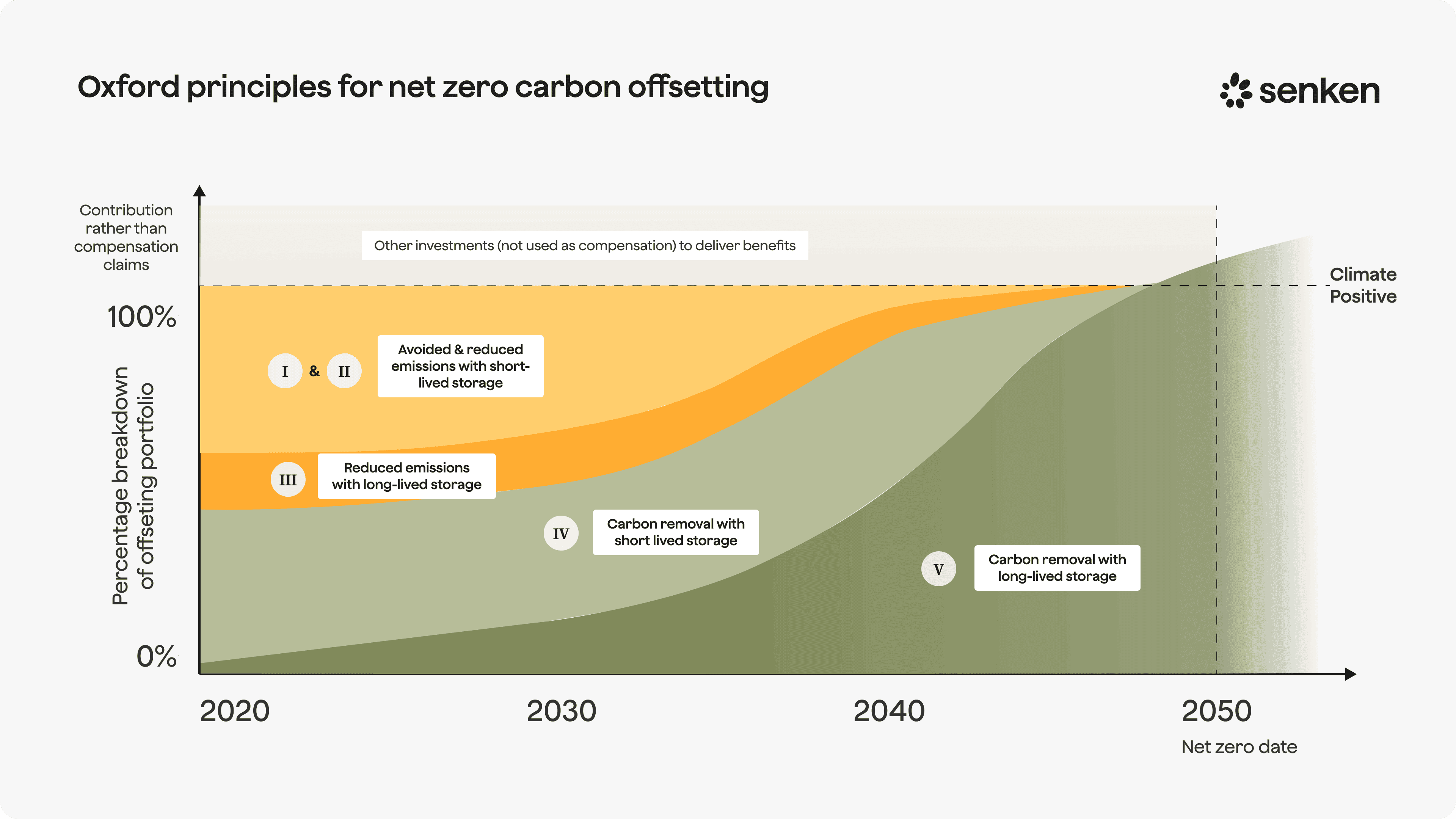
In practice that means starting with a mixed portfolio now and ratcheting the removal share each year. A 10% durable sleeve at today’s prices buys you three things: a trajectory you can defend, early access to supply the EU itself plans to start buying from 2031, and internal price discovery before the durable share has to grow.
Mix your own portfolio
We built a free tool for exactly this conversation: the Senken Portfolio Mixer.
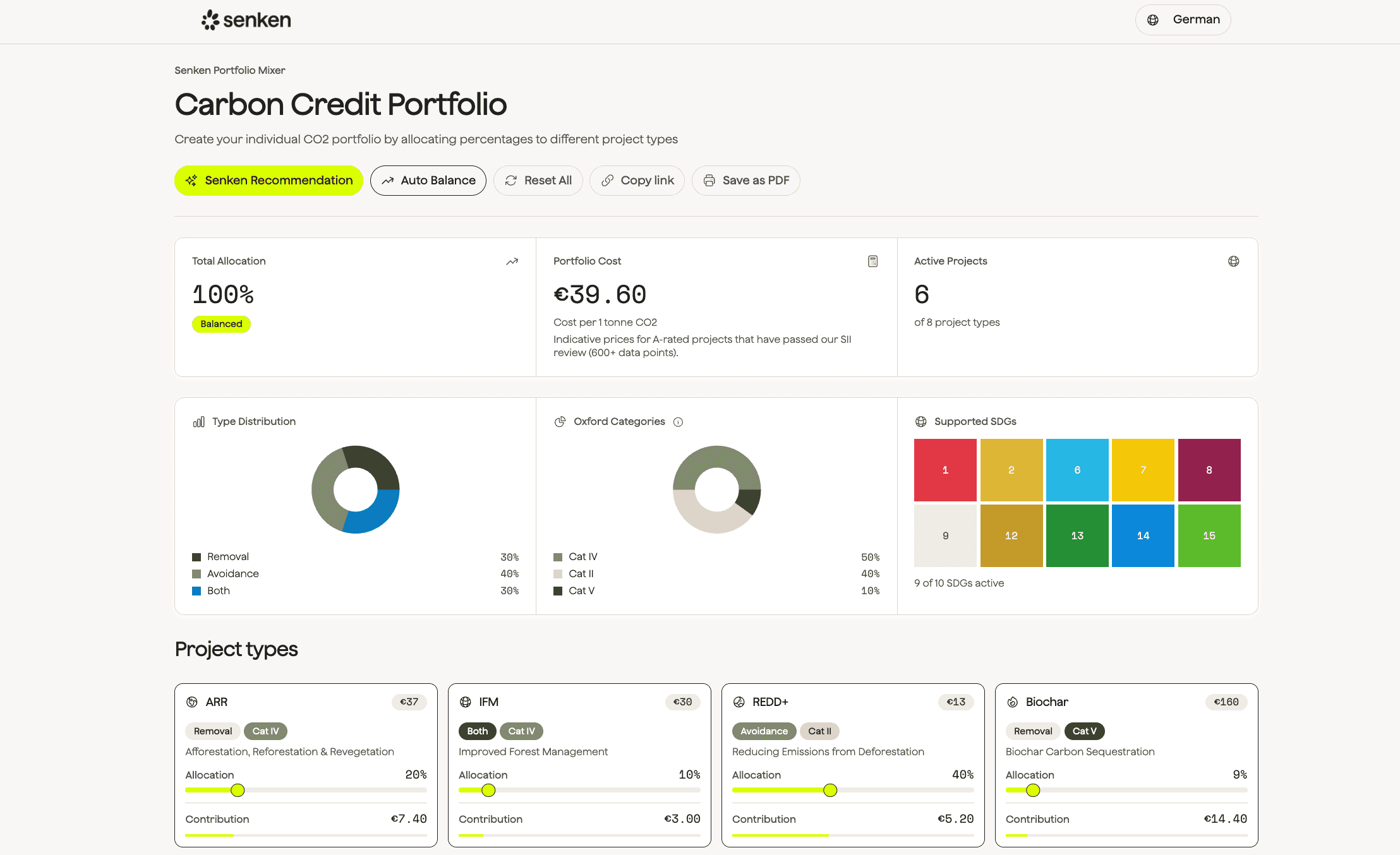
Allocate percentages across the eight project types and watch the cost per tonne update in real time. You also see the split across Oxford categories, the removal vs avoidance balance, and SDG coverage. One click loads our recommended mix as a starting point.
Try the Portfolio Mixer → portfolio-mixer.senken.io
Use it before your budget meeting. Walking in with three costed scenarios beats walking in with one number and hoping.
Bottom line
Portfolio composition is the budget. The mix you choose moves the cost per tonne by a factor of eight before you have negotiated a single contract. Set the tonnes, choose the mix, and the budget derives itself. Do it now, while next year’s budgets are still open, not in December when they are closed.
If you want a second pair of eyes on your mix, reply to this email.
Thanks for reading,
Adrian
CEO & Co-Founder | Senken
P.S. One date for your calendar
On 8 September at 11:00 CEST I am hosting a webinar together with Code Gaia, in German: what changes with SBTi V2, how to set your climate targets digitally, and how we filter roughly 6,200 market projects down to the best 5 percent for CSRD-ready procurement. 45 minutes including Q&A.

📺 More from me on YouTube:
How should you build a carbon credit strategy from scratch in 2026?
We break down the 14 steps to follow today, and why most companies start in the wrong place.
What are Germany’s biggest companies actually buying?
Using Sylvera ratings, we looked at the credits behind the DAX 40’s climate claims. The quality gap is bigger than you might expect.
Sources
- Senken Portfolio Mixer - portfolio-mixer.senken.io
- Oxford Principles for Net-Zero Aligned Carbon Offsetting, 2024 revision - Smith School, University of Oxford
- The role of carbon removal in reaching net zero - RMI