
Are you budgeting enough for carbon removal in 2030?

Author
Adrian WonsThe question I get more than any other is some version of this: what will carbon credits actually cost us in five years?
This is a budget question, not a market-curiosity question. Someone has to defend a line item to a CFO who wants a number for 2028 and 2030.
I cannot give you one answer because there is no single price. When I unpack the question, it always splits in two, and the two halves move for different reasons.
So this issue covers both: nature-based removal, where I use ARR as the reference, and permanent removal, where I use biochar.
Why those two?
On the nature-based side, I use ARR rather than soil carbon because it is still difficult to know how soil carbon will be treated under the durability rules written into SBTi V2 and ISO 14060. I am not going to build a budget on that uncertainty.
On the permanent side, I use biochar because it is the durable pathway available at scale today and the cheapest one that clears a 100-year permanence bar.
Where ARR sits today
In the portfolios I see, ARR runs €22 to €50 per tonne. Smallholder ARR in East Africa sits around €46.
The spread within that range is what I would pay attention to.
In the first half of 2026, ARR credits rated BBB+ averaged €28.55, more than three times the €9.12 paid for lower-rated ARR.
Native-species restoration in Brazil has traded above €60, but I almost never see it on the spot market. It is forward sold before it is issued.
Where ARR is heading
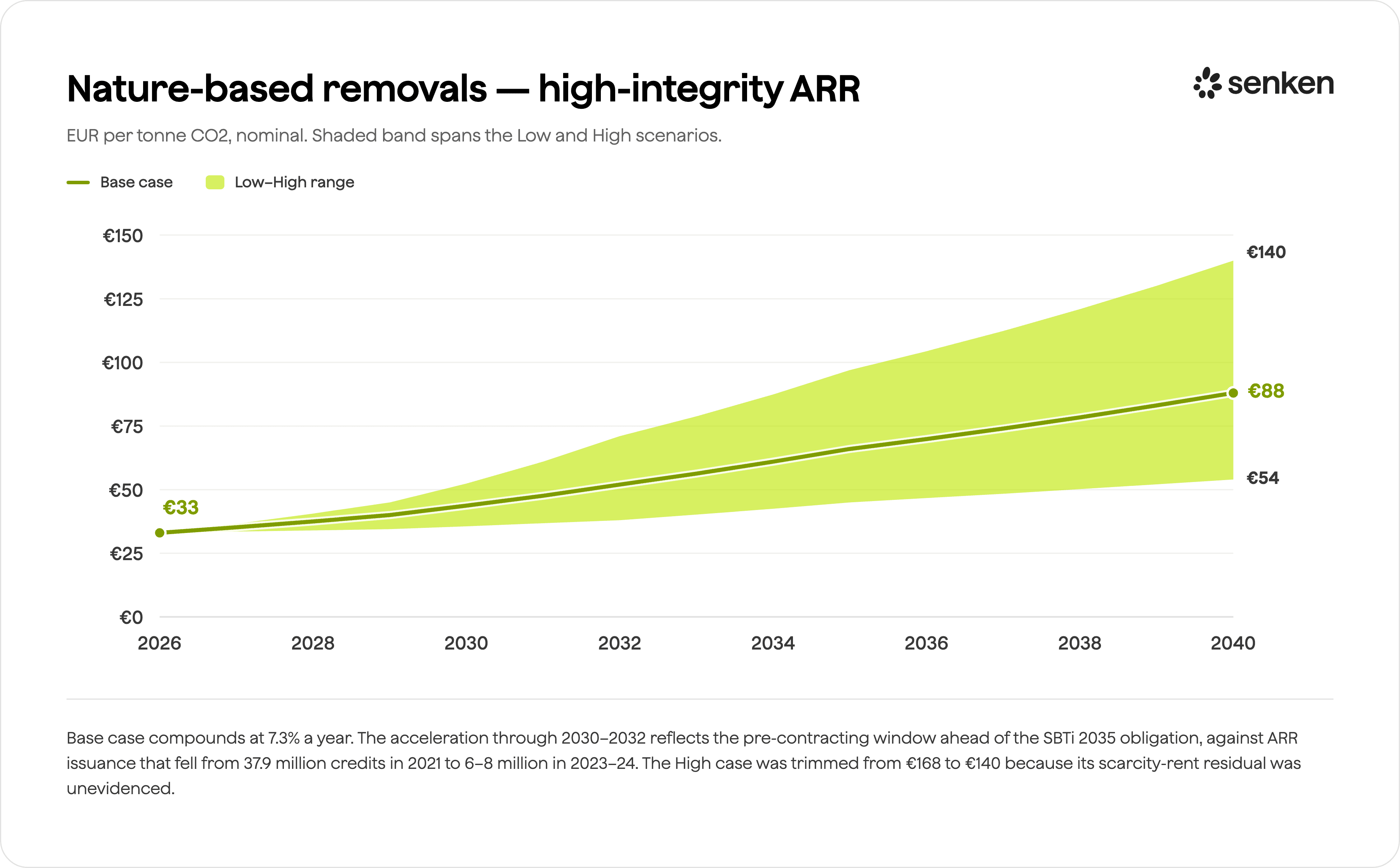
The supply side has barely moved in four years.
ARR issuances have been flat at roughly 7 to 8Mt a year, and retirements track issuances at close to 1:1. Very little accumulates as inventory.
In 2024, transaction volumes fell 21% while the average price rose 19% to €20.44. That is what I would expect when buyers compete for a shrinking pool of acceptable projects.
The demand side is moving fast.
The Symbiosis coalition has committed to up to 20Mt of restoration credits by 2030. Microsoft contracted 8Mt from BTG Pactual through 2043. Forward contracting across nature-based removals reached €5.8 billion in 2025.
I expect meaningful new ARR issuance from 2027 and real scale around 2030. But by then, the best projects will already be largely forward sold.
My expectation is that audit-grade ARR rises from €22 to €50 today to around €45 to €70 by 2030. I also expect the premium for highly rated projects to widen, not narrow.
Cheap ARR will still exist. It will just keep failing your screens.
Where biochar sits today
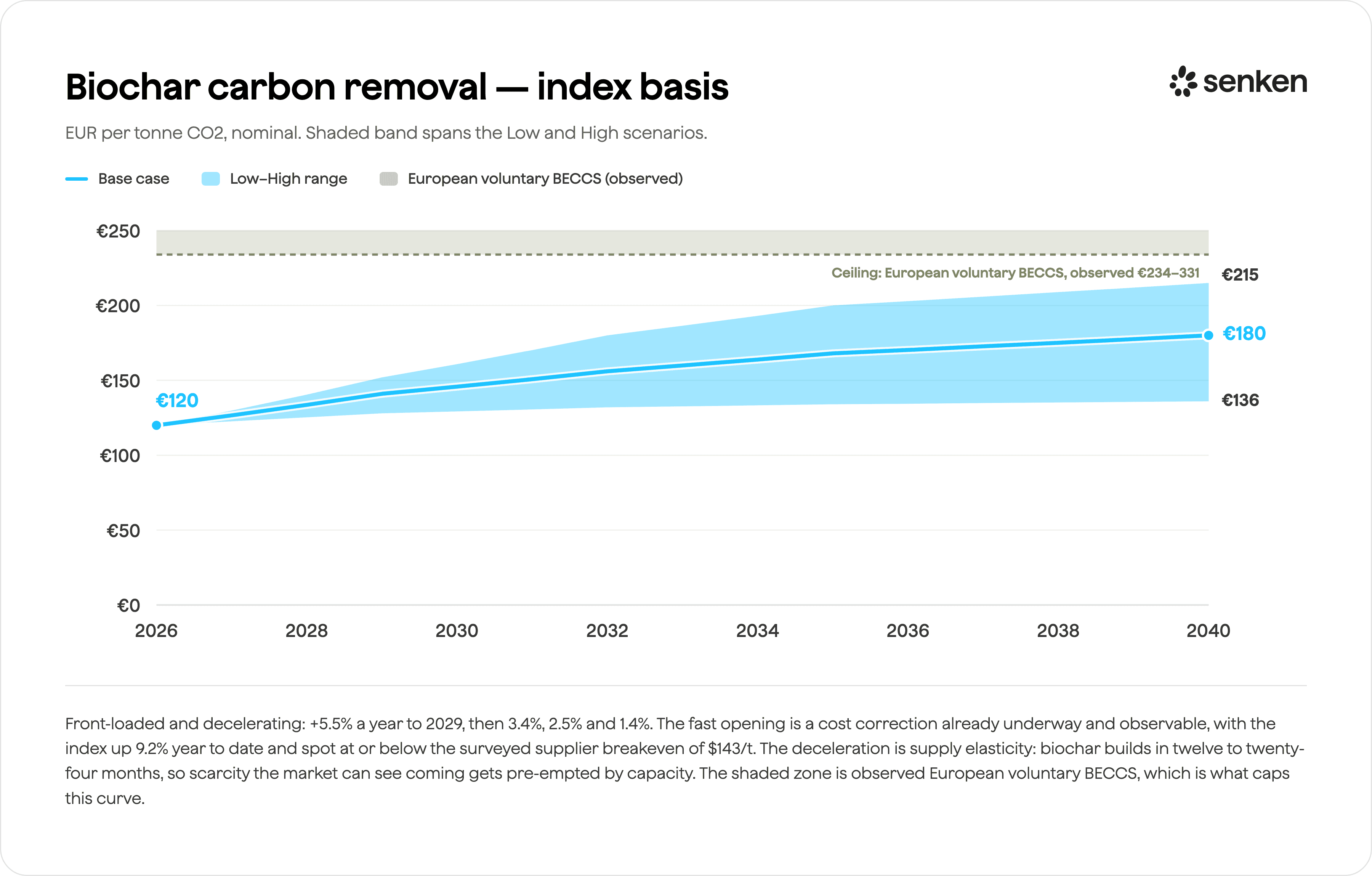
In the deals I see, biochar runs €105 to €200 per tonne, with the range driven more by origin than by quality:
- Indian biochar: artisanal around €105, industrial €120 to €150
- South American industrial biochar: €142 to €190, typically clustering around €160 to €180
- German biochar: €189 to €200
The public benchmarks match that range, and they are flat rather than falling.
The Nasdaq CORCCHAR index clustered at €125 to €145 through 2025. S&P Global put US biochar at around €150 per tonne for 2025 delivery in October, with 2026 delivery at €148.
Two years of scaling deliveries have not moved the price down.
Where biochar is heading, and why €100 is the wrong anchor
Almost every budget model I am shown still assumes permanent removal will get cheaper.
I do not think the evidence supports that.
The 2026 CDR.fyi and OPIS pricing survey found that the gap between what buyers call expensive and what suppliers need is expected to narrow from €98 to €48 per tonne by 2030.
But the headline conclusion is that durable removal is unlikely to broadly reach €100 per tonne by 2030.
Biochar and BECCS, the two most traded pathways, show the narrowest gaps today and the widest projected gaps in 2030. Buyers assume scale will bring prices down. Suppliers point to structural cost floors: biomass availability, financing costs and MRV.
In the previous survey, biochar suppliers put the price they need for a reasonable profit at €187 in 2025 and €180 in 2030.
I read that as a flat line, not a cost curve.
And that is before you factor in the demand that is still to come.
SBTi V2 opens for validation on 1 February 2027 and pushes the durable share of removals up over time. That pulls thousands of companies into the same segment.
Under the July ETS proposal, the EU intends to buy and retire up to 250Mt of permanent removal from 2031. That is against an industry that has delivered around 1.6Mt in total to date.
My expectation is that biochar holds at €100 to €200 through 2027, then trends upward to roughly €150 to €220 by 2030, with European-origin material above that.
The compression people are waiting for happens in ERW and DAC. However, I do not see those prices going below €250.
What this does to a budget
Take a company retiring 10,000 tonnes a year.
In 2026, with 80% ARR at €40 and 20% biochar at €150, the blended price is €62 per tonne. That is €620,000.
In 2030, with the durable share at 50% to stay on an SBTi-aligned glide path, ARR at €55 and biochar at €180, the blended price is €118 per tonne. That is €1.18 million.
The volume did not change.
The price per tonne did not double because the market got greedy. It doubled because the mix shifted toward permanence and the cheap end stopped qualifying.
Offtake is the lever I would pull.
Locking 2026 prices for 2027 to 2030 delivery typically saves 15 to 30% against rolling spot purchases. In ARR and biochar, I increasingly see it as the only way to secure volume at all.
Bottom line
I would ignore forecasts for the market average.
BloombergNEF’s status-quo scenario says $13 per tonne in 2030 and its removal-led scenario says €42. Neither describes what a company with an SBTi target will pay for a defensible portfolio.
What I do take from every credible forecast is the direction: high-integrity removal gets more expensive, the quality premium widens, and supply for both ARR and biochar is being committed forward faster than it is being built.
Plan for a blended portfolio price that roughly doubles by 2030.
And treat any budget that assumes falling prices as the one that needs defending.
The full price breakdown by methodology and region is here.
Thanks for reading,
Adrian
CEO & Co-Founder | Senken
P.S. Many of you have asked how the first two months have been with the little boy and his mom.
Pleased to report that we’re all happy and healthy! ❤️

📺 More from me on YouTube:
How should you build a carbon credit strategy from scratch in 2026?
We break down the 14 steps to follow today, and why most companies start in the wrong place.
What are Germany’s biggest companies actually buying?
Using Sylvera ratings, we looked at the credits behind the DAX 40’s climate claims. The quality gap is bigger than you might expect.
Sources
- Carbon credit prices by methodology and region - Senken Academy
- Afforestation and reforestation, explained - Senken Academy
- CDR pricing survey, May 2026 - CDR.fyi
- Key trends for the 2026 voluntary carbon market - Carbon Direct
- Carbon offset prices by category - Sylvera
- Biochar carbon credits in 2025: stable prices amid weakening demand - CarbonCredits.com
- Nature-based carbon credit prices grow apart - MSCI
- ARR issuances and retirements - OPIS
- Long-term carbon credit supply outlook 2025 - BloombergNEF