
18 Days until “klimaneutral” claims are banned on products

Author
Adrian WonsOn 26 August 2025, the Frankfurt Regional Court told Apple it could no longer market the Apple Watch as CO2-neutral in Germany.
The credits behind the claim were not the cheap avoidance credits everyone likes to criticise. They were removals from Verra-certified eucalyptus plantations in Paraguay.
The court did not dispute that the trees existed. It focused on how long the carbon would stay stored. Leases covering roughly three quarters of the land expire in 2029, while a consumer reading “CO2-neutral” would expect the carbon to stay put until around 2050.
Five weeks later, Apple removed “carbon neutral” from the Watch worldwide.
That judgment required a full examination of the project, the leases and the buffer pool.
From 27 September, courts across the EU will not need to do any of that. A product-level climate-neutrality claim based on carbon credits will be unfair by definition.
No examination. No defence.
In this issue, I explain what the new law actually changes for carbon credits and removals. Then I share the framework I would put in front of legal, marketing and sustainability at the same time.
More claims survive than the headlines suggest. And the ones that do are stronger than “klimaneutral” ever was.
What changes on 27 September
The Empowering Consumers Directive, or EmpCo, amends the EU’s unfair commercial practices rules.
Germany transposed it into the Unfair Competition Act, the UWG, on 19 February 2026. It applies from 27 September.
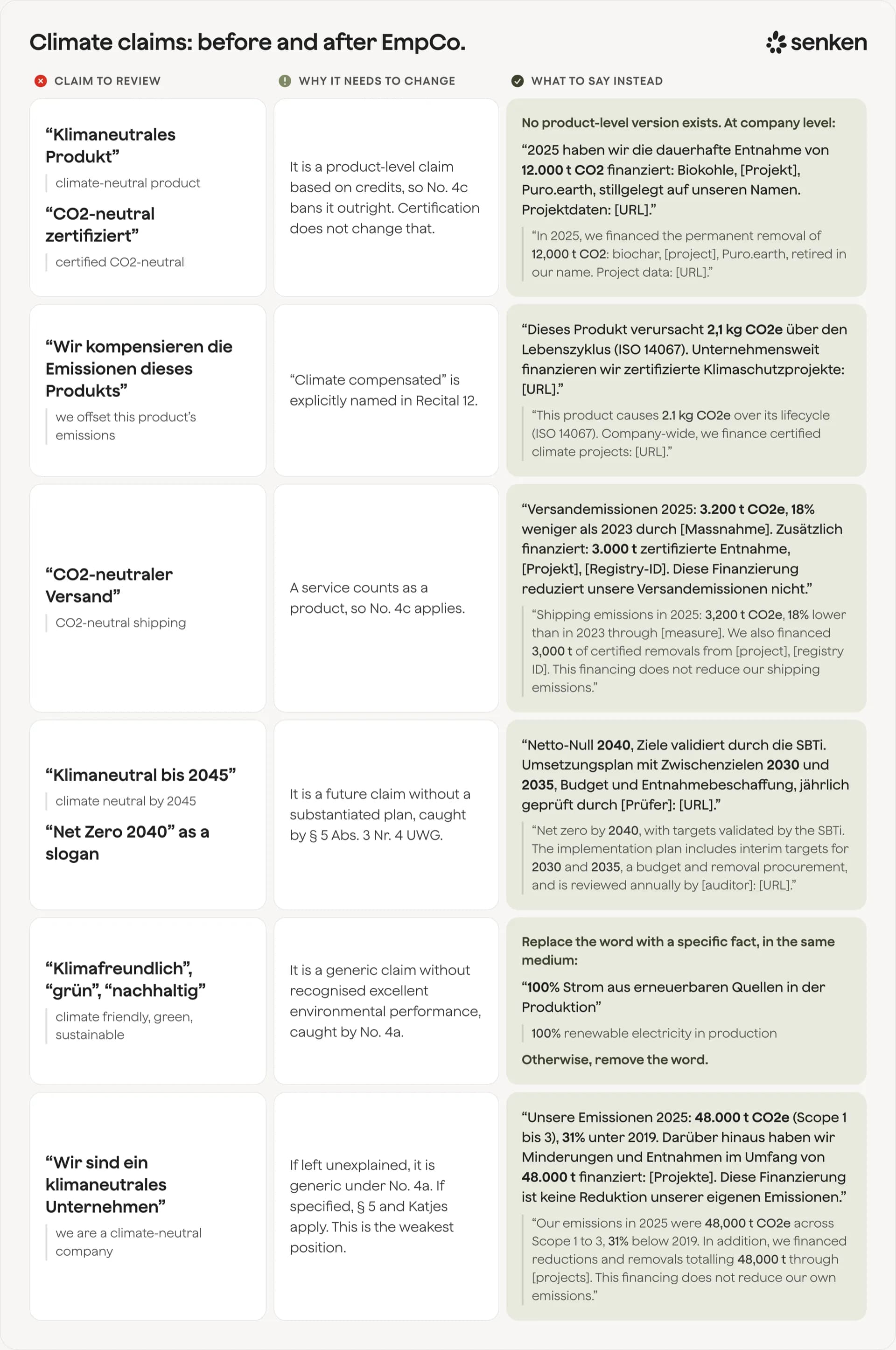
For credit buyers, the key change is a new entry on the blacklist of practices that are always unfair, No. 4c. It prohibits claims based on offsetting that say a product has a neutral, reduced or positive impact on the climate.
“Product” covers goods and services alike: a flight, an insurance policy, a parcel or a software subscription.
Three other rules matter:
There is no transition period. In Germany, enforcement is private.
Deutsche Umwelthilfe, the environmental NGO behind many German greenwashing cases, has brought more than 100 proceedings since 2022 and says it has not lost one.
The Wettbewerbszentrale, the industry-funded fair competition watchdog, took 241 cases to court in 2025, up 18% on the previous year.
The much-quoted fine of 4% of turnover applies only to coordinated EU-wide enforcement actions.
The more immediate German exposure is an injunction, a contractual penalty, an Ordnungsgeld of up to €250,000 for each breach of an injunction, and the cost of re-stickering every SKU.
Removals are not exempt
This is the point the removal community most wants to be untrue.
It is not.
The law says offsetting. It does not distinguish avoidance from removal, and it does not carve out biochar, direct air capture or eucalyptus in Paraguay.
The Commission’s own Q&A, updated in June, gives exactly one route to a product-level neutrality claim: the product’s actual lifecycle footprint must be neutral within its own value chain and substantiated by an LCA.
Guidance from the Danish Consumer Ombudsman, published on 4 September, makes the same point. Product claims are misleading whether the credits remove CO2 or avoid an emission. They remain misleading even when the marketing explains that the neutrality rests on compensation.
Consumer law is not disagreeing with climate science. The two answer different questions.
Science asks whether a tonne removed balances a tonne emitted.
Consumer law asks whether the shopper believes the product in their hand has no climate impact.
A tonne of durable biochar does not change the emissions generated by the product itself.
“Kompensiert” (offset) goes the same way.
Calling a product “50% kompensiert” (50% offset) still makes a reduced-impact claim based on offsetting, so it is caught.
Industry associations asked the Ministry of Justice to add the word “lediglich” (merely), which would have allowed mixed claims to escape. The word is not in the law.
What survives
Buying and retiring credits remain untouched.
Your CSRD sustainability statement is also generally outside scope. The Commission says mandatory reports are typically not covered, and investor communication is not consumer communication.
But the moment you lift a number from ESRS E1 and place it on a product page or in an advert, it becomes a claim and the rules apply.
Company-level claims can still survive, but the existing rules continue to apply.
The Commission is explicit that No. 4c does not cover offsetting at company level. You may also communicate your investment in carbon credit projects, as long as you do so transparently.
But the Federal Court of Justice’s 2024 Katjes judgment still governs that space. An ambiguous term must be explained in the advert itself. A QR code linking to a website is not enough. And reduction and compensation are not equivalent measures.
Removals have also become more important, just not where most people expect.
A “Net Zero 2040” claim now needs a realistic plan with allocated resources.
Under the SBTi Corporate Net-Zero Standard V2.0, final since June, that plan ends with eligible removals for all residual emissions. For large companies, it also includes a mandatory ramp from 2035, starting at 1% of ongoing emissions.
A realistic plan therefore needs a removal procurement line: volumes, budget and sourcing.
Removals are no longer a way to earn a product label. They are part of the legal substantiation of your target.
The rule: never net in public
Every banned claim follows the same formula: footprint minus credits equals a statement about the product.
The law does not ban the footprint, the credits or the target.
It bans the subtraction.
So keep these three things separate, and never do arithmetic across them in anything a consumer can see.
Footprint: What you emitted and what you have cut. Report gross Scope 1, 2 and 3 emissions, the baseline year, the percentage change and the measures behind it. “Reduced” is allowed here when it reflects real changes in production.
Pathway: Where you are going and how you will get there. Include the target year, interim targets, implementation plan, budget and independent review. This is where removals sit as the neutralisation of residual emissions. Only contracted forward volume shows that the plan is realistic.
Contribution: What you financed outside your value chain. State it clearly: tonnes, project name, registry and ID, vintage, rating, durability and retirement in your name. Under SBTi V2.0, this is Ongoing Emissions Responsibility. Under the Oxford Principles, it is a contribution, not compensation. Neither framework lets you net it against your inventory.
ESRS E1 already requires this split in your report.
EmpCo asks you to keep it when you communicate.
Five objections, answered
“We only buy removals, so this does not apply to us.”
It applies just as much. The Directive, the Commission Q&A and the Danish guidance all attach the ban to offsetting itself. Apple’s credits were removals.
“We are B2B.”
The blacklist is B2C. The general ban on misleading advertising in § 5 UWG is not. Competitors and the Wettbewerbszentrale can still sue. And your B2C customers can no longer use your neutrality claim in their own communication.
“The Green Claims Directive was withdrawn, so the EU has backed off.”
The Green Claims Directive is blocked in the Council, not withdrawn.
It is also irrelevant here. EmpCo is a separate instrument. It has been in force since March 2024, was transposed in Germany in February 2026 and applies from 27 September.
“Our neutrality is certified.”
“CO2-neutral certified” is one of the examples the Directive itself gives of a banned claim. A certification scheme can make a label lawful. It cannot make a sentence lawful when that sentence is prohibited by the blacklist.
“Nobody will enforce this against old stock.”
Public authorities have said they will be pragmatic.
Deutsche Umwelthilfe, the Wettbewerbszentrale and your competitors have said nothing of the kind. They are the parties that bring cases in Germany.
Bottom line
27 September does not end carbon credits in corporate communication.
It ends one sentence: “this product is climate neutral.”
You can still communicate what you emit, what you have cut, where you are going and what you finance outside your own value chain.
The law now rewards specificity because that is the only thing it still lets you compete on.
Companies that bought credits for the label lose the label.
Companies that bought them as part of a credible pathway now have a legal framework that distinguishes them from those that did not.
If you want to know whether the credits behind your current claims can be named, rated and traced, reply with your retirement list and I will tell you.
Thanks for reading,
Adrian
CEO & Co-Founder | Senken
📺 More from me on YouTube:
Two recent conversations worth watching:
How Europe’s largest biomass storage deal got signed
We unpack the structure behind the deal, and what buyers consistently underestimate.
What makes a carbon buyer walk away?
It is rarely price or ratings. A developer explains what really kills a deal in diligence.
Sources
- Directive (EU) 2024/825 (EmpCo)
- German UWG transposition, BGBl. 2026 I Nr. 43
- European Commission — EmpCo Q&A
- Danish Consumer Ombudsman — environmental marketing guidance (4 Sep 2026)
- Bundesgerichtshof — Katjes judgment (2024)
- LG Frankfurt — “CO2-neutrales Produkt”
- Deutsche Umwelthilfe — greenwashing proceedings
- Wettbewerbszentrale — Jahresbericht 2025
- SBTi — Corporate Net-Zero Standard V2.0
- Oxford Principles for Net-Zero Aligned Carbon Offsetting (2024)
- European Parliament — Green Claims Directive legislative train
- European Commission — supporting guidance