
Carbon credit target prices tripled. Why hasn’t the market caught up?

Author
Adrian WonsThis week, on the latest episode of Carbon Weekly News, I sat down with Bayo Owolabi. He is a partner at BCG in London and one of the authors of BCG’s new survey of around 300 carbon credit buyers.

The headline finding: target portfolio prices have roughly tripled since 2022.
That stands out, because from the outside, corporate sustainability looks like it is in retreat. The Omnibus has reduced the number of companies in scope for CSRD by around 90%, and ESG has gone quiet in many boardrooms.
But carbon credit procurement is moving in the opposite direction.
Under CSRD, the credits a company uses appear in its sustainability statement. Since 27 September, EmpCo has also made vague climate claims a legal risk. A cheap credit can now be expensive to defend.
Most of that price shift has not yet appeared in average retired prices. That is exactly why it matters for your next budget.
I’ll share Bayo’s own take at the end.
Target prices have tripled since 2022
In BCG’s 2022 survey, 84% of buyers targeted a portfolio price of $30 per tonne or less. Only 3% targeted more than $50.
On average, buyers expected to pay around $25 to $30 per tonne by 2030.
By early 2026, that picture had flipped.
Only around one in five buyers still target below $25. Roughly one in four now aim for $51 to $100 per tonne.
And a premium segment is now willing to pay more than $100, a price point that barely existed four years ago.
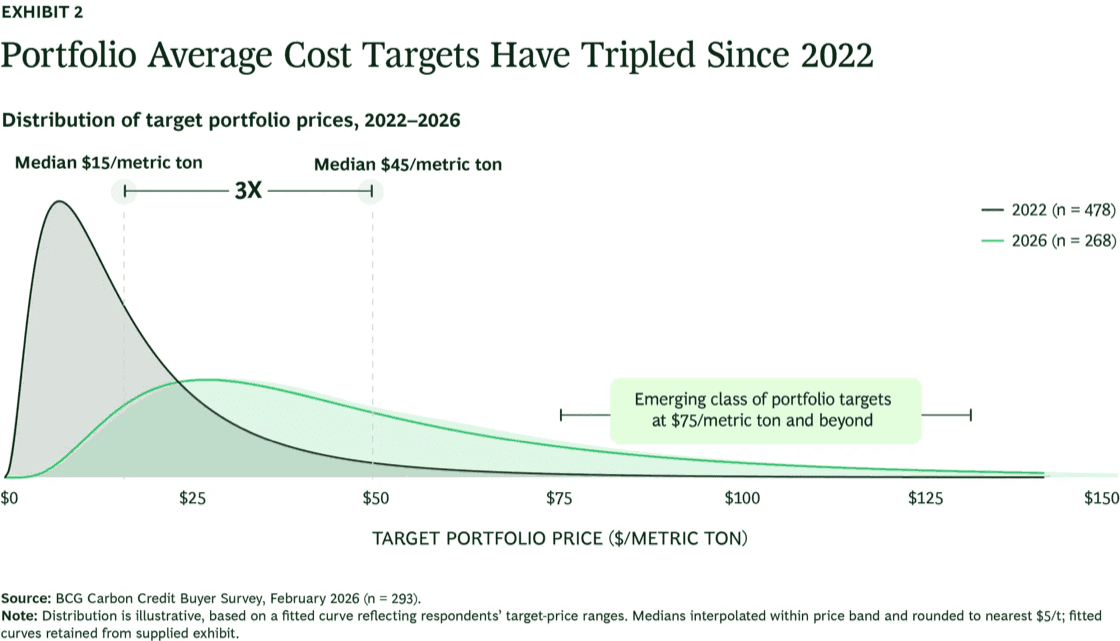
If your carbon budget still rests on a 2022 price assumption, it may not cover the higher-quality, more defensible portfolio your team is now trying to build.
Three prices for the same portfolio
The most useful part of the report, in my view, is the gap BCG exposes between the portfolio buyers currently hold and the one they actually want.
At average market prices, today’s portfolios cost $55 per tonne.
If enough credits met their quality bar, buyers would shift to a different mix costing $68 per tonne.
Price that preferred mix where demand is strongest for each credit type, and the figure rises to $79 per tonne.
Put simply, the portfolio buyers say they want costs about 44% more than the one they hold today.
Same number of tonnes. Better credits.
Then comes the catch.
Buyers’ average target budget is $58 per tonne. That is only $3 above what they pay today and $21 below the portfolio they say they want.
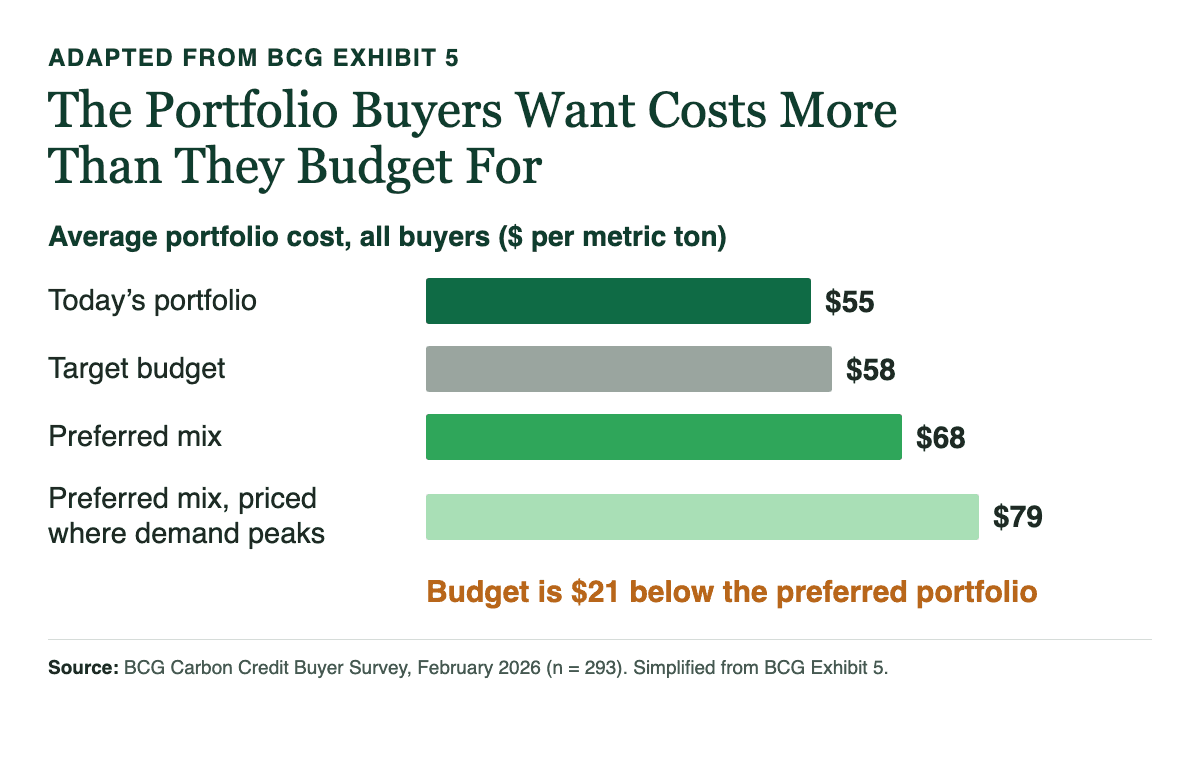
To make it concrete, a company retiring 10,000 tonnes a year spends about $550,000 on its current portfolio. It budgets $580,000, but would need $790,000 for the portfolio it actually prefers.
That $210,000 gap is the distance between what sustainability teams want to buy and what finance has approved.
Four kinds of buyer
BCG divides the market into four groups:
- Commodity: Low-cost credits that meet basic credibility standards.
- Early Days: Facing more scrutiny and seeking higher quality, but still building their assessment capabilities.
- Carbon-Intense Quality Seekers: Rigorous on quality and prioritising higher-quality portfolios.
- Premium Quality Seekers: Willing to pay a premium for the best credits, including DAC.
The spread in willingness to pay is widest for removals.
Commodity buyers place most of their biochar allocation at around $100 per tonne. Premium buyers put theirs at $400.
Both ends of the market are squeezed, but in different ways.
For Commodity and Early Days buyers, target prices are already below what their portfolios cost today.
Premium and Carbon-Intense buyers spend the most and want to spend more, but even their budgets fall short of their preferred portfolios.
The useful question is which segment you sit in, and whether your budget matches it.
How many buyers will pay today’s asking prices
BCG also asked a simple question: at the prices suppliers are asking today, would you still buy?
Here is the share of buyers who said yes:
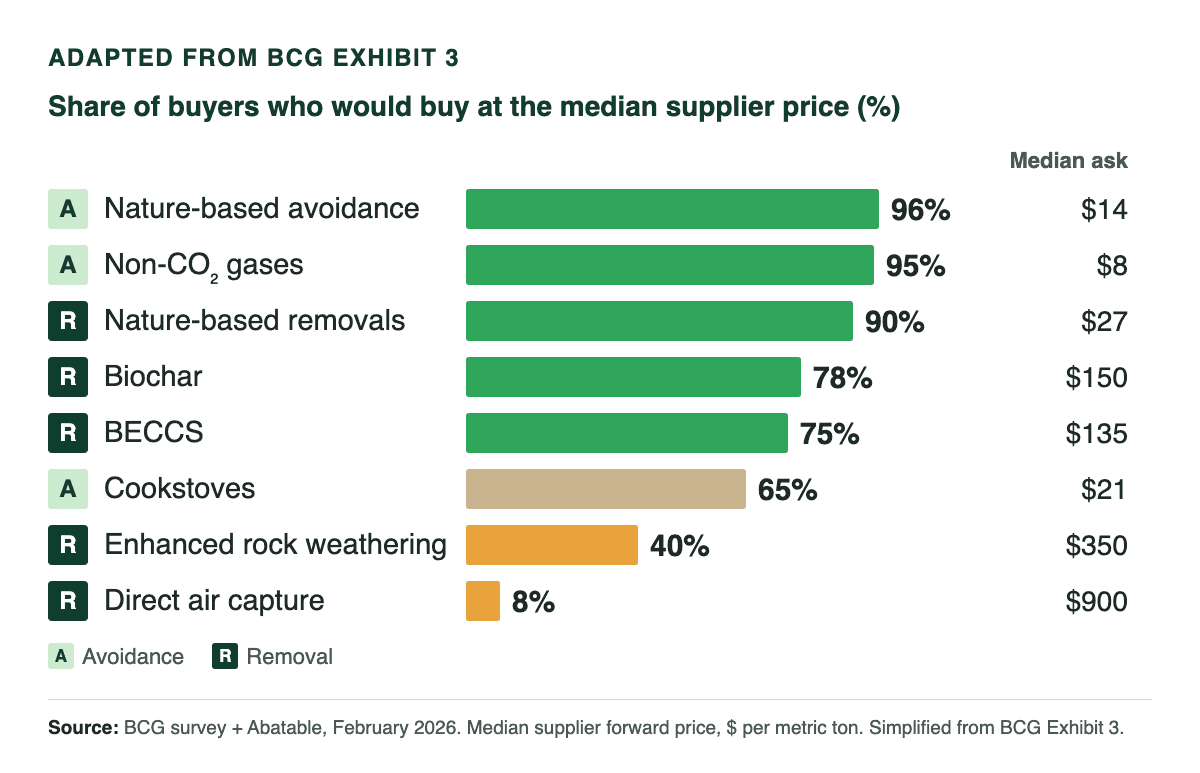
For DAC, half of buyers will not go above roughly $365.
That leaves a gap of more than $500 per tonne between the median buyer and the median seller.
The takeaway is not that DAC is dead.
It is that DAC and ERW will not scale through spot purchases from mainstream buyers.
BCG’s recommendation for frontier removals is longer-term commitments, including agreements to buy future credits. In plain terms: offtakes.
Biochar and BECCS, by contrast, already have a broad buyer base at today’s prices.
What buyers mean by quality now
Quality has narrowed to one central question: can the climate impact be measured and defended?
When buyers have to trade attributes off, trusted registries and rigorous emissions measurement come first.
Together, they account for roughly 60% of stated preference. Co-benefits and revenue sharing rank much lower.
One more finding stood out to me.
No segment wants a single credit type.
Every group built a mixed portfolio of avoidance and removals, with durable engineered removals making up roughly 20% to 25%.
If you started from the 10% durable sleeve I suggested in August, this is a useful signal of where the market is heading.
What this means for your 2027 budget
Stated willingness to pay is not a purchase order, and BCG is clear that budgets remain the binding constraint.
But the direction is unambiguous.
Three things I would do now:
- Rebase your price assumption. If your plan still uses $25 to $30 per tonne, define the portfolio you actually want first, then price it.
- Write measurability into your procurement criteria. BCG recommends building frameworks around whether the impact is measurable and defensible, rather than setting fixed preferences for particular credit types. That is also what holds up in front of an auditor.
- Separate spot from forward. Buy credits with a deep buyer base at today’s prices on the spot market. For durable removals above your spot budget, a multi-year offtake spreads the cost and secures supply before competition intensifies.
BCG also points to SBTi’s Ongoing Emissions Responsibility framework as one route to the clarity buyers need before they spend.
Bottom line
In 2022, BCG asked whether buyers would pay for quality. The answer was yes.
In 2026, the question is whether budgets and supply can catch up.
Buyers hold a $55 portfolio, budget for $58 and want one worth $79.
The companies that close that gap first, with realistic budgets and forward contracts, will secure the credits everyone else is still trying to buy.
Bayo’s take

In the episode, Bayo touches on two points that you will not find in the report:
- The tripling surprised him too. But he was clear that portfolio prices still need to roughly double again before they reach the range where durable removals work.
- Co-benefits ranking last does not mean they do not matter. Buyers were forced to rank attributes against one another. By the time co-benefits become the deciding factor, the carbon claim has already cleared a high bar. Strong community benefits often underpin permanence in the first place.
One more point stayed with me.
If average portfolio prices ever reach around $100 per tonne, Bayo argues, the “cheap way out” criticism of carbon credits loses its force.
At that level, you are in the same range as decarbonising your own value chain.
Bayo joins at 11 minutes.
📺 More from me on YouTube:
Two more conversations from New York Climate Week:
Should carbon removal count toward your near-term targets?
CDR.fyi co-founder Robert Höglund on why companies feel paralysed by their own net zero targets, and the assumption about “residual” emissions he thinks we have got wrong.
What made Google sign the first megaton-scale rock weathering deal?
Terradot’s Connor Sendel on the structure behind Google’s third deal with them, and the twist that makes the project net zero warming from the first credit rather than from 2040.
Sources
- BCG — Carbon Credit Target Prices Have Tripled Since 2022 (2026)
- BCG — Why VCM Buyers Will Pay for Quality (2023)
- CWN EP8 — What 300 Carbon Buyers Want, and How CDR Gets Debt (YouTube)
- DLA Piper — Corporate Sustainability Reporting Directive: Amendments under Omnibus I finalised
- EUR-Lex — Directive (EU) 2024/825 on empowering consumers for the green transition (EmpCo)