
Microsoft bought 80Mt of carbon removal. What can we learn?

Author
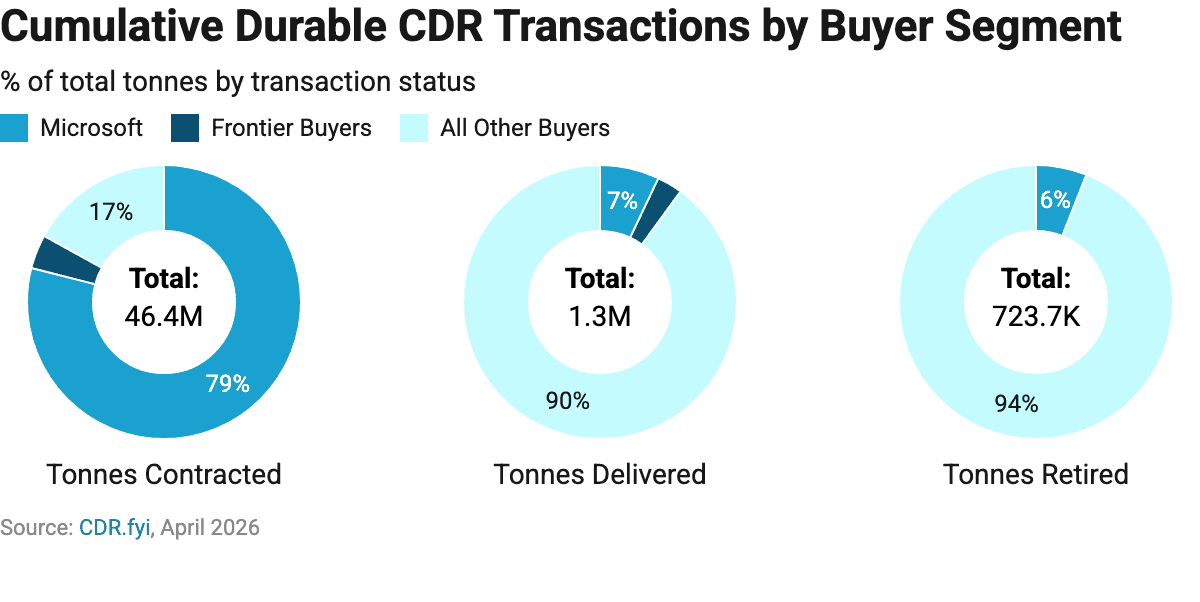
Adrian WonsOf all the durable removal credits ever contracted worldwide, Microsoft holds almost 80%. Since mid-2023 alone, it has signed deals for another 80 million tonnes, including nature-based removal.
In September, Microsoft published what it has learned along the way. It is the closest thing this market has to a buyer’s manual, written by the company that made many of the mistakes first.
Smaller buyers will run into many of the same problems, just later and at a smaller scale: projects that take years to build, deliveries that arrive late, and measurement methods that are still improving.
And with Microsoft holding most of the durable supply under contract, the tonnes left for everyone else may be scarcer than they look.
Scarce supply rewards buyers who plan early. Here’s a quick way to see how many tonnes you’ll need from 2035:
Lesson 1: Building new supply takes 5 to 8 years
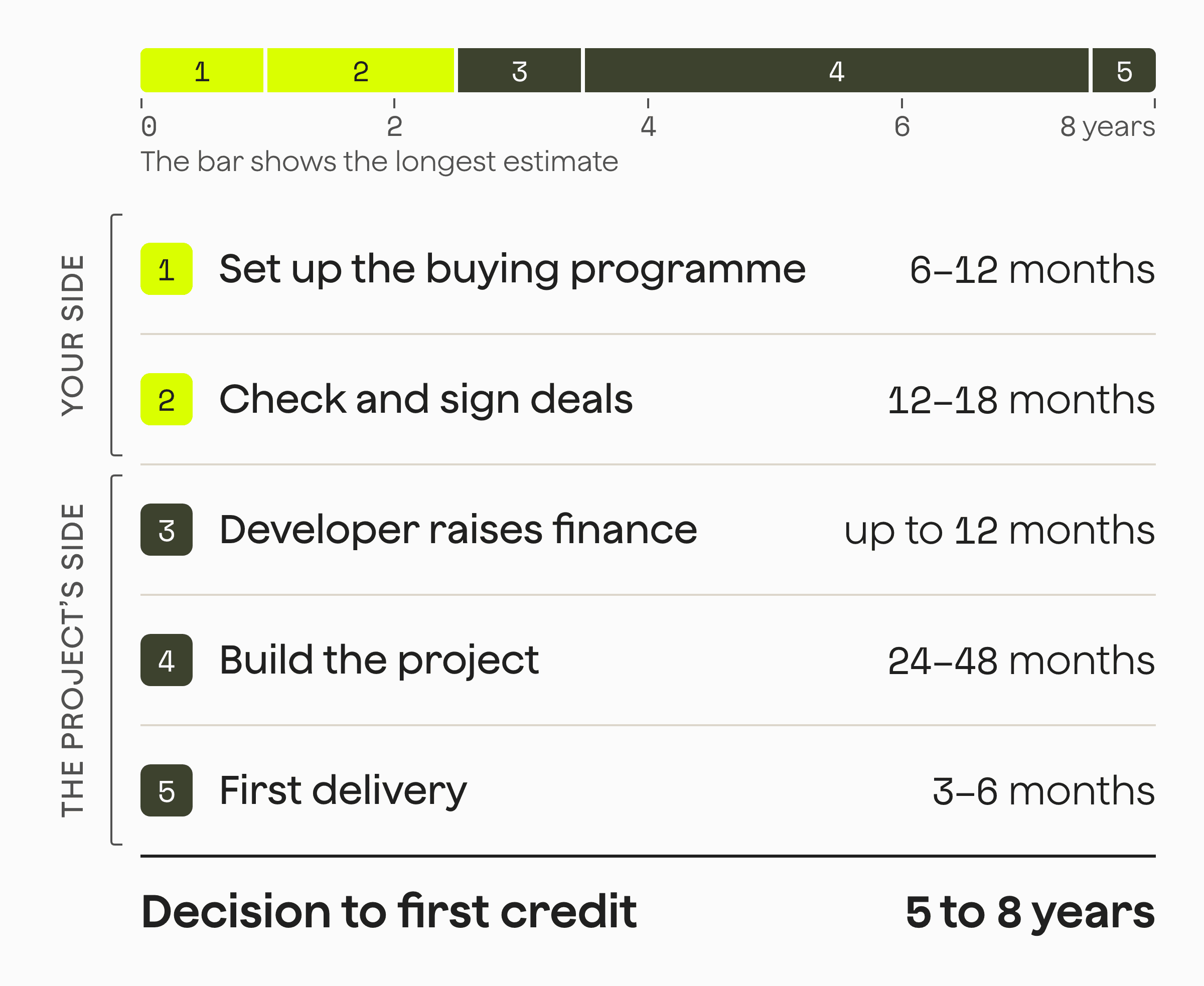
Most of Microsoft’s deals are offtakes: agreements to buy credits from a project years before it delivers them. Often, the project does not exist yet. Microsoft’s commitment is what gets it built.
That is Microsoft’s game, not necessarily yours. Microsoft needs millions of tonnes, so it has to help finance new projects. Most companies have three options:
- Projects already running: Credits are available now, within weeks or months. Volumes are limited and competition is high.
- Projects being built: Delivery starts within a few years. A forward contract signed now secures volume and price before the credits reach the open market. For most companies, this is the sweet spot.
- Brand-new projects: 5 to 8 years. Only relevant if you need large volumes in the 2030s.
The timeline still matters to you, because it limits how much supply can exist in 2030. A project that is not being built by around 2027 will not deliver this decade, however many buyers want its credits.
As of April, Microsoft had 36.4 million tonnes of durable removal under contract and around 91,000 tonnes delivered. That is 0.25%. This is not a failure. It is simply what buying years ahead looks like.
Buyers who arrive late pay higher prices for what is left, and may not secure enough volume at all.
Lesson 2: Expect things to go wrong, and plan for it in the contract
Microsoft calls delivery problems “an inevitable part of market development.” Its list of what can go wrong is a useful checklist for any buyer: permits arrive late, local communities object, subsidies fall away, equipment breaks, trees die, or the technology removes less CO2 than promised.
The answer is not to avoid risk altogether, but to agree upfront what happens when something goes wrong.
How much shortfall is acceptable? How long does the project have to catch up? What happens if it cannot? The contract should spell out the remedy, whether that means replacement credits, repayment or another form of protection.
Lesson 3: No method is perfectly measured yet, so ask the right questions
Microsoft openly acknowledges that today’s rules for measuring carbon removal are not perfect, and it refines its own quality criteria every year.
One point stood out to me. Methods that happen out in the open, such as spreading crushed rock on farmland or storing carbon in soil, can look risky because their uncertainty is easy to see. Methods inside a closed system, such as a plant capturing CO2 from a chimney, look more precise, but errors can still hide in the assumptions behind the numbers.
So a high-tech credit is not automatically safer than a nature-based one.
Microsoft also names the questions to put to the developer for each method:
- Tree planting: would the trees have grown anyway, and does the project push deforestation elsewhere?
- Anything using biomass: where does the wood or crop waste really come from?
- Machines that pull CO2 from the air: how much energy do they use?
Lesson 4: Projects with government support deliver more reliably
The projects that move fastest combine a corporate buyer with public support. Many of Microsoft’s examples are in Europe: in Denmark, Sweden and Norway, plants capture CO2 from burning biomass or waste and store it beneath the North Sea. The government covers part of the cost or carries part of the risk, and the corporate buyer funds the rest.
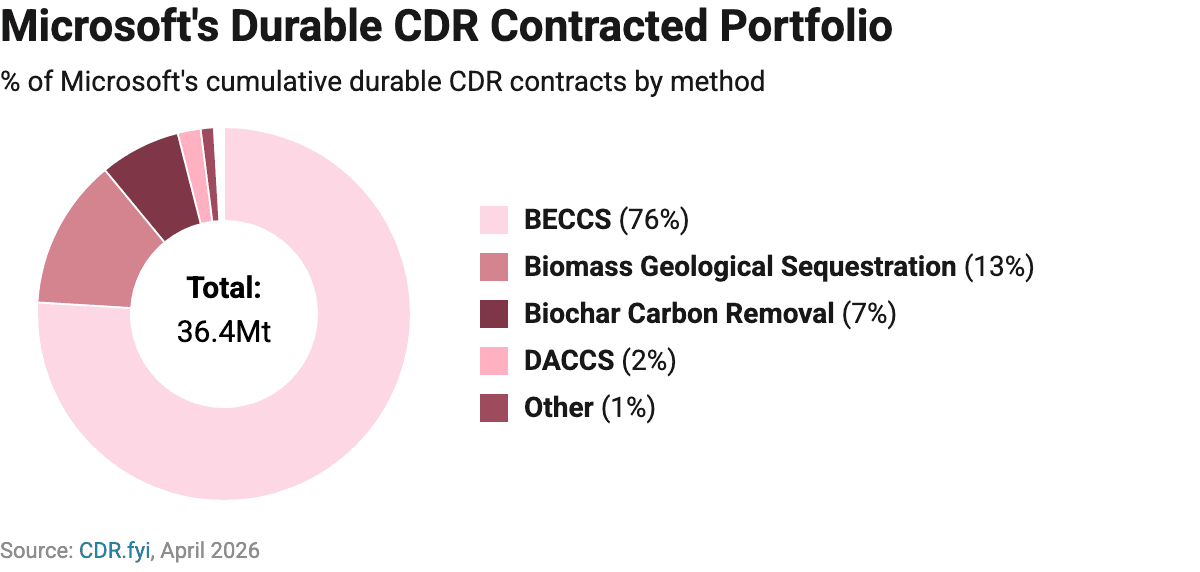
For a European buyer, this is good news: some of the most reliable carbon removal supply in the world is being built close to home.
But as I wrote in July, the European Commission has proposed buying up to 250 million tonnes of permanent removal between 2031 and 2040.
The same projects may soon have a very large public buyer competing for their credits.
What this means if you are not Microsoft
Start with a simple question: how many tonnes do you need, and when?
Take a company with 50,000 tonnes of remaining emissions that wants 10% covered by long-term removals from 2030, the share I suggested in August. That means 5,000 tonnes a year. Brand-new projects ordered today will not deliver before the early 2030s, so those tonnes must come from projects that are already running or being built now.
Then decide how much risk you can take. Cheaper, faster and safer rarely come together.
Microsoft’s advice for new buyers is simple: start small with projects that are already running or being built, and get outside help to assess them, such as ratings agencies, diligence specialists or buyer groups.
Three things I would do now:
- Plan your removal needs through to 2035, not just next year’s budget (calculate yours).
- Split your needs by delivery date: buy near-term credits from existing projects, and secure 2030s supply through offtake contracts signed in the next one to two years (here’s how ours work).
- Make sure every forward contract explains what happens if the project underdelivers.
Bottom line
Other buyers are starting to follow: purchases outside Microsoft and the Frontier buyer group rose by about 40% from 2024 to 2025.
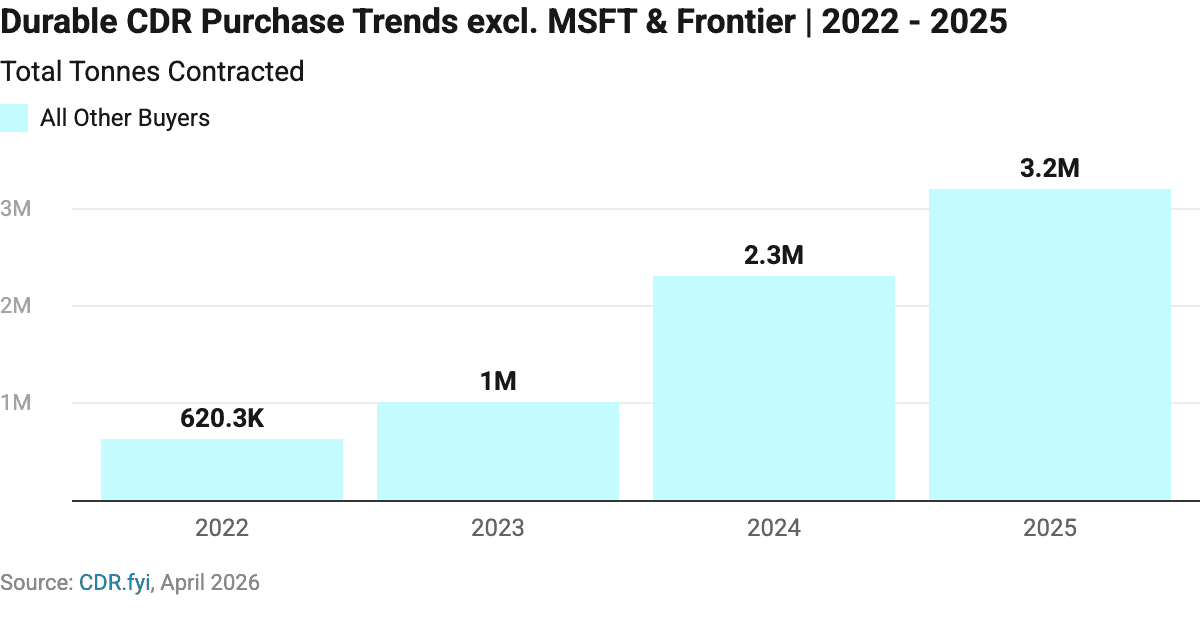
If there’s one thing to copy from Microsoft, it’s starting early. A good first step is knowing your numbers. You can work it out below, and then get in touch to discuss your results.
📺 More from me on YouTube:
The two latest episodes of Carbon Weekly News:
What comes after the first wave of carbon removal?
RMI’s Rudy Kahsar maps 14 removal methods and the ones losing favour. Gold Standard’s Owen Hewlett explains what ongoing emissions responsibility could mean for companies.
Why is Isometric expanding beyond carbon removal?
Chief Science Officer Stacy Kauk explains the strategy behind the move, where AI helps registries and where it still invents sources.