
The Truth About Corresponding Adjustments

Author
Adrian WonsIt is COP season again.
Which means I get the same question from sustainability managers every year:
“Do all your credits have corresponding adjustments?”
The short answer: No.
Only a handful of Article 6 transactions with corresponding adjustments exist today, and they’ve been government-to-government, for use towards countries’ climate targets, not for corporate use.
Let’s unpack that in plain English, so you can plan with confidence.
What is a corresponding adjustment?
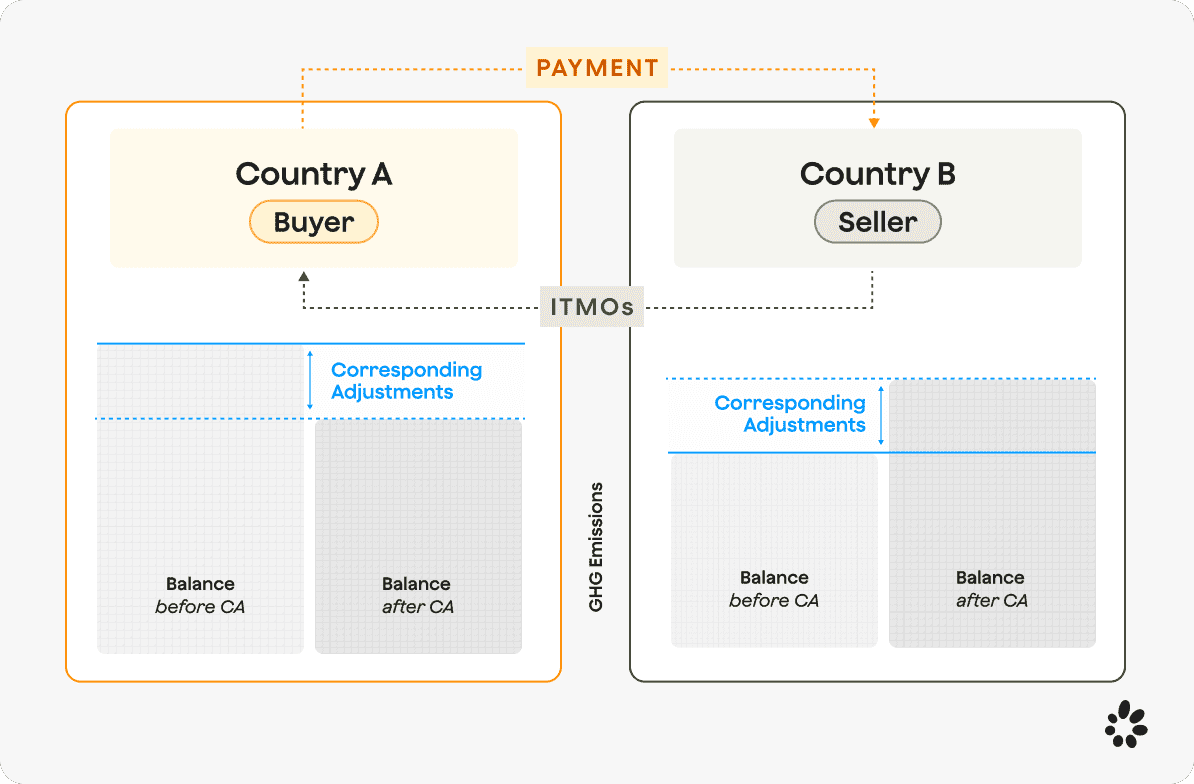
A corresponding adjustment is an accounting move between countries.
If Country A funds a project in Country B and claims the result, Country B must add those tonnes back to its books. That prevents both countries from counting the same emission reduction.
What has actually happened so far?
- Article 6.2 rules are agreed. The UNFCCC has published a database and reporting templates for adjustments and transfers. See the guidance below.
- A few bilateral deals exist, most notably between Switzerland and Ghana, which transferred the first Article 6 units for use towards Switzerland’s target.
- Progress under CORSIA (for aviation) is faster. The International Civil Aviation Organization (ICAO) now lists eligible programmes and units. Many require host-country authorisation and proof that a corresponding adjustment has been applied or guaranteed.
That’s progress, but volumes remain small, processes complex, and government timeframes slow.
What does this mean for companies?
Here’s the truth I share every year: Article 6 credits will not be the norm for corporates.
They may become a quality signal in some cases and are important for compliance schemes like CORSIA, but their main purpose is to help countries meet national targets.
If that changes, I’ll let you know right away. For now, plan on this basis:
How to get it right:
Keep it simple and practical.
1) Match claims to purpose
If your goal is a corporate climate claim, use clear wording. Lead with reductions, then explain how you compensate residuals without implying a government-level transfer.
2) Ask the right question
Don’t ask every supplier, “Do your credits have corresponding adjustments?”
Ask instead: “Do these credits meet our claim standard, audit needs, and upcoming EU and UK green-claims rules?”
3) Use Article 6 where it fits
If you need credits for CORSIA, check the ICAO eligibility list, confirm host-country authorisation, and verify the programme’s adjustment treatment.
For voluntary claims, don’t wait for Article 6 supply that may never scale.
4) Keep evidence tidy
For each project, store links to methodology, monitoring, verification, serials, issuances, and retirements.
If you ever buy an Article 6 unit, save the adjustment proof with the project file.
5) Watch the policy space
Track your host countries, as some will move faster on authorisations than others. The UNFCCC Article 6 pages and programme notices will give you early signals before headlines appear.
Thanks for following along for another week of Carbon Outlook.
Chat soon,
Adrian
Sources
P.S... Interested in working with Senken? Book a discovery call and let’s see if we’re a good fit.