
EU’s 5% Credits Rule Is Bigger Than It Sounds. Here Is What To Do Now.

Author
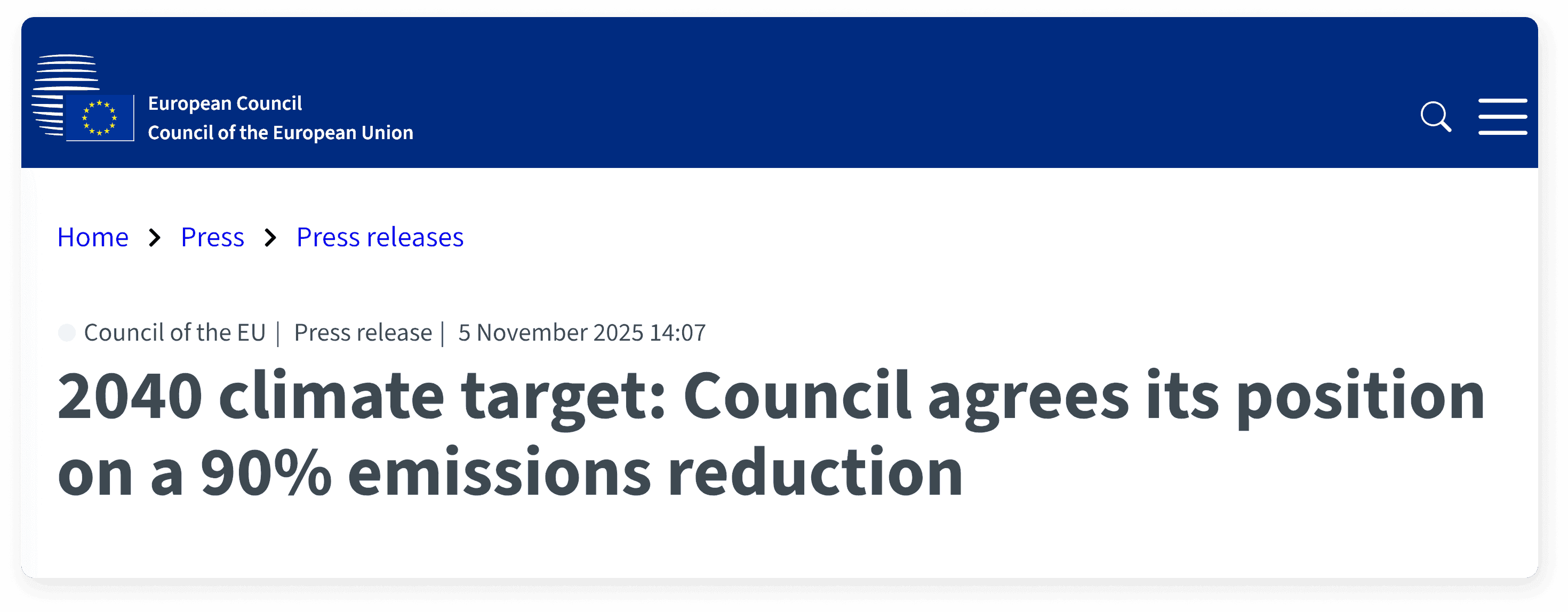
Adrian WonsThe EU just agreed to a 2040 target of a 90% reduction in emissions vs. 1990 levels. It also said that up to 5% of the target can be met with international carbon credits. This sounds small. It is not. It changes the game for companies planning access to high-integrity credits.
The simple maths
- Let's start with 1990 as 100 units.
- A 90% cut means 10 units remain in 2040.
- The EU can meet up to 5 units with international credits because 5% is measured against the 1990 baseline.
- That is half of what remains.
- So domestic emission cuts are effectively 85 units. The other 5 units come from credits.
This is why the 5% headline hides a large shift in demand. The EU could use credits for half of the residual. Several analyses now explain this clearly.
Where policy stands
EU countries have agreed on a 2040 goal to cut emissions by 90% from 1990 levels, with the option to use international carbon credits for up to 5% of that goal. The European Parliament is now drafting its own version. Next, Parliament, EU countries, and the Commission will hold three-way talks (“trilogues”) to agree on the final rules. Details can still change, but the 5% option is on the table. The current plan is to test international credits from 2031 and allow full use from 2036.
What this means for companies
- Credit demand will spike. If the EU taps the full 5%, it will crowd the market. That means competition for high-integrity tonnes.
- Prices will rise. Especially for removals with strong permanence. Budget for it.
- Quality will decide access. Expect strict criteria. Think corresponding adjustments, Article 6.4, robust MRV, and third-party ratings.
- Supply is thin. The removals pipeline is growing, but not fast enough to meet a sudden EU-wide grab. Forward supply will be scarce.
- Policy may tighten. Science advisers wanted no credits at all. If policy narrows later, only the best credits will qualify.
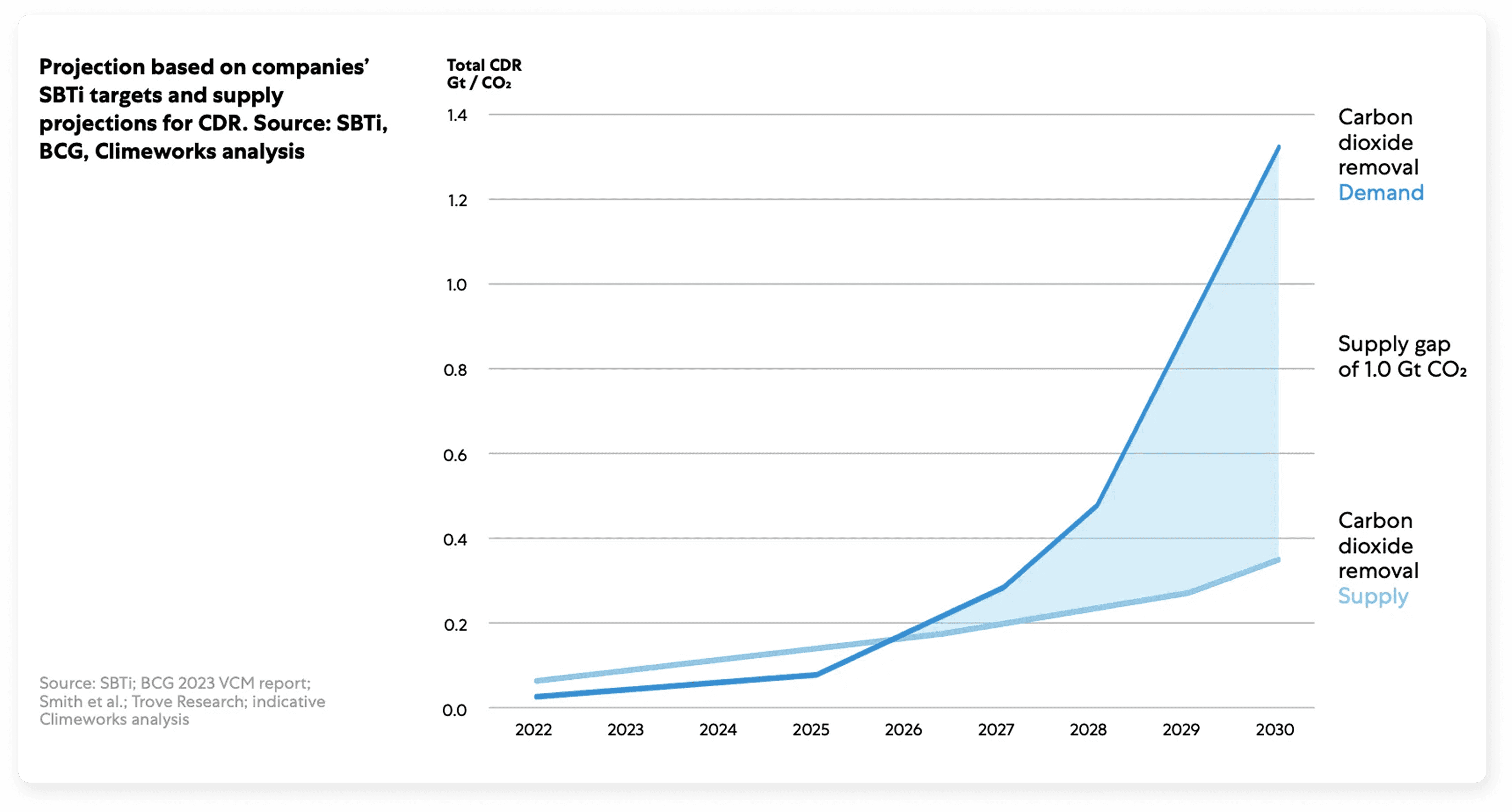
This BCG & Climeworks chart makes the gap clear: by 2030, demand for carbon removals exceeds supply by ≥1 gigaton, leaving over 70% of demand unmet.
How to get it right
1) Build a long-term procurement plan
Think like energy hedging. Set a view from 2036 to 2045. Model annual needs. Stage buys across years.
2) Secure optionality now
Use a mix of offtakes, options, and volume-flex clauses. Lock access without over-committing.
3) Tilt to removals
Prioritise durable removals where possible. Keep any avoidance use inside clear, conservative guardrails.
4) Demand full documentation
Insist on methodology, serials, issuance and retirement IDs, monitoring data, and a live link to public docs.
5) Require policy fit
Check each credit against likely EU rules. Ask for alignment with Article 6, host country authorisation, and corresponding adjustments where relevant.
6) Spread risk
Diversify by method, geography, developer, and vintage. Cap exposure to any single category.
7) Pre-clear with audit and legal
Run short pre-assurance reviews on claims and on ledger structure. Fix gaps before year-end.
8) Treat this as a supply chain
Create a cross-functional squad. Give procurement, sustainability, legal, finance, and comms clear roles.
A 90-day action for buyers
Days 1 to 30
- Map your likely needs from 2031 to 2045.
- Rank business units by exposure to credit price risk.
- Build a shortlist of project developers with credible carbon credits.
Days 31 to 60
- Open talks on multi-year access.
- Draft term sheets for offtakes and options.
- Define quality filters and a red flag list.
Days 61 to 90
- Run a pilot buy for learning.
- Stress test your portfolio for policy changes and delivery delays.
- Set an internal price curve and a quarterly review cycle.
A quick note on timing
The pilot from 2031 sounds distant. It is not. Good supply will be reserved early. The firms that move now will get choice and value. Late movers will pay more and settle for less.
See you in 2 weeks,
Adrian
Sources
- Council press note on the 2040 target and 90% cut
https://www.consilium.europa.eu/en/press/press-releases/2025/11/05/2040-climate-target-council-agrees-its-position-on-a-90-emissions-reduction/ - European Commission page on the 2040 climate target proposal
https://climate.ec.europa.eu/eu-action/climate-strategies-targets/2040-climate-target_en - Reuters overview on the final-hour 2040 deal and use of foreign credits
https://www.reuters.com/sustainability/cop/eu-eyes-weaker-climate-goal-scramble-deal-by-cop30-sources-say-2025-11-05/ - AP coverage of the 90% deal and credit use
https://apnews.com/article/a1a911e28cb9aa658b5b1e9fddc91935 - Öko-Institut briefing on the 5% based on the 1990 baseline and its effect on domestic effort
https://www.oeko.de/fileadmin/oekodoc/PB-Council-2040-target.pdf - Carbon Market Watch analysis on baseline phrasing and implications
https://carbonmarketwatch.org/2025/09/05/eus-2040-climate-target-and-the-high-costs-of-international-credits/ - Carbon Gap tracker on pilot from 2031 and use from 2036
https://tracker.carbongap.org/policy/2040-targets - Bloomberg summary of the 5% cap and pilot timing
https://www.bloomberg.com/news/articles/2025-11-05/eu-countries-agree-on-90-emissions-reduction-target-for-2040 - Table.Media report on the Council’s 5% international certificates
https://table.media/en/climate/feature/eu-climate-target-2040-countries-agree-on-5-international-certificates
P.S... Interested in working with Senken? Book a discovery call and let’s see if we’re a good fit.