
Most carbon credits are rated C or worse

Author
Adrian WonsCarbon credit rating agencies are becoming a bigger part of the market. From July 2026, ESMA’s EU ESG Ratings Regulation will bring regulatory oversight to the space for the first time. But even before that kicks in, ratings already play a critical role in how buyers assess project quality.
This newsletter covers what rating agencies actually do, introduces the four main players, explains how their scales work, and shows why the data makes a strong case for only working with higher-rated projects. AND if you read to the end I show you how to check a project rating for free.
What carbon credit rating agencies do
Rating agencies assess the likelihood that a carbon credit actually delivers what it claims: one tonne of CO2 avoided or removed.
They do this by evaluating a set of risk factors for each project. These typically include additionality (would the project have happened without carbon finance?), quantification accuracy (are the emission reductions measured correctly?), permanence (will the carbon stay stored?), and leakage (does the project just shift emissions elsewhere?)
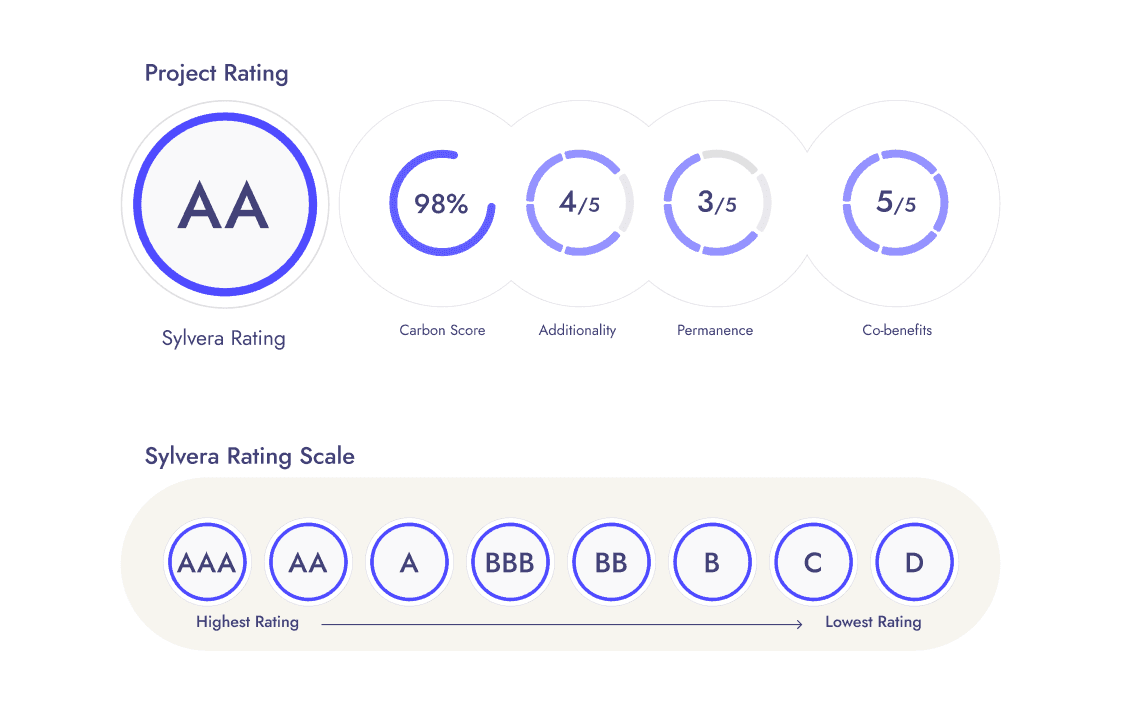
The output is a letter rating, similar to what you know from bond ratings. The rating gives buyers a shorthand for project quality. Instead of reading hundreds of pages of project documentation yourself, you get an independent, structured assessment.
Think of it like this: you would not buy a bond without checking the credit rating. The same logic applies to carbon credits.
The four main rating agencies
There are four agencies that cover the majority of the voluntary carbon market.
BeZero Carbon was one of the first dedicated carbon rating agencies. They rate over 900 projects and make all their headline ratings publicly available on their platform. That transparency is a differentiator. BeZero uses a generalised analytical framework combined with sector-specific risk assessments.
Sylvera is the other major player, with 681 rated projects. Sylvera combines automated data analysis with human analyst review. They score every project on carbon delivery, additionality, permanence, and co-benefits.
Calyx Global has rated 940 projects across 27 project types and 121 methodologies. They apply a three-part evaluation at the programme, methodology, and project level. Calyx also tracks ICVCM CCP label eligibility, which makes them useful for buyers aligning portfolios with the CCP standard.
MSCI (formerly Trove Research) brings the weight of a major financial data provider. They assess over 4,000 projects, the broadest coverage of any agency. Their ratings combine the carbon integrity assessment system Trove developed since 2021 with MSCI’s experience in investor-grade sustainability research.
How the rating scales work
All four agencies now use similar letter-based scales, broadly from AAA (highest quality) down to D or CCC (lowest quality).
BeZero uses an eight-point scale from AAA to D. Sylvera uses a similar AAA to D range. Calyx Global updated its scale to AAA–D in January 2025. MSCI rates from AAA to CCC on a seven-point scale.
While the letter grades look the same, the underlying methodologies are not identical. Each agency weighs risk factors differently. A project rated BB by one agency might be rated B or BBB by another. Research has shown that ratings for the same project can differ across agencies. That is not necessarily a problem. It reflects different analytical approaches, just as Moody’s and S&P sometimes disagree on bond ratings.
For buyers, the practical takeaway is: do not rely on a single agency. Cross-referencing ratings from two or more agencies gives you a more robust picture.
What the rating distribution tells us
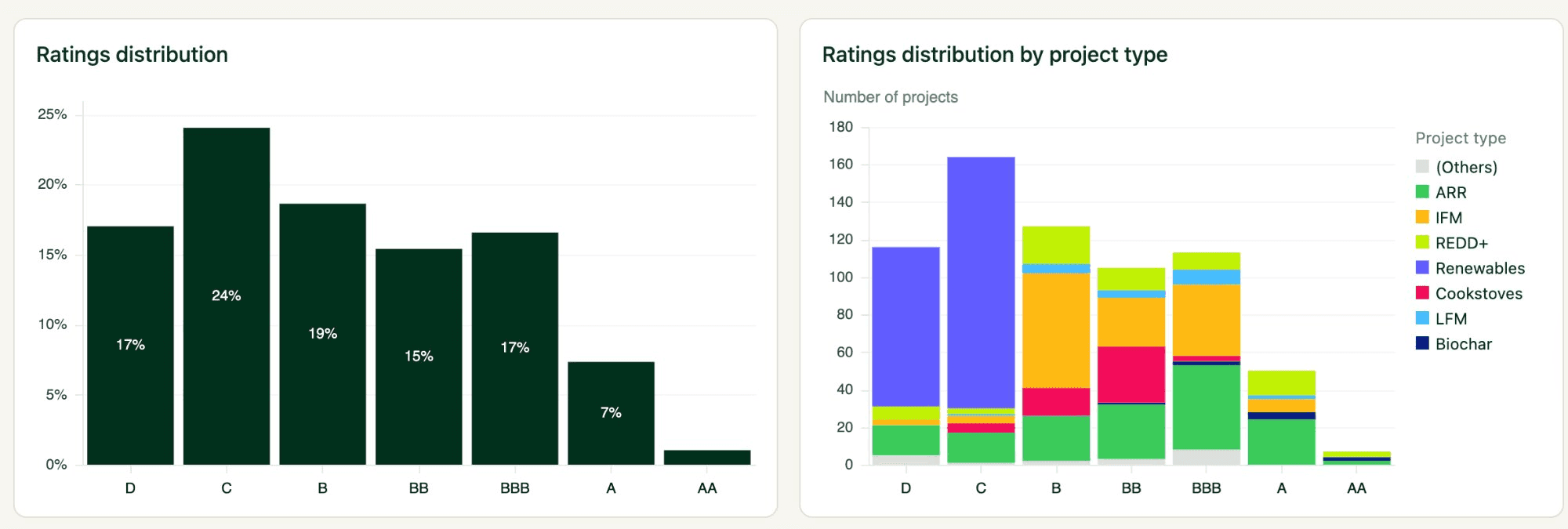
The Sylvera rating distribution data paints a clear picture. The largest share of rated projects sits at the C level (24%), followed by B (19%), D (17%), and BBB (17%). Only 7% of projects achieve an A rating, and just 1% reach AA. No projects are rated AAA.
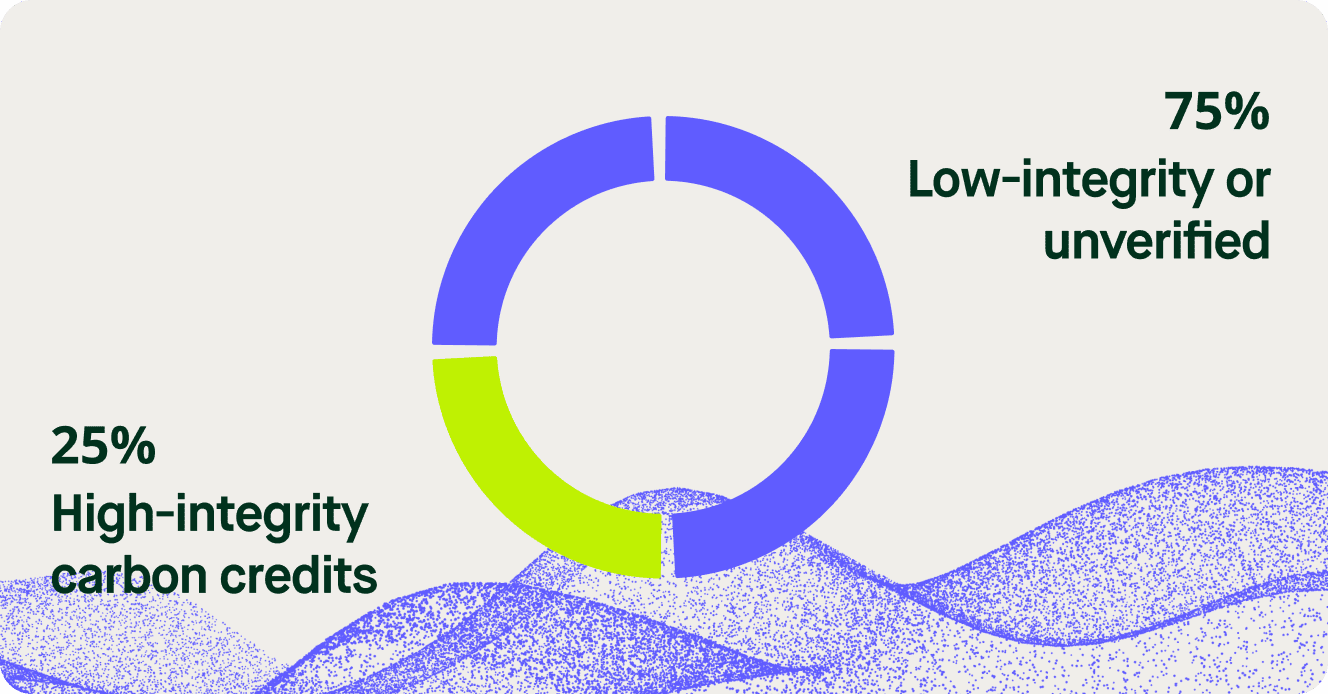
Let that sink in. The majority of carbon credits on the market are rated C or below. Only about 25% of projects are rated BBB or better.
This is exactly why ratings matter. Without them, a buyer has no way to distinguish the 25% from the 75%. (except working with Senken obviously)
Project types and quality
The distribution by project type reveals another important pattern. Renewable energy and cookstove projects tend to cluster at the lower end of the rating scale. The majority of projects in these categories sit at C or D level.
At Senken, this is why we generally do not work with renewable energy or cookstove credits. The data shows that the majority of projects in these categories are lower quality. Most also do not reach CCP label eligibility. Are there exceptions? Yes. There are rare good projects even in these categories. But they are rare, and finding them requires significant due diligence effort and is way less future-proof.
By contrast, project types like ARR (afforestation, reforestation, and revegetation) and biochar show a more balanced distribution across rating levels, with a higher share of projects at BBB and above.
Why BBB or better matters
At Senken, we recommend looking at projects rated BBB or better. Here is why.
A BBB rating means the agency has assessed that the project has a reasonable likelihood of delivering on its claimed emission reductions, with manageable risks across additionality, quantification, and permanence.
Below BBB, the risks start to compound. A B-rated project might have serious questions about additionality. A C-rated project might have both additionality and quantification concerns. A D-rated project is essentially a red flag.
If you are a corporate buyer reporting under CSRD or aligning with SBTi, using low-rated credits creates both reputational and compliance risk. The cost difference between a BBB-rated credit and a C-rated credit is small compared to the risk of retiring credits that do not hold up to scrutiny.
What is coming: regulation
One headline worth noting. From July 2026, ESMA’s EU ESG Ratings Regulation becomes applicable. Carbon ratings are likely in scope. This means rating agencies will face requirements around methodology transparency, conflict of interest policies, and oversight for the first time.
This is a positive development. Regulation will bring more trust and standardisation to the rating landscape. For buyers, it means even more reason to work with rated projects, as the quality and consistency of ratings themselves will improve.
Bottom line
Carbon credit ratings are your best tool for assessing project quality at scale. The data shows that most projects on the market are rated below BBB, and that certain project types like renewables and cookstoves skew heavily toward the lower end.
Use ratings. Cross-reference across agencies. Set a minimum threshold of BBB. And watch the regulatory space, because 2026 is the year carbon rating agencies grow up.
Want to check the rating of your carbon project for free? I put together a free guide on how to look up any project’s rating across agencies (takes 5min). You can find it here: How to check your carbon project rating
Sources