
Are your carbon credits CCP-ready? 92% are not.

Author
Adrian WonsThe ICVCM’s CCP label is becoming the closest thing the voluntary carbon market has to a quality seal. But it is also one of the most misunderstood. Most buyers know it exists. Few know how it actually works, which of their credits qualify, and where the gaps are. This newsletter breaks it down: the two-level system, which programs and project types are in or out, and how to check your own portfolio. 5 minute read.
What the CCP label is (and what it is not)
The ICVCM (Integrity Council for the Voluntary Carbon Market) created the Core Carbon Principles as a global quality threshold for carbon credits. Think of it as a minimum bar, not a gold standard. A credit with a CCP label has passed a defined set of science-based checks on additionality, permanence, governance and more.
What it is not: a guarantee that every individual project is high quality. The CCP label operates at the methodology level. It tells you the rules behind the credit are sound. It does not tell you whether a specific project executed well against those rules. You still need project-level due diligence.
How the two-tick system works
To carry the CCP label, a carbon credit needs two things:
- Tick 1: The registry (carbon-crediting program) must be approved as “CCP-Eligible”. This means its governance, tracking, transparency and verification processes meet the threshold.
- Tick 2: The specific methodology used by the project must be approved as “CCP-Approved”. This means the quantification approach, baseline setting and safeguards are sound.
Both ticks are required. A credit from a CCP-Eligible program using a non-approved methodology does not get the label. And a methodology approval means nothing if the program itself has not been assessed.
Which programs are CCP-Eligible today?
As of March 2026, 9 programs have been approved:
- ACR (American Carbon Registry)
- ART TREES
- Climate Action Reserve (CAR)
- Equitable Earth (formerly ERS)
- Gold Standard
- Isometric
- Puro.earth (approved December 2025)
- Rainbow (formerly Riverse, approved March 2026)
- Verra (VCS)
These 9 cover the vast majority of the voluntary market. But several programs are still in assessment: Cercarbono, Global Carbon Council, Plan Vivo, Ormex, Wilder Carbon, BioCarbon Standard and Open Carbon Protocol. Social Carbon withdrew and plans to reapply.
If you hold credits from a program that is not yet CCP-Eligible, those credits cannot carry the label today, regardless of project quality.
Which project types got approved, which did not
This is where it gets interesting. The ICVCM has assessed 60+ methodologies. Here is the scorecard.
Approved (38 methodologies across these categories):
- Landfill gas capture
- ODS (ozone-depleting substances) destruction
- Leak detection and repair in gas systems
- Afforestation, reforestation and revegetation (VCS VM0047, ACR, Isometric)
- Improved forest management (selected methodologies from ACR, CAR, VCS)
- Biochar (CAR, Isometric, VCS VM0044 v1.2)
- Carbon dioxide removals/engineered CDR (Isometric DAC, bio-oil, biomass storage, biogenic CCS; Gold Standard concrete carbonation)
- Jurisdictional REDD+ (ART TREES non-HFLD, VCS JNR Framework)
- Project REDD+ (VCS VM0048)
- Efficient cookstoves (selected newer methodologies only)
- One household biodigester methodology (Gold Standard animal manure management)
- N₂O abatement in adipic acid production
- Rice cultivation methane avoidance (Gold Standard)
- Sustainable agriculture (CAR Soil Enrichment, VCS VM0042 v2.2)
Rejected (“does not meet”):
- Renewable energy: grid-connected, off-grid, mini-grids and thermal. Every single renewable energy methodology assessed was rejected across both Gold Standard and VCS. This is the biggest category to fail. The reason: most grid-connected renewable energy projects struggle to demonstrate additionality. Solar and wind are now cost-competitive in most markets without carbon credit revenue.
- Most older cookstove methodologies (Gold Standard AMS-II.G and Simplified Methodology)
- Most household biodigester methodologies (AMS-I.E and AMS-I.I across both Gold Standard and VCS)
- SF₆ avoidance
Do not let the 38 approved methodologies mislead you. The rejected categories, especially renewable energy and cookstoves, represent the bulk of the voluntary carbon market by issuance volume. In practice, more than two thirds of all credits ever issued use methodologies that did not pass the CCP assessment.
Very unlikely to meet (deprioritised):
- HFC-23 destruction
- Industrial energy efficiency (supply side)
- New natural gas power
- Waste heat recovery
- Some N₂O methodologies in nitric acid production
Key patterns to note: the approved cookstove and biodigester methodologies come with strict conditions. Credits only qualify if projects use specific measurement approaches for fuel savings and non-renewable biomass fractions. Not all credits issued under an approved methodology will automatically get the label.
What Calyx Global’s analysis shows
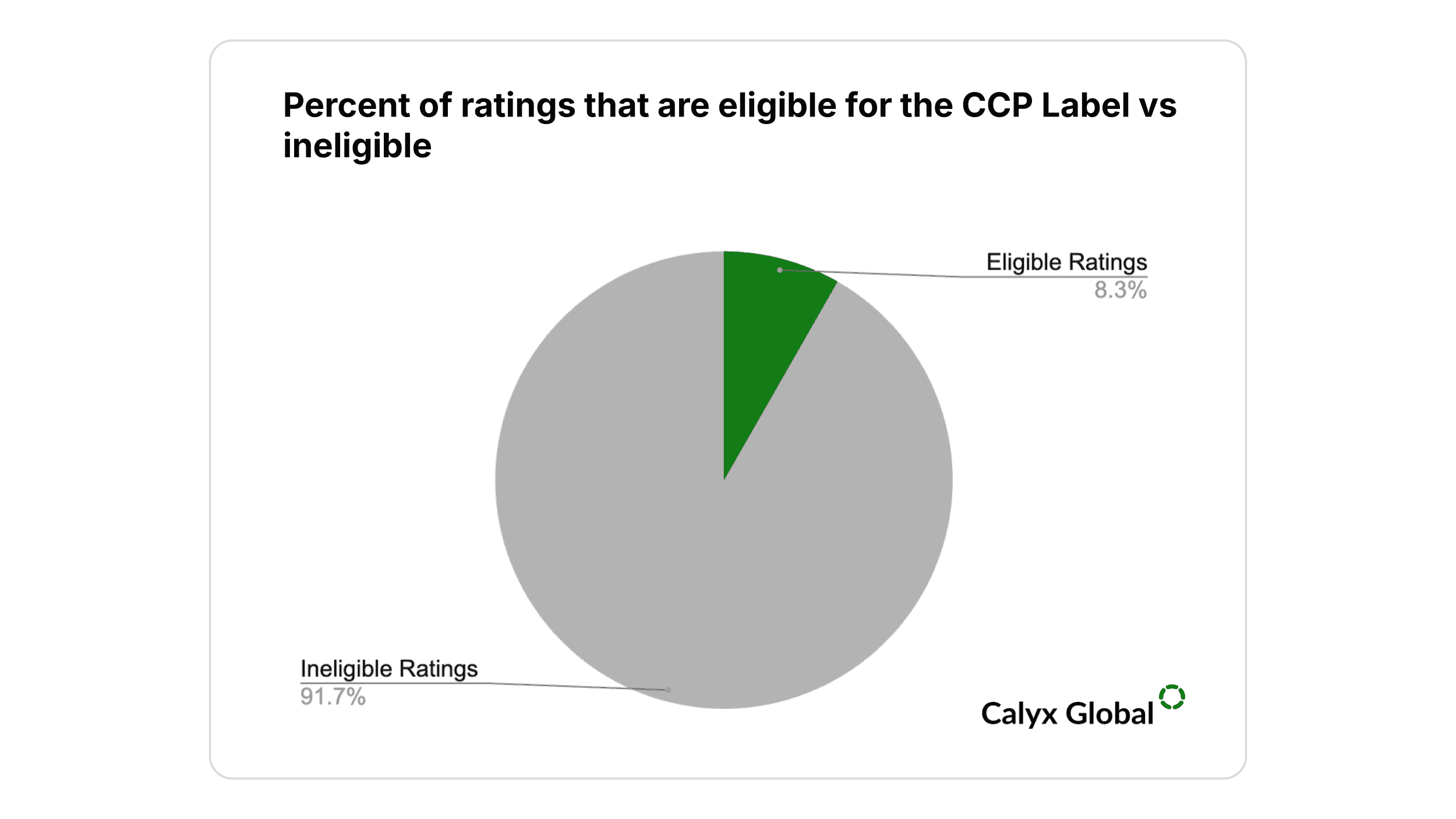
Independent ratings agency Calyx Global tracks how CCP eligibility maps to actual project quality. Their data (as of November 2025) reveals a sobering reality:
Only about 8% of the projects Calyx Global has rated are currently eligible for the CCP label. The rest either use rejected methodologies, sit under programs not yet assessed, or fall outside assessed categories entirely.
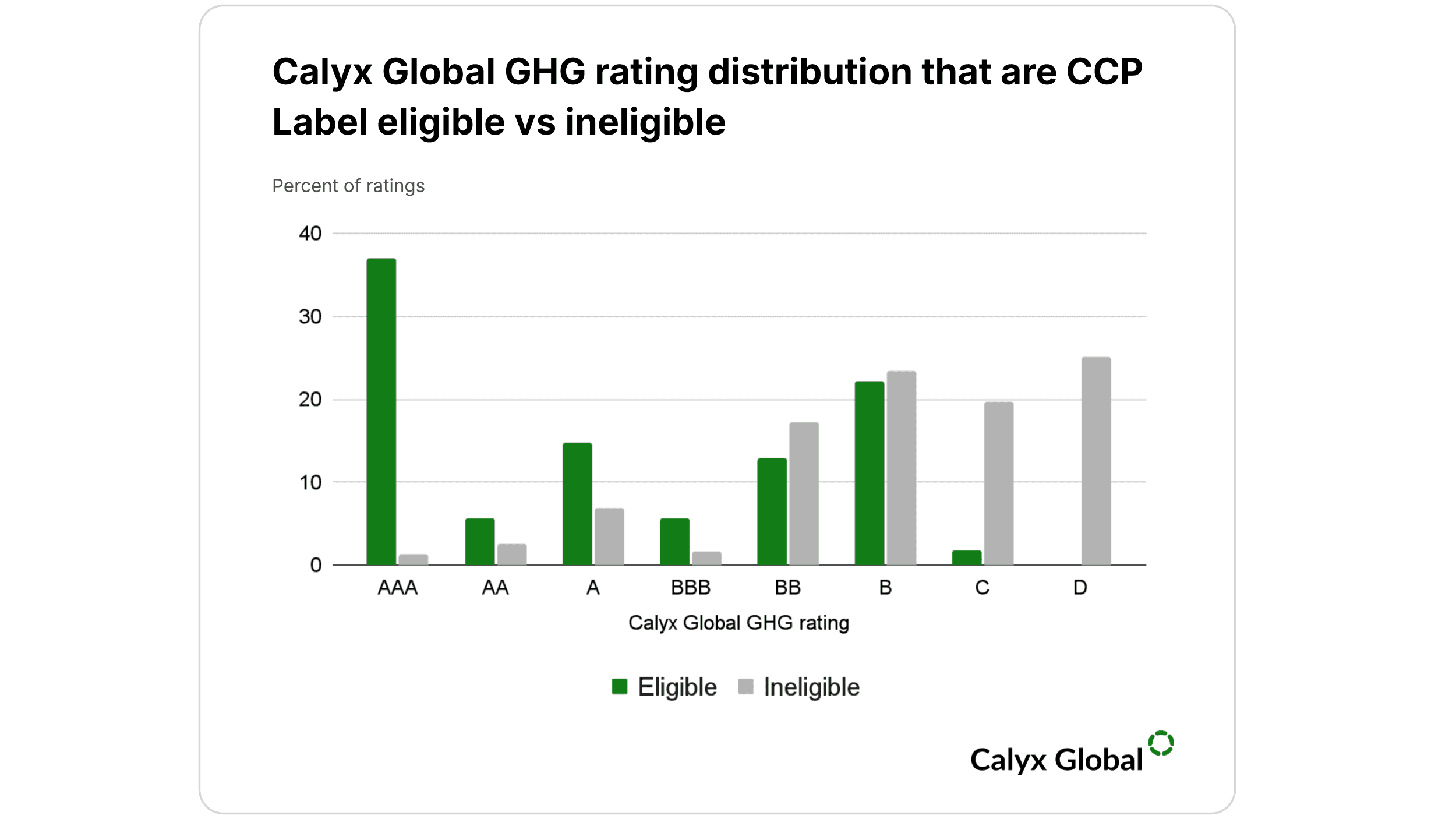
Among CCP-eligible projects, the quality distribution still varies. Some projects with CCP-eligible methodologies receive lower independent GHG integrity ratings. Some projects without CCP eligibility receive higher ones.
The takeaway: the CCP label is a useful filter. It is not a replacement for project-level assessment. Think of it as “necessary but not sufficient” for quality.
How to check if your credits have a CCP label
Three steps:
- Step 1: Check the program. Is the registry CCP-Eligible? See the full list at icvcm.org/assessment-status. If your program is not on the approved list, stop here.
- Step 2: Check the methodology. Find the exact methodology name and version your project uses. Cross-reference it against the ICVCM category assessment table on the same page. Look for “CCP-Approved” in the decision column.
- Step 3: Check the registry. Verra, Gold Standard and other CCP-Eligible programs are rolling out CCP labels directly in their registries. Verra now applies CCP labels to eligible VCUs automatically where sufficient information is available. For other cases, project developers can request the label through the registry. Gold Standard shows labels in its Impact Registry.
If you are unsure, the simplest approach: look up your project on the relevant registry, check the methodology and version, and match it against the ICVCM assessment status page.
Bottom line
The CCP label is real progress. For the first time, there is an independent, science-based threshold that lets buyers filter for credible methodologies across registries. 9 programs approved. 38 methodologies in. 22 rejected. Around 106 million credits eligible, roughly 52 million available in the market today.
But the headline numbers are misleading. The rejected categories, e.g. renewable energy, legacy cookstoves, older biodigesters, account for the majority of credits ever issued. More than two thirds of the voluntary carbon market’s total volume does not meet the CCP threshold. Some approved categories come with conditions that not every project will meet. And even within CCP-eligible categories, project-level quality still varies.
Use the CCP label as your first filter. Then layer on project-level due diligence, independent ratings and audit-ready documentation. That is how you build a portfolio that holds up under CSRD scrutiny and in the court of public opinion.
If you want help checking your current portfolio against the CCP framework, feel free to reach out.
Sources
- ICVCM Assessment Status & Category Assessment
- ICVCM Core Carbon Principles
- Calyx Global: ICVCM CCP Label Tracker
- ICVCM: Rainbow confirmed as CCP-Eligible
- ICVCM: Puro.earth confirmed as CCP-Eligible
- Verra: Updated ICVCM CCP Label Guidance
Information only. This is not legal or investment advice.