
Would your current net zero plan pass an audit?

Author
Adrian WonsFor years, a corporate net zero target has often been a press release with a date attached.
You picked 2040 or 2050, published a pathway, and no independent party could really certify whether the plan behind it was real.
That has just changed.
ISO has published the draft of ISO 14060, Net Zero Aligned Organizations. It is the first international standard that a corporate transition plan can actually be audited against.
Below: what it is, how it sits alongside SBTi V2, why it pulls your removals decision closer, and why a vague 2050 pledge is becoming a legal liability.
What ISO 14060 actually is
ISO 14060 is a Draft International Standard. That means it is still in the public consultation stage before final publication, so treat the specific thresholds as firm enough to plan around, but not yet final.
The shift that matters is what it is.
SBTi validates a target and awards a badge. ISO 14060 is a certifiable international standard your transition plan is assessed against, with independent validation and verification built in.
It sets four claim tiers, from net zero aspiration, to an aligned transition plan, to aligned progress, to net zero achievement.
For the first time, “we have a credible net zero transition plan” is something an assurer can sign.
That matters because of who now reads your plan.
Under CSRD, your climate disclosures sit inside an assured report. A badge tells the market your target is credible. An auditable standard tells your auditor the plan is real.
You are about to need both.
How it sits next to SBTi
Here is the part most people get wrong: ISO 14060 and SBTi are not rivals.
ISO is deliberately GHG-programme neutral. If you also run an SBTi programme, those requirements sit on top of ISO. They are additional, not in conflict.
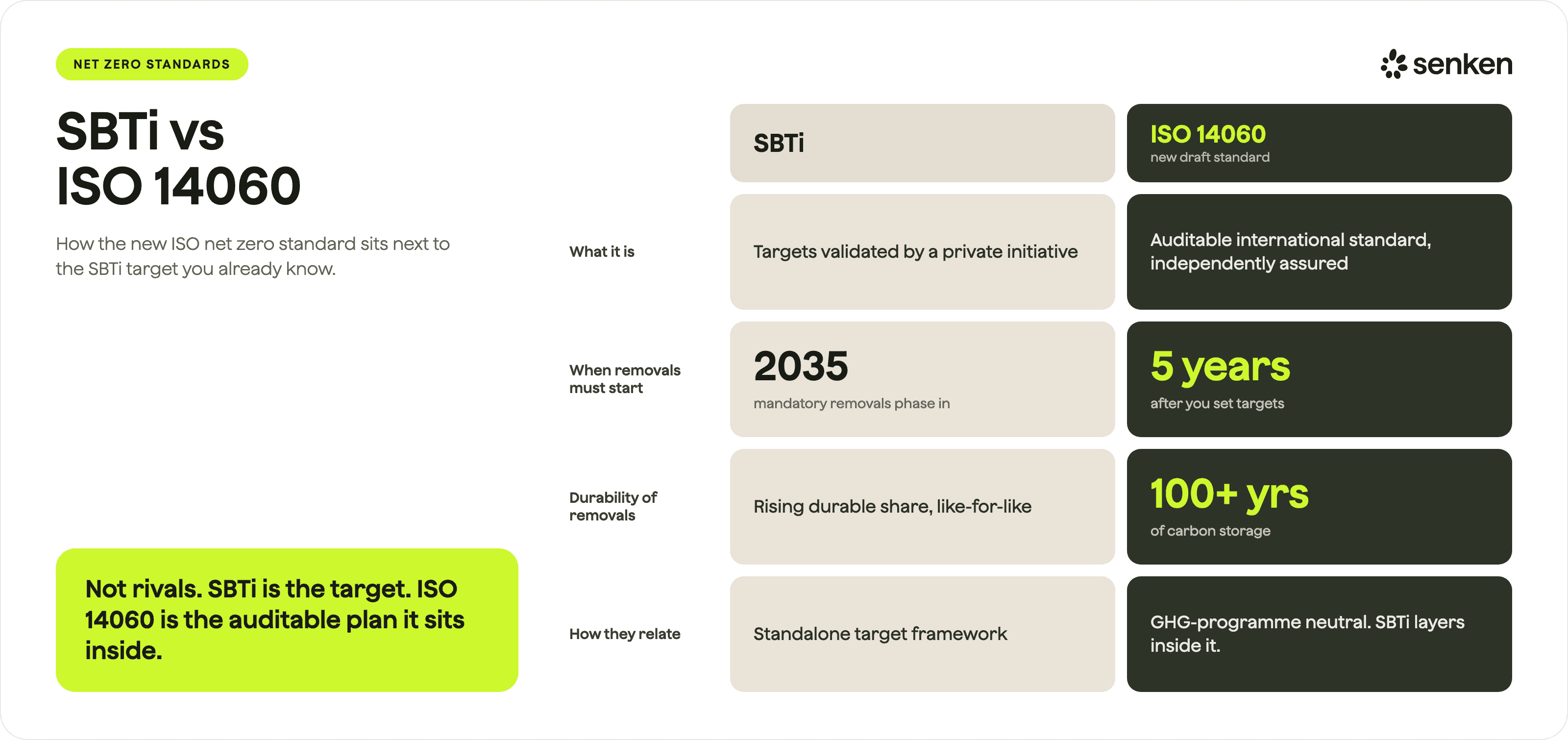
The likely end state for companies is SBTi-validated targets sitting inside an ISO 14060-conformant, independently assured transition plan that satisfies the CSRD auditor.
On the science, they converge almost word for word.
Both wall offsets off from the reduction trajectory, both require a verifiable base year and separate scope-by-scope targets, and both counterbalance residual emissions with durable removals only.
Where they differ is function and timing:
- Function: SBTi validates the target and gives a badge. ISO certifies that the plan is real.
- Removals timing: SBTi phases removals in from 2035. ISO requires milestones within five years of setting targets.
- Durability: SBTi’s durable share of removals rises from 10% to 100% by net zero. ISO is more concrete on what counts as durable: an explicit 100-year storage minimum.
- Offsetting en route: SBTi has been stricter on interim offset claims. ISO permits, and even nudges toward, parallel carbon neutrality under ISO 14068-1.
One point is worth clearing up.
SBTi’s durable share and ISO’s 100-year storage requirement are the same axis: how long the carbon actually stays out of the atmosphere.
ISO has already drawn that line. SBTi has not fixed its threshold yet, and it is likely to land somewhere around 100 to 200 years, with the post-2035 detail still under review.
Either way, the market sorts in the same direction.
Biochar, which stores carbon for centuries, clears the bar as a durable removal. Afforestation and soil carbon, which release it over decades, do not.
There is one real tension worth naming.
ISO is tougher on near-term removals but more relaxed about parallel offsetting. SBTi is the reverse.
ISO is comfortable with you making a parallel carbon-neutrality claim under its own neutrality standard, ISO 14068-1, and offsetting your current footprint while you decarbonise, as long as none of it touches your net zero reduction maths.
A company doing both feels the stricter half of each.
The removals line you cannot ignore
This is the clause almost nobody is discussing.
Under ISO 14060, you must set removal milestones starting no later than five years after you set your targets, raising the durable share at each milestone.
Removals become a line in the transition plan now, not a 2050 clean-up.
SBTi’s 2035 trigger is the more familiar date, but ISO has quietly pulled the real planning horizon to this side of 2030.
ISO also tells you how to build the portfolio, not just that you should.
It points to ex-post credits retired close to issuance, advance offtake to scale new supply, rising technological durability, and nature-based removals for co-benefits, with delivery and reversal risk managed across the mix.
Any removal has to clear seven quality criteria, among them additionality, no leakage, no double-counting, lifecycle-net quantification, and independent verification.
If you know our Sustainability Integrity Index, that list will look familiar.
This is the part that helps.
Removals have been the vaguest line in most transition plans. ISO turns “we will work out removals later” into a defined, sequenced, auditable workstream.
That makes them far easier to integrate deliberately than to scramble for volume in the year a mandate bites.
And if you already build your portfolio to the Oxford Principles, you have little to worry about. Shifting from avoidance to removals, and from short-lived to durable storage over time, is exactly what ISO is now codifying.
Your portfolio is probably already moving in this direction.
Why this matters for your claims
There is a second force making an auditable plan valuable, and it is already in court.
German courts have begun striking down long-dated net zero pledges that lack a concrete pathway.
In March 2025, the Nuremberg-Fürth court ordered Adidas to stop advertising “climate neutral by 2050” because it had not explained how it would get there beyond 2030, or whether offsets were involved.
This month, the Munich court issued a similar order against McDonald’s, which did not contest it. The claim covered 2050 climate neutrality across the supply chain, but had no verifiable plan behind it. If the claim returns, the fine can reach up to €250,000.
The important detail: McDonald’s had an SBTi-validated target, and the claim was still pulled.
A validated target is not the same as a plan a court, an auditor or a customer can check.
From 27 September 2026, this becomes statute.
The EU Empowering Consumers Directive, or EmpCo, is in force and transposed in Germany. From that date, any claim about future environmental performance, including a 2050 net zero pledge, has to rest on a clear, time-bound plan with interim milestones and independent verification.
EmpCo does not ban carbon credits.
It bans vague claims.
Credits keep their role. Offsetting still cannot buy you a “carbon neutral” product claim to consumers. And any forward-looking claim now needs a real plan behind it.
This is the gap ISO 14060 closes.
A conformant, independently assured transition plan, with milestones and durable-removal criteria, is exactly the kind of substantiation a forward-looking claim now demands, for your CSRD auditor and for anything you say in public.
Bottom line
For now, the move is simply to know this is coming.
ISO 14060 is still a draft, so it is not something to conform to yet, and the specifics could shift before it lands.
Treat it as the shape of where organisational net zero is heading. Let it inform how you structure your strategy and transition planning, rather than treating it as a box to tick today.
The draft opened for a 12-week public consultation on 17 June 2026. National standards bodies vote on it around early September, and the final standard is expected in 2027.
The figures in this note, including the five-year removal milestone and the 100-year durability floor, could still move before publication. So plan around the direction, not the exact numbers.
EmpCo applies from 27 September 2026, and SBTi V2 opens for validation from 1 February 2027.
So the useful work now is to get your transition plan and your removals thinking into shape against those, and to track ISO 14060 as it finalises.
That way, you are ready to align to it rather than starting cold once it publishes.
If you want to pressure-test where your plan sits against SBTi V2, EmpCo, and the incoming ISO standard, that is the conversation we are having with most clients right now.
Reply to this email and we will take a look.

Join us to unpack what the final standard changes for your CO2 strategy.
Thanks for reading,
Adrian
CEO & Co-Founder | Senken
📺 More from me on YouTube:
If building a corporate carbon credit strategy from scratch today, where would you start?
Most teams start in the wrong place and pay for it later. I walk through the order of operations I would actually follow in 2026.
Is Microsoft quietly pausing it's carbon removal buying?
The rumours said one thing. A fresh 7-year BioCIRC deal says another. Here is what the signing really tells you about where the big buyers are heading.
Sources
- ISO 14060, Net Zero Aligned Organizations - ISO
- A new standard for net zero alignment - ISO
- Corporate Net-Zero Standard V2.0 - SBTi
- Empowering Consumers Directive (2024/825) - EUR-Lex
- Deutsche Umwelthilfe v. Adidas - Climate Case Chart
- German court bans McDonald’s climate claim - Courthouse News
Information only. Not legal or investment advice.