
The biggest carbon buying mistake? Skipping the strategy phase

Author
Adrian WonsI have watched dozens of large European companies get carbon credits wrong.
I have seen seven-figure purchases become unusable for an SBTi submission because nobody checked the methodology against the rules. I have also seen marketing teams launch carbon-neutral claims, only for legal to withdraw them 18 months later after reviewing them against EmpCo.
The pattern is almost always the same.
Companies start shopping for credits before doing the foundational work. They choose a project that looks credible, retire the credits and announce the purchase.
A year or two later, the strategy begins to unravel.
So I recorded a video explaining the exact framework I would use to build a corporate carbon credit strategy from scratch today: 14 steps across five phases.
This newsletter is the condensed version.
You can watch the full 50-minute walkthrough below:
The framework at a glance
- Foundation: Define your climate goal, measure your footprint and map every framework you report under.
- Strategy: Set your ambition level, define minimum quality standards and align internal stakeholders.
- Sourcing: Choose the right contracting structure, build a diversified portfolio and run proper due diligence.
- Execution: Negotiate the price and get the contract right from the start.
- Ongoing: Monitor the portfolio, report transparently and communicate without creating legal risk.
The order matters.
Jumping straight to step 7 because a supplier is pitching you the perfect project means building the strategy backwards.
Start with the goal, not the project
Before buying anything, define a goal your board can approve.
That means agreeing on the timeline, scope boundaries and exact wording of any public claim, with sign-off from legal, the CFO and the CEO.
You should also review everything your company has already said publicly.
Many companies find an old “climate neutral” claim buried in a 2021 press release. That legacy claim may now be a liability.
Next, build a one-page matrix covering every framework you report under, including SBTi, CSRD, EmpCo, EU ETS, CORSIA and CDP. Record what each one requires from your credit programme.
You will use this matrix at every major decision point.
The same credit may be acceptable for CSRD reporting but unusable for an SBTi submission.
Two standards do the heavy lifting
Defining quality used to be one of the hardest parts of carbon credit procurement. Two frameworks now make that job much clearer:
- cut emissions first
- increase the share of removals over time
- favour projects with strong additionality and lower risk
- support the development of durable removal supply
The central idea is a gradual shift: roughly 20% removals today, 50% by 2030, and close to 100% durable removals by net zero. - The ICVCM Core Carbon Principles define the quality threshold for the credits inside that portfolio.
Oxford defines the shape of the portfolio. ICVCM sets the quality threshold for what goes into it.
You need both.
Pick your ambition level before you pick projects
Once the goal is clear, decide how ambitious you want the portfolio to be.
I tend to think in three broad archetypes. The choice is about defensibility as much as price.
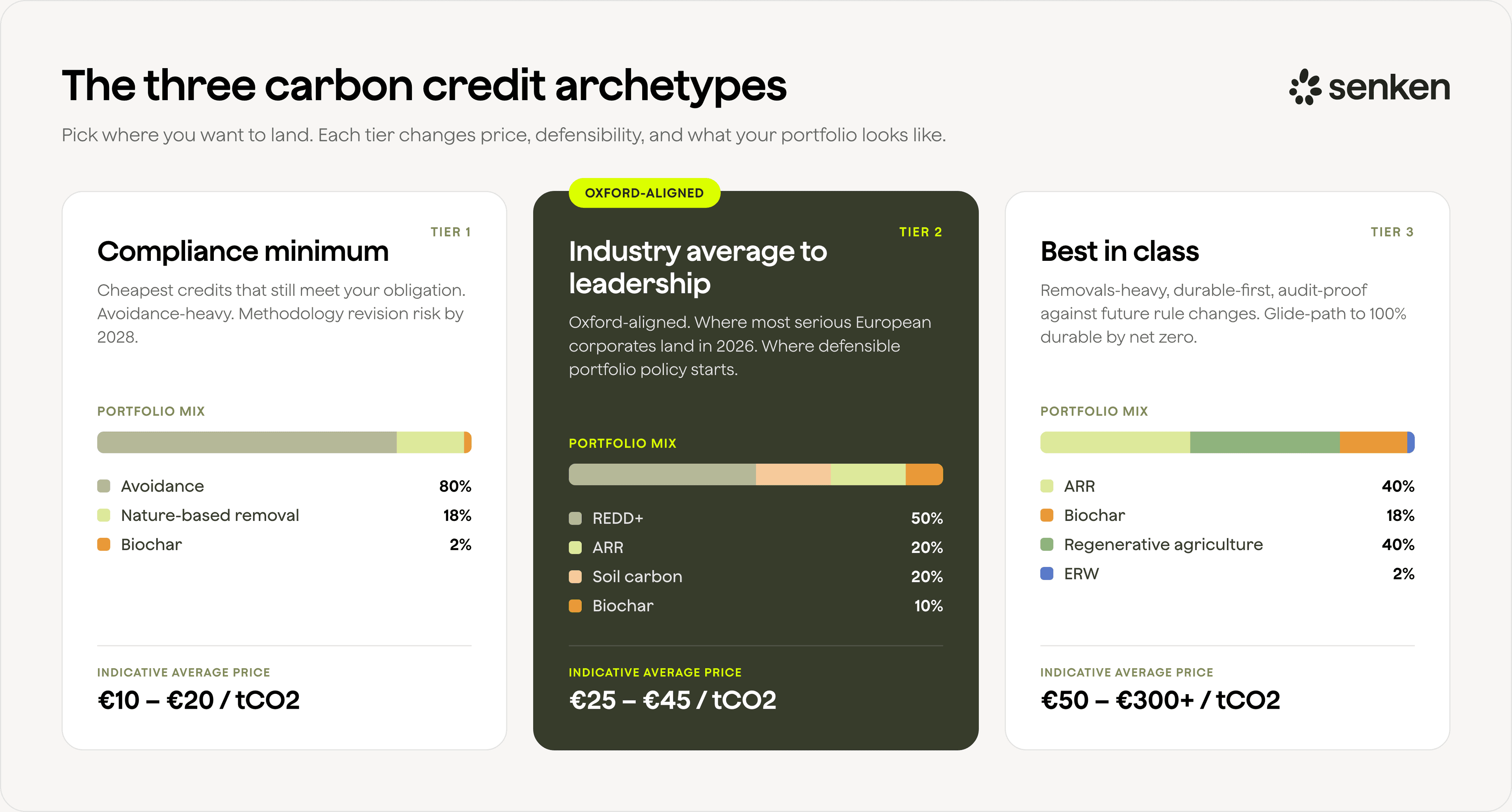
It takes a few days, but it gives you a useful market anchor.
And whatever you choose, undercommit and overdeliver. Walking back a public commitment costs far more than raising one later.
What determines the final price
The portfolio ranges above are indicative. Suppliers will usually quote in US dollars, so treat the euro figures as rounded equivalents.
The final price will depend on the project type, quality, delivery date, contract structure and volume you commit to.
For long-term volumes, multi-year offtake agreements can be priced 10% to 30% below comparable spot purchases of high-quality removals.
They also give you more certainty over future supply.
Diversification matters as the portfolio grows.
As a rule of thumb:
- keep any single project below 40% to 50% of total volume
- keep any single registry below 60%
- spread the portfolio across more than one geography
The headline price is not the full cost.
Once you include due diligence, audit work, internal management time and reputational risk, a questionable €10 credit can cost more than a robust €50 credit.
Your claim rules change on 27 September
EmpCo, the Empowering Consumers Directive, applies across the EU from 27 September 2026.
That is less than 11 weeks away.
It bans generic environmental claims without recognised substantiation. It also prohibits product-level carbon-neutral claims based solely on carbon credits.
To be clear: EmpCo does not ban carbon credits.
It changes what companies can claim and how those claims must be supported.
You can still say:
“We reduced Scope 1 and 2 emissions by 47% since 2019, third-party verified.”
You can also say:
“As a climate contribution, we fund 20,000 tonnes of removals annually beyond our value chain.”
Lead with reductions. Describe credits as a climate contribution or as part of a clearly defined net zero pathway. And disclose the projects behind the claim.
Bottom line
Build the strategy in this order and every later decision becomes easier, cheaper and more defensible.
Jump straight to sourcing and the strategy is unlikely to stand up to scrutiny.
The full framework, including the due diligence questions, contract clauses and monitoring routines behind all 14 steps, is in the video:
Chat soon,
Adrian
CEO & Co-Founder | Senken
📺 More from me on YouTube:
What does the EU’s new carbon removal certification actually change for buyers?
The CRCF introduces certification, a buyers club, and a link to the ETS. We unpack which pieces are real today, which are still years away, and what it means for sourcing removals in Europe.
Microsoft BECCS, SBTi’s 2030 timeline, and the EU CRCF Days — up to speed on all three?
The three stories that mattered most, in one tight episode. We break down what each one signals for carbon buyers over the rest of 2026.
Sources
- How I Would Build a Corporate Carbon Credit Strategy From Scratch in 2026 - YouTube
- Oxford Offsetting Principles (revised 2024) - Smith School
- ICVCM Core Carbon Principles - ICVCM
- Empowering Consumers Directive (2024/825) - EUR-Lex
Information only. Not legal or investment advice.